Muscat Stock Exchange cap tops $72.8bn after index climbs for 5th week

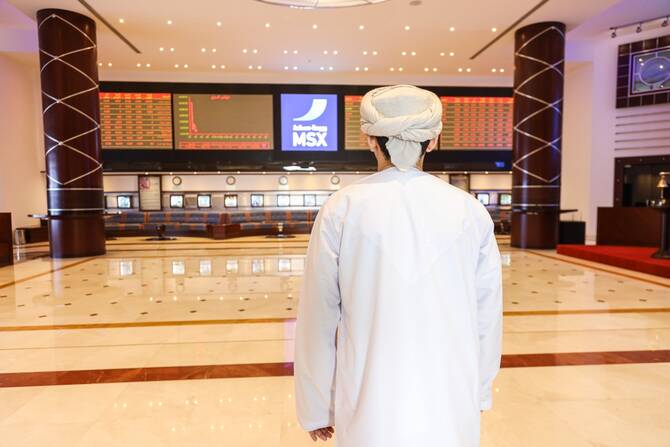
Trading volume on the Muscat bourse rose to 11 million rials per day. Shutterstock
Short Url
Updated 09 June 2025
Follow

Muscat Stock Exchange cap tops $72.8bn after index climbs for 5th week

  • Benchmark MSX index rose 17 points to close at 4,578, reflecting improved investor sentiment
  • Trading volume on the Muscat bourse rose to 11 million rials per day, up from 10 million the previous week

RIYADH: The Muscat Stock Exchange extended its rally for a fifth consecutive week, with market capitalization rising to 28 billion Omani rials ($72.8 billion) in the week ending June 7. 

Driven by gains in key services and industrial stocks, the benchmark MSX index rose 17 points to close at 4,578, reflecting improved investor sentiment and increased activity across sectors, the Oman News Agency reported. The bourse recorded a weekly market capitalization gain of 79.3 million rials.

This comes as markets across the Middle East and North Africa rallied in early 2025, with the Arab Monetary Fund’s May report showing its Composite Index rising 4.37 percent year on year, supported by reforms to boost liquidity and attract foreign investment. 

“Last week witnessed a good performance for the stock market, with 34 securities rising, 30 declining, and 17 remaining stable,” the Oman News Agency report stated. 


The bourse recorded a weekly market capitalization gain of 79.3 million rials. Oman News Agency

It added: “Muscat Gases recorded the highest increase, rising 18 percent to close at 118 baisas. Galfar Engineering and Contracting rose to 72 baisas, up 9 percent. National Gas recorded an 8.8 percent increase to close at 86 baisas.” 

National Gas Co. Oman announced it has acquired an 80 percent stake in Samharam Gas Co., which operates in the bottling and distribution of liquefied petroleum gas in Dhofar Governorate. The acquisition is expected to strengthen its presence in Oman’s LPG market and boost group-level revenues and net profits. 

Trading volume on the Muscat bourse rose to 11 million rials per day, up from 10 million the previous week, while average daily transactions climbed to 2,149 from 1,787. The trading week was shortened to four days due to the Eid Al-Adha holiday, with the exchange set to resume operations on June 10. 

The services sector led gains, with its index rising five points on the back of strong performances from Ooredoo, Omantel, and OQ Gas Networks. In contrast, the industrial index fell 17 points, the financial index dropped 10 points, and the Shariah index edged lower by less than one point. 


National Gas Co. Oman announced it has acquired an 80 percent stake in Samharam Gas Co. File/National Gas Co. Oman

Last week, investors concentrated on OQ Base Industries shares, which traded 10.584 million rials — 24 percent of the total 44 million rials traded. The stock saw 1,678 transactions and closed at 122 baisas, up 4 baisas. 

Bank Muscat’s shares recorded 5.48 million rials in trades, accounting for 12.4 percent of the total trading value. OQ Gas Networks ranked third, with trades worth approximately 5.1 million rials. 

Sohar International Bank was fourth, with trading valued at 5.03 million rials. OQ Exploration and Production came fifth, with trades totaling 4.30 million rials, representing 9.7 percent of the total trading value. 


Acwa signs key terms to develop 5GW of renewable energy capacity in Turkiye

Updated 23 February 2026
Follow

Acwa signs key terms to develop 5GW of renewable energy capacity in Turkiye

JEDDAH: Saudi utility giant Acwa has signed key investment agreements with Turkiye’s Ministry of Energy and Natural Resources to develop up to 5 gigawatts of renewable energy capacity, starting with 2GW of solar power across two plants in Sivas and Taseli.

Under the investment agreement, Acwa will develop, finance, and construct, as well as commission and operate both facilities, according to a press release.

The program builds on the company’s first investment in Turkiye, the 927-megawatt Kirikkale Independent Power Plant, valued at $930 million, which offsets approximately 1.8 million tonnes of carbon dioxide annually, the statement added.

A separate power purchase agreement has been concluded with Elektrik Uretim Anonim Sirketi for the sale of electricity generated by each facility.

Turkiye aims to boost solar and wind capacity to 120GW by 2035, supported by around $80 billion in investment, while recent projects have already helped prevent 12.5 million tonnes of CO2 emissions and reduced reliance on imported natural gas.

Turkiye’s energy sector has undergone a rapid transformation in recent years, with renewable power emerging as a central pillar of its strategy.

Raad Al-Saady, vice chairman and managing director of ACWA, said: “The signing of the IA (implementation agreement) and PPA key terms marks a pivotal moment in Acwa’s partnership with Turkiye, reflecting the country’s strong potential as a clean energy leader and manufacturing powerhouse.”

He added: “Building on our long-standing presence, including the 927MW Kirikkale Power Plant commissioned in 2017, this step elevates our partnership to a new level,” Al-Saady said.

In its statement, Acwa said the 5GW renewable energy program will deliver electricity at fixed prices, enhancing predictability for grid planning and supporting long-term industrial investment.

By replacing imported fossil fuels with domestically generated clean energy, the initiative is expected to reduce Turkiye’s exposure to global energy market volatility, strengthening energy security and lowering long-term power costs.

The company added that the economic impact will extend beyond the anticipated investment of up to $5 billion in foreign direct investment, with thousands of jobs expected during the construction phase and hundreds of high-skilled roles created during operations.

The energy firm concluded that its existing progress in Turkiye reflects a strong appreciation for Turkish engineering, construction, and manufacturing capacity, adding that localization has been a strategic priority, and it has already achieved 100 percent local employment at its developments in the country.