Pakistan delegation in UK after ‘successful’ talks in New York on India conflict

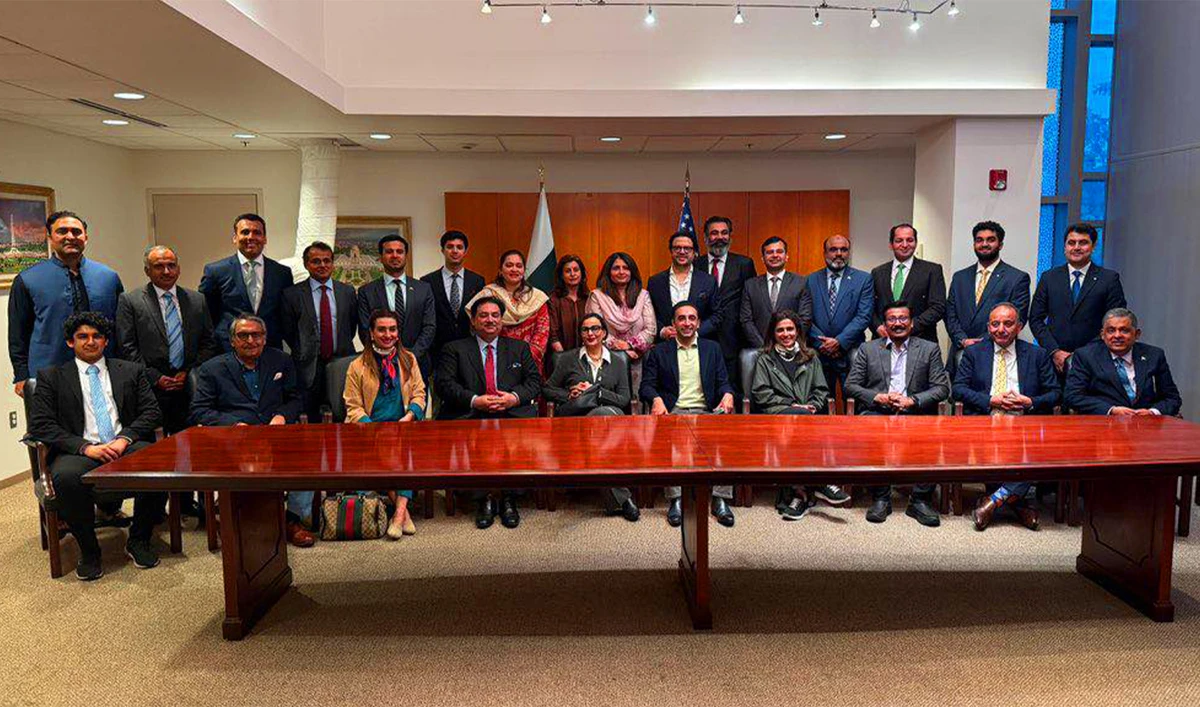
Pakistan’s high-level delegation in New York poses for a picture at Pakistan Embassy in US, New York, on June 7, 2025. (Bilawal Bhutto-Zardari/File)
Short Url
Updated 08 June 2025
Follow

Pakistan delegation in UK after ‘successful’ talks in New York on India conflict

  • India and Pakistan last month engaged in the worst fighting between them in decades, killing 70 people on both sides
  • Pakistani delegates are currently visiting key capitals as part of efforts to present Islamabad’s stance on the standoff

KARACHI: A Pakistani delegation has arrived in the United Kingdom (UK) as part of Islamabad’s diplomatic outreach over last month’s military conflict with India, following their “successful” talks in New York.

India and Pakistan engaged in the worst fighting between them in decades, raising fears of the prospect of an all-out nuclear war. After both countries traded heavy fire for four days, pounding each other with missiles, fighter jets and drone strikes, US President Donald Trump announced a ceasefire between them on May 10.

The nine-member Pakistan delegation, led by former foreign minister Bilawal Bhutto-Zardari, held several meetings with representatives of the United Nations (UN), its member states and US officials to present Pakistan’s stance on the standoff with India and peace in the region.

The Pakistan delegates said the purpose of their meetings was to have peace in the region and to have talks with New Delhi on all India-Pakistan issues, including the restoration of the Indus Waters Treaty and the resolution of Kashmir dispute.

“We have explained to them [US officials] that Pakistan’s water, this is a civilization, the lives of 240 million people, their culture [depend on it],” Khurram Dastgir, a Pakistani lawmaker who is part of the delegation, told a Pakistani news channel in the UK.

“We explained this to America that their economic partnership with India, it will not bring about that development if India and Pakistan will perpetually remain [in a state of] war.”

India announced in April that it was putting the 1960 World Bank-mediated treaty in abeyance after it accused Pakistan of backing an attack on tourists in Indian-administered Kashmir. Islamabad denied complicity in the attack that killed 26 people.

Jalil Abbas Jilani, a former Pakistani foreign secretary, said they held quite constructive talks with members of the UN Security Council during their New York visit.

“Basically, our message was that India committed an aggression and that Pakistan is a peaceful country... Pakistan wants all India-Pakistan issues to be resolved in a peaceful manner,” he said.

Pakistani senator Sherry Rehman, who was also part of the talks, said the main objective of their discussions was peace in the region.

“Our goal was peace, promote dialogue, to have the status of water treaty changed, which they [India] have unilaterally suspended, and to start a discussion on Kashmir,” she said.

The Pakistani delegates are expected to meet key UK officials during their visit to highlight Pakistan’s perspective on last month’s conflict and its possible consequences for the region.

British foreign minister David Lammy is the highest-profile Western official to have visited both New Delhi and Islamabad since the South Asian neighbors agreed to a ceasefire last month.

“We want the situation to be maintained, but of course we recognize fragility, particularly in the backdrop of terrorism, terrorism designed to destabilize India,” Lammy said, adding that he discussed the next steps with both Modi and Indian Foreign Minister S. Jaishankar, but gave no specifics. “We are keen to continue to work with our Indian partners on counter-terrorism measures.”

India and Pakistan, bitter rivals since they gained independence in 1947 from British rule, have fought three wars, including two over the disputed Himalayan territory of Kashmir.

Both countries administer Kashmir in parts but claim the region entirely. Pakistan accuses India of occupying Kashmir and denying its people their right to self-determination. It regularly calls on India to abide by the United Nations Security Council resolutions and hold a transparent plebiscite in the territory.

India, on the other hand, accuses Pakistan of arming and funding militant separatists in the part of Kashmir it administers. Islamabad has denied the allegations and says it extends only diplomatic and moral support to the people of Indian-administered Kashmir.

Pakistan showcases fiscal turnaround, reform agenda at Saudi-hosted AlUla forum

Updated 6 sec ago
Follow

Pakistan showcases fiscal turnaround, reform agenda at Saudi-hosted AlUla forum

  • Pakistan has delivered successive primary surpluses and reduced its fiscal deficit from around 8 percent of GDP to approximately 5.4 percent
  • Muhammad Aurangzeb says fiscal space created through consolidation, reforms is being directed toward priority growth-enabling sectors

KARACHI: Finance Minister Muhammad Aurangzeb on Monday highlighted Pakistan’s recent fiscal progress, ongoing reforms and strategy to build buffers while sustaining growth at the AlUla Conference for Emerging Market Economies, underscoring the importance of institutional strengthening in navigating economic and climate-related shocks.

The second edition of the annual AlUla conference was launched by the Saudi Arabia’s Ministry of Finance and the International Monetary Fund (IMF) on Sunday. The conference brings together economic decision-makers, finance ministers, central bank governors, leaders of international financial institutions and a select group of experts and specialists from around the world.

Pakistan, which nearly defaulted on its foreign debt obligations in 2023, is currently making efforts to stabilize its economy under a $7 billion International Monetary Fund (IMF) program. The program, agreed in Sept. 2024, accompanied reforms such as privatization of loss-making, state-owned enterprises (SOEs), tax regime overhaul and ending various subsidies for fiscal consolidation.

Attending a high-level panel discussion “Fiscal Policy in a Shock‑Prone World” on the 2nd day of the AlUla Conference, Aurangzeb shared Pakistan’s experience in managing structural constraints, strengthening revenue mobilization, reducing debt vulnerabilities, and responding to shocks while protecting priority development spending.

“Pakistan’s fiscal strategy has been shaped by a history of boom-and-bust cycles, persistent structural deficits, high debt levels, and limited fiscal space,” he said, stressing that it has been critical to carefully safeguard the fiscal progress achieved over the past two to three years.

“Pakistan has delivered successive primary surpluses and reduced its fiscal deficit from around 8 percent of GDP (gross domestic product) to approximately 5.4 percent, with the current trajectory pointing toward a further reduction below five percent.”

This year’s conference highlighted the rapid transformations in the global economy and challenges and the opportunities they presented for emerging market economies, particularly in international trade, monetary and financial systems.

Aurangzeb stressed the discussion around fiscal buffers is not academic for Pakistan but rooted in lived experience as a climate-vulnerable country.

Recalling the catastrophic floods of 2022, he noted that Pakistan was forced to make an immediate international appeal even for rescue and relief operations. In contrast, he said, the country was able to mobilize its own resources despite limited fiscal space during the large-scale floods affecting multiple provinces and river systems this year, demonstrating the practical value of rebuilding fiscal buffers to absorb exogenous shocks.

On the revenue side, he outlined sustained efforts to expand the tax base and strengthen compliance.

“Pakistan’s tax-to-GDP ratio has risen from below 10 percent to close to 12 percent,” the minister said, highlighting the transformation of the tax authority through reforms in people, processes and technology, including the use of AI-led production monitoring systems across various sectors to improve enforcement, curb leakages and reduce corruption by minimizing human intervention.

“The tax policy function has been separated from tax collection and placed within the Ministry of Finance to ensure that budgetary decisions are guided by economic value and policy considerations rather than purely arithmetic targets, while maintaining overall fiscal discipline.”

About expenditure management, the finance minister noted that Pakistan’s federal structure adds complexity, requiring close coordination between the federation and provinces. He shared that a national fiscal framework has been agreed upon and that work is ongoing to strengthen fiscal coordination and discipline across all tiers of government.

“Pakistan’s debt-to-GDP ratio, which had reached around 74 percent, has been reduced to approximately 70 percent,” he said, underscoring ongoing domestic liability management operations aimed at lowering debt servicing costs, which remain the single largest expenditure item in the budget.

“Continued fiscal discipline would further ease debt pressures and help create additional fiscal space.”

Pakistan faced a prolonged economic crisis in recent years, marked by fiscal pressure, high debt levels and balance-of-payments difficulties. Officials now say that decreasing levels of inflation and higher foreign exchange reserves reflect the government’s prudent fiscal policies and debt management.

“The fiscal space created through consolidation and reforms is being directed toward priority growth-enabling sectors, including human capital development, agriculture, information technology, and other areas with strong growth potential,” Aurangzeb said, adding that rebuilding buffers, dampening pro-cyclicality, and sustaining growth require persistence, institutional reform and disciplined policymaking, particularly for countries facing repeated structural and climate-related shocks.