

Hajj pilgrims on Tashreeq day amid high temperatures, tight security measures

1 / 4
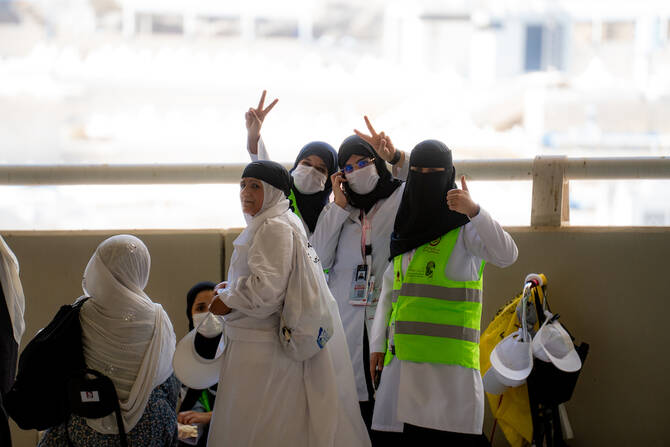
Hajj pilgrims on Saturday continued the ritual stoning of the devil, casting pebbles at the Jamarat, three stone pillars in Mina, on the second day of Tashreeq. (AN Photo/Abdulrahman Shalhoub)
2 / 4
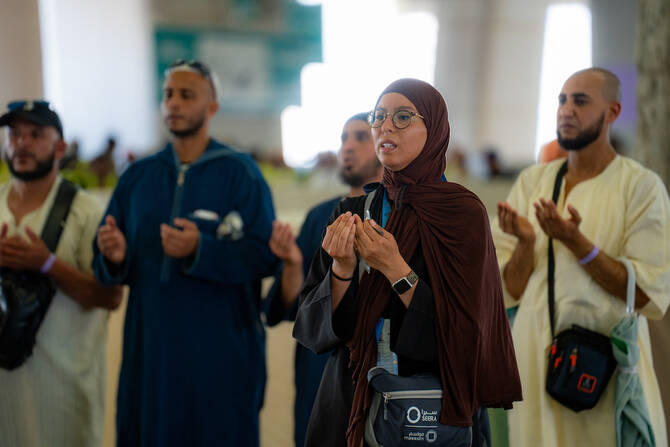
Hajj pilgrims on Saturday continued the ritual stoning of the devil, casting pebbles at the Jamarat, three stone pillars in Mina, on the second day of Tashreeq. (AN Photo/Abdulrahman Shalhoub)
3 / 4
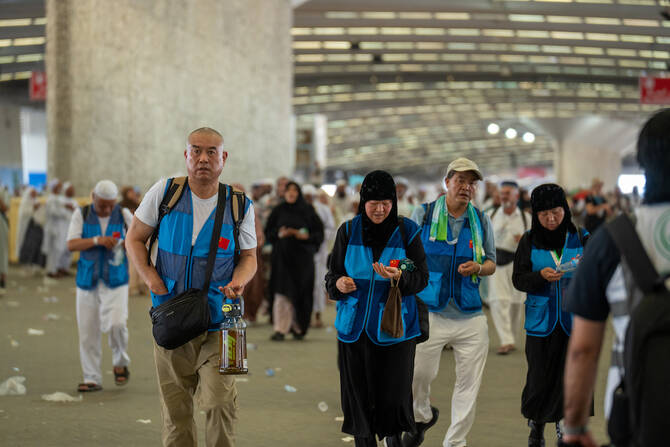
Hajj pilgrims on Saturday continued the ritual stoning of the devil, casting pebbles at the Jamarat, three stone pillars in Mina, on the second day of Tashreeq. (AN Photo/Abdulrahman Shalhoub)
4 / 4
Hajj pilgrims on Saturday continued the ritual stoning of the devil, casting pebbles at the Jamarat, three stone pillars in Mina, on the second day of Tashreeq. (AN Photo/Abdulrahman Shalhoub)
Short Url
Updated 07 June 2025
Follow

Hajj pilgrims on Tashreeq day amid high temperatures, tight security measures

  • Pilgrims are carrying out their stoning rituals amid soaring temperatures reaching 46 C
  • The Interior Ministry has reiterated its ongoing commitment to ensuring the protection and safety of pilgrims across Mina

MINA: Hajj pilgrims on Saturday continued the ritual stoning of the devil, casting pebbles at the Jamarat, three stone pillars in Mina, on the second day of Tashreeq, which follows Eid Al-Adha.

The stoning ritual commenced with the smallest pillar, followed by the middle one, and concluded with Jamarat Al-Aqaba, the largest, in accordance with the practice of Prophet Muhammad. 

Pilgrims are carrying out their stoning rituals amid soaring temperatures reaching 46 C, according to the National Center for Meteorology. The center also forecast a further rise in temperatures by three degrees. However, the weather is expected to cool down with minimum temperatures reaching 31 C.

The Interior Ministry has reiterated its ongoing commitment to ensuring the protection and safety of pilgrims across Mina and within their camps. The ministry added that these efforts include managing pedestrian movement from the tents to the Jamarat area and during their journey to the Grand Mosque.

The ministry also urged pilgrims to continue adhering to the instructions that regulate their movement during the days of Tashreeq, emphasizing the importance of safety—particularly when circling the Kaaba, hastening between the hills of Al-Safa and Al-Marwa, and performing the stoning ritual at the Jamarat in Mina. 

For its part, the Ministry of Hajj and Umrah called on pilgrims to adhere to the organizational guidelines and follow the designated Hajj schedules to ensure the smooth performance of rituals and to minimize the risk of heat exhaustion and sunstroke.

Speaking to Arab News, Mohammed Isaaq, a Pakistani pilgrim, said that his Hajj journey has been “exceptional” in every aspect.

“It is my first time performing Hajj, and everything around us is remarkably well-organized, allowing us to complete our rituals with ease and serenity. What an experience. I am deeply grateful to the Almighty for granting me the opportunity to be part of this Hajj season and to perform the rites in such a profoundly spiritual atmosphere,” he said. 

On her way back from the stoning ritual, Naeema Yousuf, a Libyan pilgrim, said she cannot describe her feelings as she prepares to end her pilgrimage and return to her country “with no sins.” 

She said: “Allah has promised us forgiveness, and we are hopeful he will accept our Hajj and forgive our sins. I am an elderly woman who only wishes to leave this world with no sins.”

Yousuf added: “I would like to thank all those here who have shown us kindness and care. May Allah reward you for the efforts and services you provide to your brothers and sisters who come from all over the world to perform Hajj.”

More than 1.67 million pilgrims will continue their stay in Mina during the three days of Tashreeq to complete the remaining rites of Hajj.


Experimental farm in Al-Lith looks into future of Saudi Arabian agriculture

Updated 01 February 2026
Follow

Experimental farm in Al-Lith looks into future of Saudi Arabian agriculture

  • Research initiative reflects strategic transformation

JEDDAH: An experimental farm in Saudi Arabia’s Al-Lith Governorate is one of the research initiatives reflecting the strategic transformation taking place in the Kingdom’s agricultural sector.

The farm uses highly efficient, sustainable production models that combine scientific research with commercial application, contributing to strengthening the country’s food security system and the sustainability of water resources.

Located in the Ghumaiqa Center on an area of about 10 hectares, the cutting-edge farm is a testing platform for modern agricultural technologies that tackle the challenge of water scarcity.

The farm includes developed open fields and modern greenhouses, supported by smart irrigation encompassing drip and sprinkler irrigation alongside surface and subsurface technologies.

All the systems operate via smart controls that enable the monitoring of water consumption and ensure improved efficiency, thereby achieving a balance between agricultural production and water conservation.

The farm also uses treated and diluted low-salinity seawater.

It aims to diversify agricultural water sources, reduce reliance on freshwater, and open new horizons for agriculture in coastal and semi-arid environments.

The project represents a promising investment opportunity in the field of smart agriculture, enabling the development of commercially scalable production models, particularly for high-value vegetables and fruits, while reducing operational costs associated with water and energy, enhancing the economic feasibility of future agricultural projects.

In addition, the project contributes to transferring and localizing agricultural expertise, supporting local food supply chains, and creating an attractive environment for agricultural investment.

This aligns with Sustainable Development Goals and enhances the efficiency of the private sector in adopting innovative agricultural solutions.

Yahya bin Abdulrahman Al-Mahabi, the director of the Ministry of Environment, Water and Agriculture office in Al-Lith Governorate, told the Saudi Press Agency that the project represented the future of agriculture in the Kingdom.

He explained that the vision was based on investing in technology, enhancing the return on water per unit, and integrating scientific research with investment opportunities.

Al-Mahabi spoke of the experimental farm as a modern, scalable and replicable model applicable in several regions of the Kingdom, particularly in coastal environments.

Al-Mahabi highlighted the Ministry of Environment, Water and Agriculture’s commitment to supporting distinctive projects that contributed to achieving food security while developing rural areas and enhancing agricultural production efficiency, in line with the objectives of the Kingdom’s Vision 2030.