Federal judge approves $2.8 billion settlement, paving way for US colleges to pay athletes millions

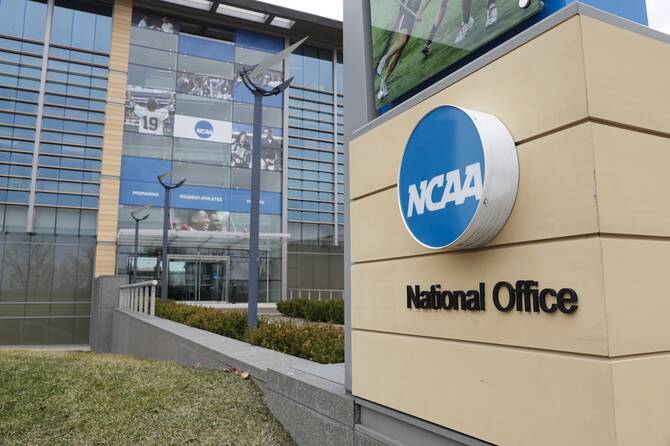
The NCAA headquarters in Indianapolis is seen on March 12, 2020. (AP file photo)
Short Url
Updated 07 June 2025
Follow

Federal judge approves $2.8 billion settlement, paving way for US colleges to pay athletes millions

  • The sweeping terms of the so-called House settlement include approval for each school to share up to $20.5 million with athletes over the next year and $2.7 billion that will be paid over the next decade
  • The agreement brings a seismic shift to hundreds of schools that were forced to reckon with the reality that their players are the ones producing the billions in TV and other revenue, mostly through football and basketball, that keep this machine humming

NEW YORK: A federal judge signed off on arguably the biggest change in the history of college sports Friday, clearing the way for schools to begin paying their athletes millions of dollars as soon as next month as the multibillion-dollar industry shreds the last vestiges of the amateur model that defined it for more than a century.

Nearly five years after Arizona State swimmer Grant House sued the NCAA and its five biggest conferences to lift restrictions on revenue sharing, US Judge Claudia Wilken approved the final proposal that had been hung up on roster limits, just one of many changes ahead amid concerns that thousands of walk-on athletes will lose their chance to play college sports.

The sweeping terms of the so-called House settlement include approval for each school to share up to $20.5 million with athletes over the next year and $2.7 billion that will be paid over the next decade to thousands of former players who were barred from that revenue for years.

The agreement brings a seismic shift to hundreds of schools that were forced to reckon with the reality that their players are the ones producing the billions in TV and other revenue, mostly through football and basketball, that keep this machine humming.

The scope of the changes — some have already begun — is difficult to overstate. The professionalization of college athletics will be seen in the high-stakes and expensive recruitment of stars on their way to the NFL and NBA, and they will be felt by athletes whose schools have decided to pare their programs. The agreement will resonate in nearly every one of the NCAA’s 1,100 member schools boasting nearly 500,000 athletes.

“Approving the agreement reached by the NCAA, the defendant conferences and student-athletes in the settlement opens a pathway to begin stabilizing college sports,” NCAA President Charlie Baker said.

The road to a settlement

Wilken’s ruling comes 11 years after she dealt the first significant blow to the NCAA ideal of amateurism when she ruled in favor of former UCLA basketball player Ed O’Bannon and others who were seeking a way to earn money from the use of their name, image and likeness (NIL) — a term that is now as common in college sports as “March Madness” or “Roll Tide.” It was just four years ago that the NCAA cleared the way for NIL money to start flowing, but the changes coming are even bigger.

Wilken granted preliminary approval to the settlement last October. That sent colleges scurrying to determine not only how they were going to afford the payments, but how to regulate an industry that also allows players to cut deals with third parties so long as they are deemed compliant by a newly formed enforcement group that will be run by auditors at Deloitte.

The agreement takes a big chunk of oversight away from the NCAA and puts it in the hands of the four biggest conferences. The ACC, Big Ten, Big 12 and SEC hold most of the power and decision-making heft, especially when it comes to the College Football Playoff, which is the most significant financial driver in the industry and is not under the NCAA umbrella like the March Madness tournaments are.

Roster limits held things up

The deal looked ready to go since last fall, but Wilken put a halt to it after listening to a number of players who had lost their spots because of newly imposed roster limits being placed on teams.

The limits were part of a trade-off that allowed the schools to offer scholarships to everyone on the roster, instead of only a fraction, as has been the case for decades. Schools started cutting walk-ons in anticipation of the deal being approved.

Wilken asked for a solution and, after weeks, the parties decided to let anyone cut from a roster — now termed a “Designated Student-Athlete” — return to their old school or play for a new one without counting against the new limit.

Wilken ultimately agreed, going point-by-point through the objectors’ arguments to explain why they didn’t hold up.

“The modifications provide Designated Student-Athletes with what they had prior to the roster limits provisions being implemented, which was the opportunity to be on a roster at the discretion of a Division I school,” Wilken wrote.

Her decision, however, took nearly a month to write, leaving the schools and conferences in limbo — unsure if the plans they’d been making for months, really years, would go into play.

“It remains to be seen how this will impact the future of inter-collegiate athletics — but as we continue to evolve, Carolina remains committed to providing outstanding experiences and broad-based programming to student-athletes,” North Carolina athletic director Bubba Cunningham said.

Winners and losers

The list of winners and losers is long and, in some cases, hard to tease out.

A rough guide of winners would include football and basketball stars at the biggest schools, which will devote much of their bankroll to signing and retaining them. For instance, Michigan quarterback Bryce Underwood’s NIL deal is reportedly worth between $10.5 million and $12 million.

Losers, despite Wilken’s ruling, figure to be at least some of the walk-ons and partial scholarship athletes whose spots are gone.

Also in limbo are Olympic sports many of those athletes play and that serve as the main pipeline for a US team that has won the most medals at every Olympics since the downfall of the Soviet Union.

All this is a price worth paying, according to the attorneys who crafted the settlement and argue they delivered exactly what they were asked for: an attempt to put more money in the pockets of the players whose sweat and toil keep people watching from the start of football season through March Madness and the College World Series in June.

What the settlement does not solve is the threat of further litigation.

Though this deal brings some uniformity to the rules, states still have separate laws regarding how NIL can be doled out, which could lead to legal challenges. NCAA President Charlie Baker has been consistent in pushing for federal legislation that would put college sports under one rulebook and, if he has his way, provide some form of antitrust protection to prevent the new model from being disrupted again.


How Saudi football scored in the runup to 2026 FIFA World Cup

Updated 03 January 2026
Follow

How Saudi football scored in the runup to 2026 FIFA World Cup

  • Saudi Pro League asserted global dominance with star-studded lineups and record-breaking performances from Asia’s elite top-tier clubs
  • Domestic leagues reached new heights, yet the national team faces mounting pressure ahead of a high-stakes global tournament

DUBAI: FIFA President Gianni Infantino seemed full of optimism on Dec. 21 when he said Saudi Arabia had become a major hub on the global football stage and that the Saudi Pro League was on track to become one of the top three in the world.

With players like Cristiano Ronaldo and Karim Benzema and a nation crazy about the great game, this endorsement perhaps comes as little surprise.

Infantino also predicted a successful World Cup in 2034 when the tournament will be hosted by Saudi Arabia. With infrastructure being built and upgraded, the Expo 2030 venue under construction, and reforms underway, the World Cup seems destined to be a success.

At the 2026 World Cup, Saudi Arabia will face Uruguay, European champions Spain, and Cape Verde in their three Group H matches, taking place in Miami, Atlanta, and Houston respectively. (Reuters/File)

The FIFA boss also praised the progress made not only at the senior national team level and across youth categories, but also in the women’s game, thanks to the backing of football authorities in recent years.

While this paints a positive picture of the game in the Kingdom, it follows the national team’s 1-0 loss to Jordan in the semi-finals of the 2025 Arab Cup. Many supporters will need far more convincing of the team’s prospects going into the New Year.

Although the return of Herve Renard as coach of the Green Falcons following Roberto Mancini’s disappointing stint has resulted in a second consecutive World Cup qualification (and seventh overall), failure to win the Arab Cup in Qatar and some less than inspiring performances means the jury is still out on the Frenchman.

At the 2026 World Cup, Saudi Arabia will face Uruguay, European champions Spain, and Cape Verde in their three Group H matches, taking place in Miami, Atlanta, and Houston respectively.

Saudi fans sharing Infantino’s positive outlook will hope Renard’s men can emulate the historic win over Argentina on that memorable night at Lusail Stadium in 2022. But that is far easier said than done, and many remain unconvinced.

Cristiano Ronaldo celebrates after scoring a goal during the Saudi Pro League. (AFP/File)

For a start, just as Poland and Mexico were alerted to Saudi Arabia’s potential following that humbling of Lionel Messi and co in Qatar, their opponents in the US will likewise be on their guard this time around.

Worryingly for Saudi fans, the team has rarely, if at all, hit the same highs since Saleh Al-Shehri’s equalizer and Salem Al-Dawsari’s stunning strike brought about arguably the most famous win in the Green Falcons’ history.

The 2023 AFC Asian Cup, played in early 2024 and only months after Mancini’s arrival, saw Saudi Arabia eliminated by South Korea on penalties in the round of 16.

World Cup qualification was eventually secured but not before the team needed to negotiate a fourth round group that included Iraq and Indonesia in October.

The semi-final exit at the Arab Cups prompted rumors — immediately denied by the Saudi Arabian Football Federation — that Renard’s job was under threat. Still, it was hardly a ringing endorsement of the way things had turned out on his second stint as national team coach. 

Al-Ahli's Roberto Firmino lifts the trophy as he celebrates with teammates after winning the Asian Champions League. (Reuters/File)

Outspoken Saudi-based football pundit Battal Algoos has been scathing in his criticism of Renard and his employers, and in particular of the excuses for the Arab Cup disappointment.

“It seems to be a contagion that has affected the Saudi camp,” he said on the football show “Filmarma” on Al Arabiya.

“Everyone justifies (their position) through others’ failures. We brought you to win a championship, not to say ‘those before me didn’t win championships, I’m no worse than them’.

“It seems to be contagious, from (SAFF President) Yasser Al-Misehal to Renard. Or their thinking is one and the same.”

Paul Williams, Australian journalist and founder and presenter of “The Asian Game” podcast, was at Lusail Stadium the day Saudi Arabia beat the eventual world champions, but believes urgent fixes are needed by Renard this time round.

New Murabba Stadium. (Supplied)

“There are a multitude of areas that Saudi Arabia need to improve,” he told Arab News. “The obvious is in the final third, where there are still issues finding a reliable avenue to goal, an issue that blighted most of their qualification campaign.

“But they also haven’t yet found a capable replacement in midfield for Salman Al-Faraj, and the entire narrative around Saudi football has changed since before 2022.

“There has always been pressure and expectation from the fans, but that is even more intense now and it feels like that sits heavily on the squad, who are yet to prove they are capable of delivering under that burden of expectation.”

The team’s main concern remains, as it was four years ago in Qatar, its lack of fire power up front and an over-reliance on Al-Dawsari for goals and inspiration. In that sense, at least the 34-year-old talisman can still be relied on.

Al-Ittihad's Karim Benzema celebrates. (Reuters/File)

The Al-Hilal and Saudi Arabia captain provided one of the highlights of 2025 when he was named AFC Player of the Year at the awards ceremony in Riyadh. Al-Dawsari is the only Saudi to have won the Asian award twice.

On an individual level, he enjoyed a stellar 2024-25 season with his club, although Al-Hilal lost out on the Saudi Pro League title to a Benzema-inspired Al-Ittihad.

Al-Dawsari and Al-Hilal came back strongly in the summer to reach the quarter-finals of the 2025 FIFA Club World Cup in the US, along the way drawing 1-1 with Real Madrid in the group stage and brilliantly beating Manchester City 4-3 in the round of 16.

Domestically, however, it is their local rivals that have stolen all the headlines, with their lead at the top of the SPL delighting millions of fans around the world and perhaps in the process reinforcing Infantino’s estimation of the league.

Al-Nassr, now managed by former Al-Hilal boss Jorge Jesus and inspired by the relentlessly enduring Ronaldo, look near invincible at the top of the table, having won all nine matches during this campaign.

The coronation that their fans and the Portuguese legend’s army of global followers had envisioned since he landed in Riyadh three years ago is looking increasingly likely to happen in May. Their end of year report card is glowing 9 out of 10.

Cristiano Ronaldo scores a goal in the Saudi Pro League. (Reuters/File)

Al-Hilal, the self-styled Real Madrid of Asia, can never be counted out however, and the title race in 2026 could be one of the most exciting and close in recent years.

Reigning champions Al-Ittihad, on the other hand, have put up a dismal defense of their title resulting in the sacking of Laurent Blanc, who was succeeded by Sergio Conceicao. Their card will read “must do better.”

Al-Ahli provided further evidence of the SPL’s continental dominance by claiming the 2025 AFC Champions League Elite after beating Japan’s Kawasaki Frontale 2-0 in Jeddah last May. 

Elsewhere, Aramco-owned Al-Qadsiah and newly promoted NEOM provide intriguing plot lines as they sit in fifth and eighth respectively, while Al-Taawoun continue to punch above their weight in third.

One of the standout personalities of the season has been US investor Ben Harburg who — through Harburg Group — acquired 100 percent of Al-Kholood in July, making it the first Saudi club wholly owned by a foreign entity. The purchase opens up new possibilities for the SPL.

Al-Hilal's Salem Al-Dawsari poses with the trophy and the President of the Asian Football Confederation Salman bin Ibrahim Al Khalifa after winning the AFC Player of the Year. (Reuters/File)

There is little debate now that the SPL is the most powerful and entertaining in Asia and could in future years, if Infantino is right, become one of the world’s best. The national team’s standing however, until the 2026 World Cup at least, remains up in the air.