

Drought, rising prices and dwindling herds undercut this year’s Eid Al-Adha in North Africa

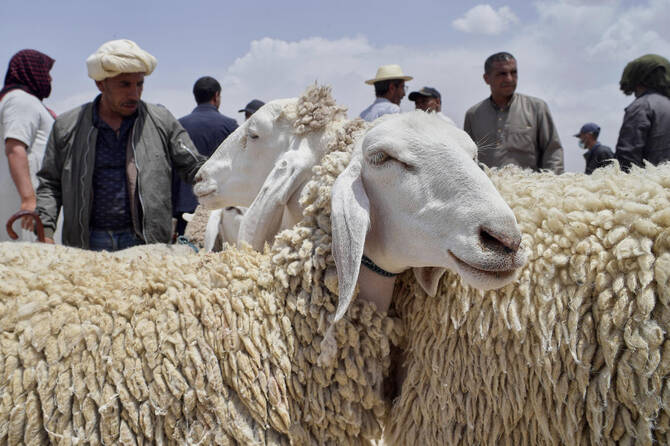
People shop for sheep at a livestock market in Algeria on June 5, 2025 as Muslims around the world celebrate Eid Al-Adha. (AP)
Short Url
Updated 07 June 2025
Follow

Drought, rising prices and dwindling herds undercut this year’s Eid Al-Adha in North Africa

  • Rising prices and falling supply are creating new challenges, breeders and potential buyers throughout the region say
  • Each year, Muslims slaughter sheep to honor a passage of the Qur’an in which the prophet Ibrahim prepared to sacrifice his son as an act of obedience to God

CASABLANCA: Flocks of sheep once quilted Morocco’s mountain pastures, stretched across Algeria’s vast plateaus and grazed along Tunisia’s green coastline. But the cascading effects of climate change have sparked a region-wide shortage that is being felt acutely as Muslims throughout North Africa celebrate Eid Al-Adha.

Each year, Muslims slaughter sheep to honor a passage of the Qur’an in which the prophet Ibrahim prepared to sacrifice his son as an act of obedience to God, who intervened and replaced the child with a sheep.

But this year, rising prices and falling supply are creating new challenges, breeders and potential buyers throughout the region say.

At a market in suburban Algiers last week, breeders explained to angry patrons that their prices had increased because the cost of everything needed to raise sheep, including animal feed, transport and veterinary care, had grown.

Slimane Aouadi stood watching livestock pens, discussing with his wife whether to buy a sheep to celebrate this year’s Eid.

“It’s the same sheep as the one I bought last year, the same look and the same weight, but it costs $75 more,” Aouadi, a doctor, said.

Amid soaring inflation, sheep can sell for more than $1,200, an exorbitant amount in a country where average monthly incomes hover below $270.

Tradition meets reality

Any disruption to the ritual sacrifice can be sensitive, a blow to religious tradition and source of anger toward rising prices and the hardship they bring.

So Morocco and Algeria have resorted to unprecedented measures.

Algerian officials earlier this year announced plans to import a staggering 1 million sheep to make up for domestic shortages. Morocco’s King Mohammed VI broke with tradition and urged Muslims to abstain from the Eid sacrifice. Local officials across the kingdom have closed livestock markets, preventing customers from buying sheep for this year’s celebrations.

“Our country is facing climatic and economic challenges that have resulted in a substantial decline in livestock numbers. Performing the sacrifice in these difficult circumstances will cause real harm to large segments of our people, especially those with limited incomes,” the king, who is also Morocco’s highest religious authority, wrote in a February letter read on national television.

Trucks have unloaded thousands of sheep in new markets in Algiers and the surrounding suburbs. University of Toulouse agro-economist Lotfi Gharnaout told the state-run newspaper El Moudjahid that Algeria’s import strategy could cost between $230 and $260 million and still not even meet nationwide demand.

Thinning pastures

Overgrazing has long strained parts of North Africa where the population is growing and job opportunities beyond herding and farming are scarce. But after seven years of drought, it’s the lack of rainfall and skyrocketing feed prices that are now shrinking herds. Drought conditions, experts say, have degraded forage lands where shepherds graze their flocks and farmers grow cereals to be sold as animal feed.

With less supply, prices have spiked beyond the reach of middle class families who have historically purchased sheep for slaughter.

Moroccan economist Najib Akesbi said shrinking herds stemmed directly from vegetation loss in grazing areas. The prolonged drought has compounded inflation already fueled by the war in Ukraine.

“Most livestock farming in North Africa is pastoral, which means it’s farming that relies purely on nature, like wild plants and forests, and vegetation that grows off rainwater,” Akesbi, a former professor at Hassan II Institute of Agronomy and Veterinary Medicine, said.

For breeders, he added, livestock serve as a kind of bank, assets they sell to cover expenses and repay debts. With consecutive years of drought and rising feed costs, breeders are seeing their reserves drained.

Pressed herders

With less natural vegetation, breeders have to spend more on supplemental feed, Acharf Majdoubi, president of Morocco’s Association of Sheep and Goat Breeders said. In good years, pastures can nourish nearly all of what sheep flocks require, but in dry years, it can be as low as half or a third of the feed required.

“We have to make up the rest by buying feed like straw and barley,” he said.

Not only do they need more feed. The price of barley, straw and alfalfa – much of which has to be imported – has also spiked.

In Morocco, the price of barley and straw are three times what they were before the drought, while the price of alfalfa has more than doubled.

“The future of this profession is very difficult. Breeders leave the countryside to immigrate to the city, and some will never come back,” Achraf Majdoubi said.


Louvre Museum closed as workers launch rolling strike

Museum staff protest outside the entrance to the Louvre in Paris on Monday. (AFP)
Updated 7 sec ago
Follow

Louvre Museum closed as workers launch rolling strike

  • After the memo, French President Emmanuel Macron announced a massive renovation plan for the museum, expected to cost €700 million to €800 million (up to $940 million)

PARIS: The Louvre closed its doors to thousands of disappointed visitors on Monday as staff launched a rolling strike to protest working conditions at the Paris landmark, two months after a shocking robbery.

Staff assembled outside the museum’s world-famous glass pyramid, blocking the main entrance and holding signs, as security agents turned tourists away.

“The Louvre on strike,” said a banner.

“All together all together,” striking staff shouted. “Who does the Louvre belong to? To us!“

Workers are demanding extra staff and measures to tackle overcrowding, adding to the woes of the world’s most visited museum just as France gears up for the Christmas holidays.

“We are angry,” Elize Muller, a security guard, told reporters. “We disagree with the way the Louvre has been managed.”

The strike comes nearly two months after the museum was victim of an embarrassing daylight heist that saw crown jewels worth $102 million stolen.

A notice in the museum’s courtyard said the Louvre would remain closed on Monday.

At a general meeting, around 400 employees voted unanimously to launch a strike, which can be renewed, to protest the “deterioration” of working conditions, the CGT and CFDT unions said.

Another general meeting was scheduled to take place Wednesday. The museum is closed on Tuesdays.

“I’m very disappointed, because the Louvre was the main reason for our visit in Paris, because we wanted to see the ‘Mona Lisa’,” said 37-year-old Minsoo Kim, who had traveled from Seoul with his wife for their honeymoon.

Natalia Brown, a 28-year-old tourist from London, said she understands “why they’re doing it,” but called it “unfortunate timing for us.”

Rachel Adams, a 60-year-old real estate agent from Utah, said she had heard of the plans to strike.

“I think that the Louvre makes a lot of money and they should be handling their finances quite a bit better. They had the big water leak. I mean, this is important stuff.”

Speaking on the eve of the action, Christian Galani, from the hard-left CGT union, said the strike would have broad support across the museum’s 2,200-strong workforce.

“We’re going to have a lot more strikers than usual,” Galani said.

“Normally, it’s front-of-house and security staff. This time, there are scientists, documentarians, collections managers, even curators and colleagues in the workshops telling us they plan to go on strike.”

All have different grievances, adding up to a picture of staff discontent inside the institution, just as it finds itself in a harsh public spotlight following the shocking robbery on Oct. 19.

Reception and security staff complain they are understaffed and required to manage vast flows of people, with the home of Leonardo da Vinci’s “Mona Lisa” welcoming several million people beyond its planned capacity each year.

A spontaneous walk-out protest in June led the museum to temporarily close.

The Louvre has become a symbol of so-called “over-tourism,” with the 30,000 daily visitors facing what unions call an “obstacle course” of hazards, long queues, and sub-standard toilets and catering.

Documentarians and curators are increasingly horrified by the state of disrepair inside the former royal palace, with a recent water leak and the closure of a gallery due to structural problems underlining the difficulties.

“The building is not in a good state,” chief Louvre architect Francois Chatillon admitted in front of lawmakers last month.

Under-fire Louvre boss Laurence des Cars, who faces persistent calls to resign, warned the government in January in a widely publicized memo about leaks, overheating and the declining visitor experience.

After the memo, French President Emmanuel Macron announced a massive renovation plan for the museum, expected to cost €700 million to €800 million (up to $940 million).

Questions continue to swirl since the break-in over whether it was avoidable and why the national treasure appeared to be poorly protected.

Two intruders used a portable extendable ladder to access the gallery containing the crown jewels, cutting through a glass door with angle grinders in front of startled visitors before stealing eight priceless items.

Investigations have since revealed that only one security camera was working outside when they struck, that guards in the control room did not have enough screens to watch the coverage in real time, and that police were initially misdirected.