WASHINGTON: The State Department is weighing giving $500 million to the new foundation providing aid to war-shattered Gaza, according to two knowledgeable sources and two former US officials, a move that would involve the US more deeply in a controversial aid effort that has been beset by violence and chaos.
The sources and former US officials, all of whom requested anonymity because of the sensitivity of the matter, said that money for Gaza Humanitarian Foundation (GHF) would come from the US Agency for International Development (USAID), which is being folded into the US State Department.
The plan has met resistance from some US officials concerned with the deadly shootings of Palestinians near aid distribution sites and the competence of the GHF, the two sources said.
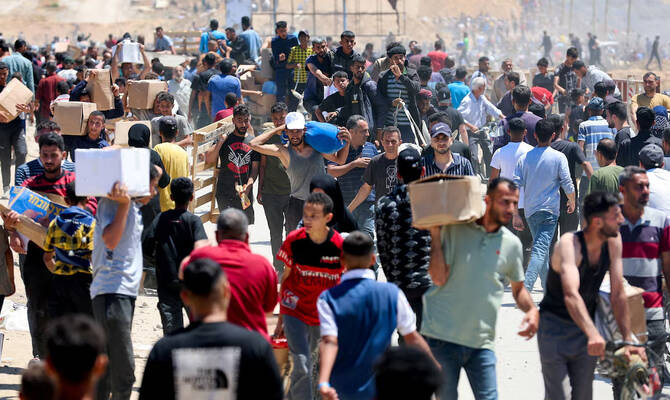
The GHF, which has been fiercely criticized by humanitarian organizations, including the United Nations, for an alleged lack of neutrality, began distributing aid last week amid warnings that most of Gaza’s 2.3 million population is at risk of famine after an 11-week Israeli aid blockade, which was lifted on May 19 when limited deliveries were allowed to resume.
The foundation has seen senior personnel quit and had to pause handouts twice this week after crowds overwhelmed its distribution hubs.
The State Department and GHF did not immediately respond to requests for comment.
Reuters has been unable to establish who is currently funding the GHF operations, which began in Gaza last week. The GHF uses private US security and logistics companies to transport aid into Gaza for distribution at so-called secure distribution sites.
On Thursday, Reuters reported that a Chicago-based private equity firm, McNally Capital, has an “economic interest” in the for-profit US contractor overseeing the logistics and security of GHF’s aid distribution hubs in the enclave.
While US President Donald Trump’s administration and Israel say they don’t finance the GHF operation, both have been pressing the United Nations and international aid groups to work with it.
The US and Israel argue that aid distributed by a long-established UN aid network was diverted to Hamas. Hamas has denied that.
USAID has been all but dismantled. Some 80 percent of its programs have been canceled and its staff face termination as part of President Donald Trump’s drive to align US foreign policy with his “America First” agenda.
One source with knowledge of the matter and one former senior official said the proposal to give the $500 million to GHF has been championed by acting deputy USAID Administrator Ken Jackson, who has helped oversee the agency’s dismemberment.
The source said that Israel requested the funds to underwrite GHF’s operations for 180 days.
The Israeli government did not immediately respond to a request for comment.
The two sources said that some US officials have concerns with the plan because of the overcrowding that has affected the aid distribution hubs run by GHF’s contractor, and violence nearby.
Those officials also want well-established non-governmental organizations experienced in running aid operations in Gaza and elsewhere to be involved in the operation if the State Department approves the funds for GHF, a position that Israel likely will oppose, the sources said.
Gaza hospital officials have said more than 80 people had been shot dead and hundreds wounded near GHF’s distribution points between June 1-3.
Since launching its operation, the GHF has opened three hubs, but over the past two days, only two of them have been functioning.
Witnesses blamed Israeli soldiers for the killings. The Israeli military said it fired warning shots on two days, while on Tuesday it said soldiers had fired at Palestinian “suspects” advancing toward their positions.

US mulls giving millions to controversial Gaza aid foundation, sources say
https://arab.news/vtxyh
US mulls giving millions to controversial Gaza aid foundation, sources say
- The plan has met resistance from some US officials concerned with the deadly shootings of Palestinians near aid distribution sites and the competence of the GHF, the two sources said
Netanyahu says Israel and Hamas will enter ceasefire’s second phase soon
- Says the second phase addresses the disarming of Hamas and withdrawal of Israeli troops from Gaza
- Second stage also includes the deployment of an international force to secure Gaza and forming a temporary Palestinian government
TEL AVIV, Israel: Israeli Prime Minister Benjamin Netanyahu said Sunday that Israel and Hamas are “very shortly expected to move into the second phase of the ceasefire,” after Hamas returns the remains of the last hostage held in Gaza.
Netanyahu spoke during a news conference with visiting German Chancellor Friedrich Merz and stressed that the second phase, which addresses the disarming of Hamas and the withdrawal of Israeli troops from Gaza, could begin as soon as the end of the month.
Hamas has yet to hand over the remains of Ran Gvili, a 24-year-old police officer who was killed in the Hamas-led Oct. 7, 2023, attack that sparked the war. His body was taken to Gaza.
The ceasefire’s second stage also includes the deployment of an international force to secure Gaza and forming a temporary Palestinian government to run day-to-day affairs under the supervision of an international board led by US President Donald Trump.
A senior Hamas official on Sunday told The Associated Press the group is ready to discuss “freezing or storing or laying down” its weapons as part of the ceasefire in a possible approach to one of the most difficult issues ahead.
Netanyahu says second phase will be challenging
Netanyahu said few people believed the ceasefire’s first stage could be achieved, and the second phase is just as challenging.
“As I mentioned to the chancellor, there’s a third phase, and that is to deradicalize Gaza, something that also people believed was impossible. But it was done in Germany, it was done in Japan, it was done in the Gulf States. It can be done in Gaza, too, but of course Hamas has to be dismantled,” he said.
The return of Gvili’s remains — and Israel’s return of 15 bodies of Palestinians in exchange — would complete the first phase of Trump’s 20-point ceasefire plan.
Hamas says it has not been able to reach all remains because they are buried under rubble left by Israel’s two-year offensive in Gaza. Israel has accused the militants of stalling and threatened to resume military operations or withhold humanitarian aid if all remains are not returned.
A group of families of hostages said in a statement that “we cannot advance to the next phase before Ran Gvili returns home.”
Meanwhile, Israeli military Chief of Staff Lt. Gen. Eyal Zamir on Sunday called the so-called Yellow Line that divides the Israeli-controlled majority of Gaza from the rest of the territory a “new border.”
“We have operational control over extensive parts of the Gaza Strip and we will remain on those defense lines,” Zamir said. “The Yellow Line is a new border line, serving as a forward defensive line for our communities and a line of operational activity.”
Germany says support for Israel is unchanged
Merz said Germany, one of Israel’s closest allies, is assisting with the implementation of the second phase by sending officers and diplomats to a US-led civilian and military coordination center in southern Israel, and by sending humanitarian aid to Gaza.
The chancellor also said Germany still believes that a two-state-solution is the best possible option but that “the German federal government remains of the opinion that recognition of a Palestinian state can only come at the end of such a process, not at the beginning.”
The US-drafted plan for Gaza leaves the door open to Palestinian independence. Netanyahu has long asserted that creating a Palestinian state would reward Hamas and eventually lead to an even larger Hamas-run state on Israel’s borders.
Netanyahu also said that while he would like to visit Germany, he hasn’t planned a diplomatic trip because he is concerned about an arrest warrant issued by the International Criminal Court, the UN’s top war crimes court, last year in connection with the war in Gaza.
Merz said there are currently no plans for a visit but he may invite Netanyahu in the future. He added that he is not aware of future sanctions against Israel from the European Union nor any plans to renew German bans on military exports to Israel.
Germany had a temporary ban on exporting military equipment to Israel, which was lifted after the ceasefire began on Oct. 10.
Israel kills militant in Gaza
The Israeli military said it killed a militant who approached its troops across the Yellow Line.
Gaza’s Health Ministry says Israeli forces have killed more than 370 Palestinians since the start of the ceasefire, and that the bodies of six people killed in attacks had been brought to local hospitals over the past 24 hours.
In the original Hamas-led attack in 2023, the militants killed around 1,200 people and took more than 250 others hostage. Almost all the hostages or their remains have been returned in ceasefires or other deals.
Israel’s offensive in Gaza has killed at least 70,360 Palestinians, according to Gaza’s Health Ministry, which operates under the Hamas-run government. The ministry does not differentiate between civilians and combatants, but says that nearly half the dead have been women and children. The ministry is part of Gaza’s Hamas government and its numbers are considered reliable by the UN and other international bodies.


