While women have always traditionally supported the pilgrimage, their role is growing under Vision 2030
‘Education is key,’ says professor dedicated to increasing women’s participation in Hajj services
Updated 06 June 2025
Rahaf Jambi
RIYADH: The role played by women during Hajj has evolved considerably in recent years, highlighting their contributions to one of the world’s largest gatherings of humanity.
One inspiring woman involved in the pilgrimage is Alyaa Malibari, a professor at Umm Al-Qura University in Makkah.
She has dedicated her career to enhancing pilgrims’ experiences while also empowering other women and works with several operators to run courses for members of the public interested in volunteering during Hajj.
(AN photo/Adnan Salem Mahdaly)
She devised the Qaidat program, a leadership initiative for women that introduces them to various roles and responsibilities. Another, Hunna, is a female-led project that aligns with Vision 2030 and focuses on applying innovative practices during Hajj. Meanwhile, the Aguadyat program empowers women in food safety, enhancing the quality of meals provided to pilgrims.
Women have been integral to Hajj ever since its inception, offering hospitality, preparing meals and sharing religious knowledge. Today, their roles have expanded to reflect their educational and professional advancements.
Malibari has been a pivotal figure. With a background in leadership training and communication, she began her journey at a young age, inspired by her family’s commitment to serving pilgrims.
“My earliest memories of Hajj are filled with admiration for my father and the work he did. I always knew I wanted to contribute in some way,” she said, adding that empowering women was a lifelong commitment: “I want to ensure that women have the tools and knowledge to thrive during Hajj.”
Malibari’s earliest memories of Hajj are of when she was five years old and accompanied her father. Her formal involvement began in 2005 when she volunteered with the Women’s Assembly at Umm Al-Qura to assist female pilgrims.
(AN photo/Adnan Salem Mahdaly)
She later studied abroad, which allowed her to bring international attention to Saudi efforts in serving pilgrims.
“It was important for me to share our story with the world and highlight the dedication of those who serve,” she said.
In 2019, Malibari led a translation project for the Ministry of Media, producing multilingual content to enhance communication.
Beyond her contributions during Hajj, Malibari is a dedicated doctor and academic. She is keen to emphasize the importance of education and aims to inspire the next generation of leaders.
“Education is the key to unlocking potential. I want my students to understand that they can make a difference,” she said.
Defense Minister Prince Khalid bin Salman inaugurates 3rd World Defense Show in Riyadh
Organized by the General Authority for Military Industries (GAMI), the five-day event will run until February 12
Prince Khalid launched several key initiatives, including the launch of several defense firms and signing of cooperation deals
The show is also serving as a launchpad for cutting-edge security technologies across various government sectors
Updated 09 February 2026
Arab News
RIYADH: Minister of Defense Prince Khalid bin Salman inaugurated the third edition of the World Defense Show (WDS) on Sunday on behalf of Crown Prince Mohammed bin Salman.
Organized by the General Authority for Military Industries (GAMI), the five-day event will run until February 12, showcasing the Kingdom’s rapid strides toward strategic independence and technological leadership in the defense sector.
The 2026 edition features a purpose-built venue with a 2,700-meter runway for live air and land demonstrations, underscoring the show’s status as a premier global defense event.
GAMI Governor Ahmad Al-Ohali emphasized that the show reflects Saudi Arabia's commitment to localizing over 50 percent of military spending in line with Vision 2030, fostering an integrated ecosystem where government bodies and international partners collaborate on innovation.
The event brings together official delegations, government entities, and leading international companies specializing in the defense and security sectors. (SPA)
Strategic agreements and major launches
The opening day witnessed significant activity at the Saudi Arabian Military Industries (SAMI) Group pavilion, where Prince Khalid launched several key initiatives:
• New entities: The inauguration of SAMI Land Company, SAMI Autonomous Company, and the SAMI Land Industrial Complex.
• Supply chain: The unveiling of the SAMI Local Content Program (RUKN) and the HEET Program.
• International cooperation: A memorandum of understanding was signed between the Saudi General Authority for Defense Development and the Korean Agency for Defense Development to cooperate on advanced military research.
• Defense deals: The Minister signed cooperation agreements with Slovakia, Malaysia, and Somalia.
Defense Minister Prince Khalid signed cooperation agreements with Slovakia, Malaysia, and Somalia. (SPA)
Technological debuts & innovations
The show is also serving as a launchpad for cutting-edge security technologies across various government sectors:
AI-Powered Lucid Gravity: Public Security debuted its advanced Lucid Gravity electric security vehicle at the Ministry of Interior's pavilion. The vehicle integrates state-of-the-art artificial intelligence and specialized security equipment designed to accelerate emergency response times and support field operations.
Public Security’s advanced Lucid Gravity electric security vehicle is displayed at the Ministry of Interior’s pavilion. (SPA)
This high-tech addition highlights Public Security’s shift toward smart, sustainable security solutions. By leveraging predictive intelligence and advanced command-and-control systems, the Lucid Gravity exemplifies the ministry’s commitment to protecting the Kingdom through integrated technological innovation and sustainable mobility.
Smart Helmet: Also at the Ministry of Interior’s pavilion, the General Directorate of Civil Defense unveiled its smart helmet. Designed to revolutionize public safety and emergency response, the helmet features day-and-night cameras and specialized sensors to detect hazardous materials in hard-to-reach locations.
The device serves as a mobile command node, delivering live video feeds directly to command-and-control centers. By enabling real-time data analysis and faster decision-making, the smart helmet significantly reduces incident response times and enhances personnel safety in high-risk environments.
The smart helmet features day-and-night cameras and specialized sensors to detect hazardous materials in hard-to-reach locations. (SPA)
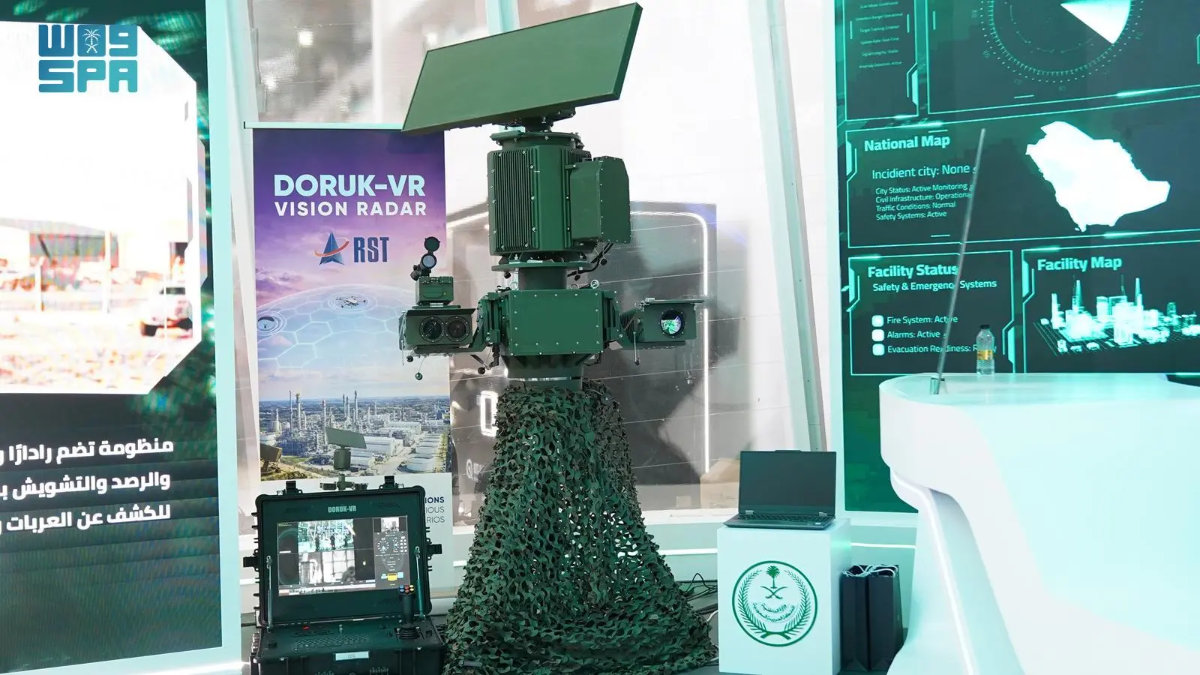
Border Security: The General Directorate of Border Guard (GDBG) showcased an integrated security system featuring radar and thermal cameras capable of detecting drones and classifying moving targets to protect critical infrastructure.
It also functions as an early warning system for critical facilities and border areas and is fully integrated with command and control systems.
Border Guard's ntegrated security system features radar and thermal cameras capable of detecting drones and classifying moving targets to protect critical infrastructure. (SPA)
Counter-Terrorism: The Islamic Military Counter Terrorism Coalition (IMCTC) presented a comprehensive framework integrating intellectual, media, and military domains to combat extremism and terror financing.
Visitors are briefed on specialized programs designed to raise the readiness of national personnel and foster sustainable institutional cooperation among member states to combat extremism. On the event’s opening day, the pavilion hosted high-level delegations, including ministers, military leaders, and ambassadors who reviewed the coalition's pivotal role in coordinating international security efforts and commended its initiatives that support regional and global stability.
A view of the Islamic Military Counter Terrorism Coalition pavilion. (SPA)
Meteorology: The National Center for Meteorology (NCM) displayed advanced weather systems essential for ensuring the safety of the event's air shows and military operations.
At its dedicated pavilion, the NCM is showcasing its latest advanced meteorological technologies and systems. These solutions serve both the military and civilian sectors, providing accurate data to support beneficiary entities' operational processes and highlighting the center's pivotal role in national security and safety.
NCM's latest meteorological technologies and systems serve both the military and civilian sectors
World Defense Show CEO Andrew Pearcey noted that participation is expected to surpass previous records, reflecting the event's growing importance on the international stage. The show continues through February 12.