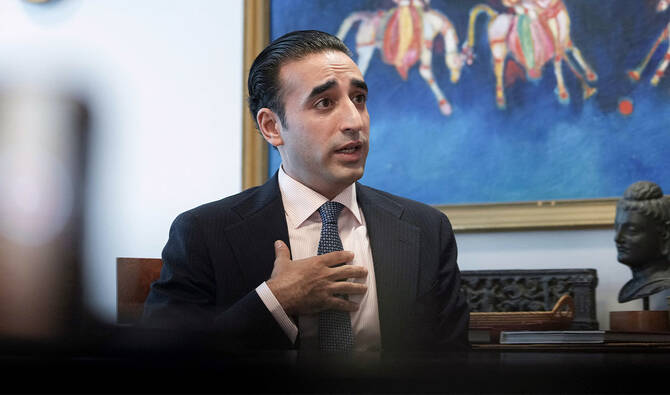

ISLAMABAD: The head of a delegation visiting Washington DC to present Islamabad’s position following a recent military standoff with New Delhi said on Thursday India’s use of a nuclear-capable missile during the conflict had made the situation more precarious.
India and Pakistan have dispatched delegations to world capitals to defend their positions following last month’s four-day conflict between the nuclear-armed neighbors. Bilawal Bhutto Zardari, a former foreign minister, is leading a Pakistani team of lawmakers and former diplomats to the US and will go onwards to London and Brussels. A separate Indian team led by Indian opposition lawmaker Shashi Tharoor is also in the US for official meetings.
The latest escalation between May 7-10 saw the two countries’ militaries trade missile, drones and artillery fire before a ceasefire was brokered by the US and other allies.
“Our concern for next time, heaven forbid, for next time round is that the threshold is low for a military conflict,” Bhutto Zardari said in an interview with Bloomberg News in Washington.
He said India’s use during the conflict of a supersonic missile with nuclear capabilities presented a new danger in future clashes.
“Now we then have about 30 seconds time to decide, off a grainy little image, this nuclear-capable missile — is it armed with a nuclear weapon? And how do we respond?”
In any future conflict, Bhutto Zardari added, both countries were likely to climb the “escalation ladder” too quickly for President Donald Trump or other leaders to intervene.
India has not officially declared its BrahMos missile to be nuclear capable and has a stated no-first-use nuclear policy. On Saturday, a top Indian military official said the conflict with Pakistan in May never came close to the point of nuclear war.
The latest conflict was sparked by an April attack by gunmen that killed 26 civilians — mostly Indian tourists — in Indian-administered Kashmir. India accused Pakistan of being behind the attack, which Islamabad denies.
After the conflict concluded with a ceasefire, which Trump said was brokered by the US, Indian Prime Minister Narendra Modi said India wouldn’t hesitate to use force against “terror camps” in Pakistan again, calling the response a “new normal” in relations.
India has denied the May 10 ceasefire was the result of US intervention.
“The new sort of normal, or we call it an abnormal, that the Modi government is trying to impose on the region is that if there’s a terrorist attack anywhere in India, mainland India and Indian-occupied Kashmir, you don’t have to provide a shred of evidence.” Bhutto Zardari said.
“You just need an accusation, and you launch into full-blown war with Pakistan. Therefore, from our perspective, it’s of the utmost importance that Pakistan and India engage in a comprehensive dialogue.”
India insists it attacked militant hideouts inside Pakistan during the latest conflict, marking the deepest breach into Pakistani territory since their 1971 war. Pakistan retaliated and shot down six Indian warplanes, using Chinese-made J-10C fighters to take down three French-made Rafales flown by India, said Bhutto Zardari.
India’s military has confirmed that it lost an unspecified number of fighter jets but said it was “absolutely incorrect” that Pakistan shot down six of its warplanes.
Pakistan has welcomed the US’s involvement in the dispute and called for an international investigation into its cause. India has historically rejected any third-party mediation with Pakistan.
“India will deal with Pakistan purely bilaterally,” India’s External Affairs Minister Subrahmanyam Jaishankar told his German counterpart on May 23. “There should be no confusion in any quarter in that regard.”