

Europe’s tough talk on Gaza belies its thirst for Israeli weapons

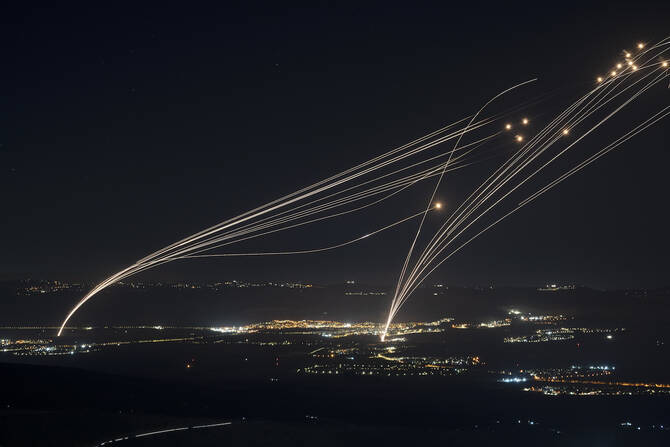
Israel's Iron Dome air defense system intercepts an attack from Lebanon. Europe increased purchases of Israeli military equipment in 2024. (AP)
Short Url
Updated 05 June 2025
Follow

Europe’s tough talk on Gaza belies its thirst for Israeli weapons

  • Israeli defense ministry figures show exports of weapons to Europe surged in 2024
  • European leaders have voiced growing anger over Gaza atrocities and threatened sanctions

LONDON: European leaders may recently have taken a tougher stance against Israel over the devastating Gaza war, but that is not reflected in their desire for Israeli weapons.

Israel’s arms exports increased by 13 percent in 2024 to a record $14.8 billion, an increase largely attributed to growing demand in Europe, according to Israel’s defense ministry figures released Wednesday.

Europe was the largest buyer, making up 54 percent of sales, a sharp increase from a 35 percent share in 2023.

Israel is among the top 10 largest arms exporters in the world and while it is dwarfed by the United States in terms of volume, its defense industry is one of the most technologically advanced.

European countries have increased defense spending to counter the threat from Russia and after pressure from the Trump administration to provide a greater contribution to the NATO alliance.

The figures show European demand has become a key new market for Israel, but there are signs that increasing opposition from countries like the UK, France, Germany and Italy to the Gaza war are affecting sales.

On Tuesday, Spain canceled a $325 million deal for anti-tank missile systems that were to be built by a subsidiary of an Israeli company. A government spokesperson said: “The goal is clear … a total disconnection from Israeli technology.”

Israel’s largest foreign defense deal was signed in September 2024 — to build an Arrow missile defense system for Germany at the cost of $4.3 billion. The system is expected to be delivered this year.

Yet even Germany, traditionally one of Israel’s closest allies, has started to condemn Israel’s Gaza operation, with Chancellor Friedrich Merz saying it “can no longer be justified.”

Israeli defense ministry officials are concerned that European countries may cancel further contracts or impose sanctions on Israeli defense companies, The Times of Israel reported.

Last month, the UK, France and Canada threatened “concrete actions” against Israel if it did not halt its military operation in Gaza and allow humanitarian aid into the territory.

The UK also paused negotiations on a free trade agreement with Israel.

The shift in stance from countries that were previously among Israel’s staunchest supporters came after Israel imposed a two-month blockade on food and humanitarian aid to Gaza’s desperate population and ramped up its military operation in the territory.

The killing of dozens of Palestinians congregating to access food aid from a controversial new distribution system has led to further rounds of strongly worded condemnation from European and global leaders.

The defense ministry export figures show that since the war started in October 2023, Israel has managed to continue growing its arms industry while at the same time carrying out operations in Gaza, Lebanon, Yemen and Syria. 

The numbers show the next biggest market for arms exports was the Asia-Pacific region with 23 per cent of the purchases. Arab countries that normalized relations with Israel under the Abraham Accords made up 12 percent.

Defense Minister Israel Katz said the all-time record in defense exports were the “direct result” of the military campaigns against Hamas, Hezbollah, the Houthis, and Iran.

“The world sees Israeli strength and seeks to be a partner to it,” Katz added.

The ministry said that nearly half the deals were for air defense systems, missiles, and rockets, an increase of 12 percent from 2023.

About 9 percent of the sales were for vehicles, while satellite and space systems, electronic warfare systems, and manned aircraft and avionics, amounted to 8 percent each.

More than half of the deals were worth more than $100 million each.

Europe’s governments have also faced pressure to cut back arms sales to Israel 

Israel’s military exports are dwarfed by the military aid it receives from the US, which was estimated at nearly $18 billion for the 12 months after the October 2023 Hamas-led attack.

During the attack, 1,200 people were killed and 251 hostages seized. Israel’s resulting military operation in Gaza has killed more than 54,000 people, mostly women and children, and sparked a humanitarian disaster.


US military visits contested area in northern Syria to defuse rising tensions

Updated 14 sec ago
Follow

US military visits contested area in northern Syria to defuse rising tensions

  • US has good relations with both sides and has urged calm

DEIR HAFER, Syria: A US military delegation arrived in a contested area of northern Syria on Friday following rising tensions between the Syrian government and a Kurdish-led force that controls much of the northeast.
The US has good relations with both sides and has urged calm. A spokesperson for the US military did not immediately respond to a request for comment.
Earlier in the day, scores of people carrying their belongings arrived in government-held areas in northern Syria ahead of a possible offensive by Syrian troops on territory held by Kurdish-led fighters east of the city of Aleppo.
Many of the civilians who fled were seen using side roads to reach government-held areas because the main highway was blocked by a checkpoint in the town of Deir Hafer normally controlled by the Kurdish-led and US-backed Syrian Democratic Forces, or SDF.
The Syrian army said late Wednesday that civilians would be able to evacuate through the “humanitarian corridor” from 9 a.m. to 5 p.m. Thursday and then extended the evacuation period another day. The announcement appeared to signal plans for an offensive against the SDF in the area.
There have been limited exchanges of fire between the two sides.
Men, women and children arrived in cars and pickup trucks that were packed with bags of clothes, mattresses and other belongings. They were met by local officials who directed them to shelters.
In other areas, people crossed canals on small boats and crossed a heavily damaged pedestrian bridge to reach the side held by government forces.
The SDF closed the main highway but more than 11,000 people were still able to reach government-held areas on other roads, Syrian state TV reported.
A US military convoy arrived in Deir Hafer in the early afternoon accompanied by SDF officials. Associated Press journalists saw SDF leaders and American officials enter one of the government buildings, where they met inside for more than an hour before departing the area.
Inside Deir Hafer, many shops were closed and people stayed home.
“When I saw people leaving I came here,” said Umm Talal, who arrived in the government-held area with her husband and children. She added that the road appeared safe and her husband plans to return to their home.
Abu Mohammed said he came from the town of Maskana after hearing the government had opened a safe corridor, “only to be surprised when we arrived at Deir Hafer and found it closed.”
SDF fighters were preventing people from crossing through Syria’s main east-west highway and forcing them to take a side road, he said.
Kortay Khalil, an SDF official at the Deir Hafer the checkpoint, said they had closed it because the government closed other crossings.
“This crossing was periodically closed even before these events, but people are leaving through other routes, and we are not preventing them,” he said. “If we wanted to prevent them, no one would be able to leave the area.”
The tensions in the Deir Hafer area come after several days of intense clashes last week in Aleppo, previously Syria’s largest city and commercial center, that ended with the evacuation of Kurdish fighters from three neighborhoods north of the city that were then taken over by government forces.
The fighting broke out as negotiations stalled between Damascus and the SDF over an agreement reached in March to integrate their forces and for the central government to take control of institutions including border crossings and oil fields in the northeast.
The US special envoy to Syria, Tom Barrack, posted on X on Friday that Washington remains in close contact with all parties in Syria, “working around the clock to lower the temperature, prevent escalation, and return to integration talks between the Syrian government and the SDF.”
The SDF for years has been the main US partner in Syria in fighting against the Daesh group, but Turkiye considers the SDF a terrorist organization because of its association with Kurdish separatist insurgents in Turkiye.