Pakistan accelerates push to operationalize regulatory framework for digital assets

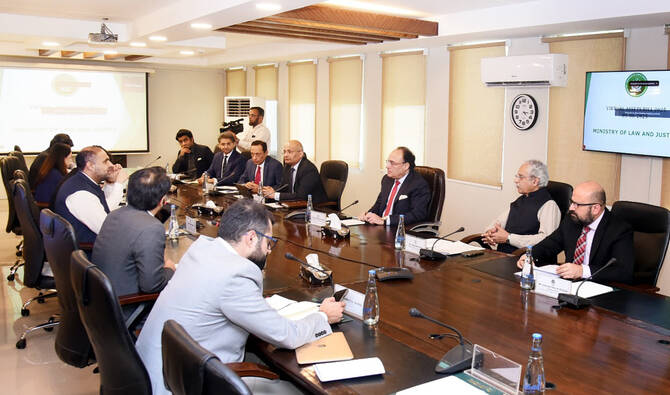
Pakistan Finance Minister Muhammad Aurangzeb speaks during a meeting with the officials from the Pakistan Crypto Council at the Finance Division in Islamabad on June 5, 2025. (Photo courtesy: Finance Ministry)
Short Url
Updated 05 June 2025
Follow

Pakistan accelerates push to operationalize regulatory framework for digital assets

  • Finance Minister Muhammad Aurangzeb chairs key meeting on Pakistan’s digital assets legislation
  • Pakistan state minister for crypto meets US lawmakers to strengthen digital assets cooperation

KARACHI: Pakistan’s Finance Minister Muhammad Aurangzeb on Thursday stressed operationalizing a framework to harness blockchain and crypto technologies’ economic potential and to fast-track their approval process, the Finance Division said amid Islamabad’s push to adopt digital assets.

Islamabad established the Pakistan Crypto Council (PCC) in March to help guide national policy on blockchain, digital currencies and crypto-related investments. This was followed by the government’s announcement of a Strategic Bitcoin Reserve (SBR) at the Bitcoin 2025 Conference in Las Vegas, making Pakistan one of the first Asian countries to integrate Bitcoin into its sovereign asset strategy. The government also plans to establish an autonomous regulatory body to oversee the country’s digital finance and crypto ecosystem.

Aurangzeb chaired a meeting at the Finance Division to review progress on the development of a comprehensive regulatory framework for digital and virtual assets in the country. The law ministry tabled a draft of the proposed legal framework during the meeting, which was developed through close collaboration with members of the PCC, key stakeholders and technical experts.

“During the meeting, the draft was thoroughly reviewed and refined,” the Finance Division said. “It was collectively agreed that in-principle approval process will be fast-tracked to ensure timely enactment and effective implementation.”

The draft legislation outlines a regulatory structure for digital and virtual assets, encompassing governance mechanisms, licensing protocols and investor protection provisions, the statement said. The proposed framework seeks to position Pakistan as a forward-looking participant in the digital asset ecosystem, it added.

‘BEST IDEAS’

Separately, Pakistan’s State Minister for Crypto and Blockchain Bilal Bin Saqib met over a dozen key American officials and lawmakers in Washington to strengthen cooperation in digital assets, blockchain regulation, and financial innovation, his office said.

Saqib met Senator Cynthia Lummis, co-author of the Lummis-Gillibrand Responsible Financial Innovation Act and co-sponsor of the BITCOIN Act, which seeks to designate Bitcoin as a strategic reserve asset.

Saqib’s office said Lummis has been a leading advocate for “thoughtful and comprehensive” crypto legislation in the US.

He also met Senator Ted Cruz, Congressman Troy Downing, who is a member of the House Financial Services Subcommittee on Digital Assets, Congressman Ryan Zinke, Congressman Rick McCormick, and Congressman Derrick Van Orden.

Saqib’s office said these lawmakers were engaged in shaping policy frameworks related to emerging technologies in the US.

“We came to learn, to listen, and to contribute,” Bilal said. “Pakistan is actively studying how global leaders are approaching regulation, innovation, and financial inclusion — not to copy, but to adapt the best ideas for our own unique landscape.”

Pakistan’s broader digital asset strategy includes allocating 2,000 megawatts of surplus power to support Bitcoin mining and AI-driven data zones, aiming to turn untapped energy into economic productivity, job creation and digital infrastructure growth.

As regulatory frameworks continue to evolve globally, Pakistan says it is taking proactive steps to integrate private sector innovation with state policy and international partnerships, positioning itself as a key player in the next phase of the global digital economy.


Over 60 Pakistan–Middle East flights canceled in 24 hours amid regional airspace disruptions

Updated 6 sec ago
Follow

Over 60 Pakistan–Middle East flights canceled in 24 hours amid regional airspace disruptions

  • More than 384 flights scrapped nationwide since US, Israel began pounding Iran on Saturday
  • Pakistan says airspace remains open, advises passengers to check with airlines for updates

ISLAMABAD: More than 60 flights between Pakistan and destinations in the Arab Gulf were canceled at various Pakistani airports in the last 24 hours, officials said on Tuesday, amid widescale regional airspace disruptions due to heightened tensions in Middle East.

Several regional countries shut down their airspace when Tehran launched strikes against US bases in the Gulf following US-Israeli strikes on Iran last Saturday. The conflict has affected key air corridors and forced airlines to cancel or reroute thousands of flights.

Pakistani officials said more than 369 international and domestic flights have been canceled nationwide since the conflict began, with most of them scheduled to fly between Pakistan and destinations in the Middle East.

Around 64 international flights scheduled for Middle East destinations were canceled on Tuesday alone due to the geopolitical developments in the Middle East, while several others were diverted to airports in the South Asian country, according to authorities.

“The bulk of diverted flights [mainly to Karachi] have already departed after refueling or necessary rest,” the Pakistan Civil Aviation Authority (PCAA). “Airlines have efficiently arranged alternative flights for their passengers to original or onward destinations.”

Of the 64 canceled flights, 39 were grounded in Karachi, 10 in Lahore, four in Islamabad, six in Multan, and five in Faisalabad, with destinations including Sharjah, Dubai, Abu Dhabi, Doha, Muscat, Bahrain and Riyadh.

Meanwhile, several foreign aircraft also remained stranded at various airports.

“One Air Arabia aircraft was stationed at Peshawar’s Bacha Khan International Airport,” the PCAA said on Tuesday morning. “Another Air Arabia plane remained at Sialkot International Airport with a planned departure at 6:00 pm.”

Two Air Arabia Airbus A320s and one Qatar Airways Boeing 777 were still on the ground at Karachi’s Jinnah International Airport, according to the authority. In Islamabad, one Gulf Air Airbus A320 was parked at the airport.

The aviation authority said passengers affected by earlier diversions had been accommodated at hotels by their respective airlines and rebooked on subsequent flights.

The Pakistan Airports Authority (PAA) said it was in close coordination with airlines to ensure safe and smooth flight operations.

Khan advised passengers to stay in touch with their respective airlines for flight updates to avoid inconvenience.

“The most accurate and up-to-date information on flight statuses, including any cancelations or changes, is maintained and communicated directly by the individual airlines as they hold real-time passenger and schedule data,” he said.

Separately on Tuesday, the PAA denied media reports of a partial closure of Pakistani airspace between March 3 and March 31 and said the Notice to Airmen (NOTAM) cited in these reports had announced temporary unavailability of specific route segments due to “standard operational reasons.”

“Pakistan’s entire airspace remains fully open, safe, and available for all civil aviation traffic, including commercial flights. Air traffic services continue without interruption, and alternative routing options are routinely used for affected flows,” it said.

“There are no restrictions on commercial operations, arrivals, departures, or overflights across Pakistan. Our air traffic controllers and airport teams are fully operational and managing traffic normally.”