

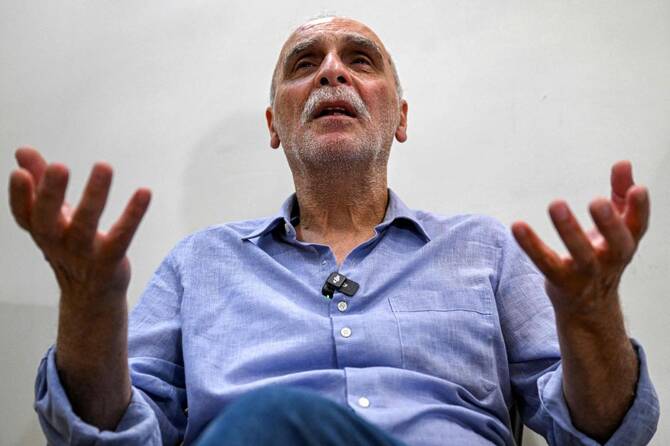

DAMASCUS: Syrian fighter pilot Ragheed Tatari was 26 when he was arrested. Now 70, the country’s longest-serving political prisoner is finally free after Bashar Assad’s fall, seeking justice and accountability.
Tatari, arrested in 1981 and sentenced to life behind bars, was among scores of prisoners who walked free when longtime ruler Assad was overthrown on December 8 in an Islamist-led offensive.
He has made it out alive after 43 years in jail, but tens of thousands of Syrian families are still searching for their loved ones who disappeared long ago in Syria’s hellish prison system.
“I came close to death under torture,” Tatari told AFP in his small Damascus apartment.
Since a military field court gave him a life sentence for “collaborating with foreign countries” — an accusation he denies — Tatari was moved from one prison to another, first under late president Hafez Assad and then his son Bashar who succeeded him in 2000.
Showing old pictures of him in his pilot uniform, Tatari said he was not seeking revenge, but stressed that “everyone must be held accountable for their crimes.”
“We do not want anyone to be imprisoned” without due process, said Tatari.
More than two million Syrians were jailed under the Assad dynasty’s rule, half of them after anti-government protests in 2011 escalated into civil war, according to the Syrian Observatory for Human Rights monitor.
The Britain-based monitor says around 200,000 died in custody.
Diab Serriya, co-founder of the Association of Detainees and Missing Persons of Saydnaya Prison, said that Tatari was “the longest-serving political prisoner in Syria and the Middle East.”
Rights group Amnesty International has called the notorious Saydnaya prison outside Damascus a “human slaughterhouse.”
Tatari had been detained there, but he said his 15 years in the Palmyra prison in the Syrian desert were the most difficult.
The Palmyra facility operated “without any discipline, any laws and any humanity,” Tatari said.
Detainees were “not afraid of torture — we wished for death,” he added.
“Everything that has been said about torture in Palmyra... is an understatement.”
“A guard could kill a prisoner if he was displeased with him,” Tatari said, adding that inmates were forced under torture to say phrases like “Hafez Assad is your god,” although he refused to do so.
In 1980, Palmyra witnessed a massacre of hundreds of mostly Islamist detainees, gunned down by helicopters or executed in their cells after a failed assassination attempt on Hafez Assad.
Tatari said he was completely disconnected from the outside world there, only learning of the fall of the Berlin Wall and the collapse of the Soviet Union through a prisoner who had returned from a hospital visit.
In Sweida prison in the south, where Tatari was transferred after the 2011 revolt began, some inmates had phones that they would keep hidden from the guards.
“The cell phone gets you out of prison, it makes you feel alive,” he said, recalling how he used to conceal his device in a hole dug in his cell.
But after his phone was discovered, he was transferred to a prison in Tartus — his final detention facility before gaining freedom.
Tatari was one of several military officers who were opposed to Syria’s intervention in Lebanon in 1976, and to the violent repression in the early 1980s of the Muslim Brotherhood, Syria’s main opposition force at the time.
“Many of us were against involving the army in political operations,” he said.
After two of his fellow pilots defected and fled to Jordan in 1980, he escaped to Egypt and then on to Jordan.
But he returned when security forces began harassing his family and was arrested on arrival.
His wife was pregnant at the time with their first and only son.
For years, the family assumed Tatari was dead, before receiving a proof of life in 1997 after paying bribes, a common practice under the Assads’ rule.
It was then that Tatari was finally able to meet his son, then aged 16, under the watchful eye of guards during the family’s first authorized prison visit that year.
“I was afraid... I ended the meeting after 15 minutes,” Tatari said.
His wife has since died and their son left Syria, having received threats at the start of the protest movement, which had spiralled into war and eventually led to Assad’s overthrow.
During his time behind bars, Tatari said he “used to escape prison with my thoughts, daydreams and drawing.”
“The regime getting toppled overnight was beyond my dreams... No one expected it to happen so quickly.”


