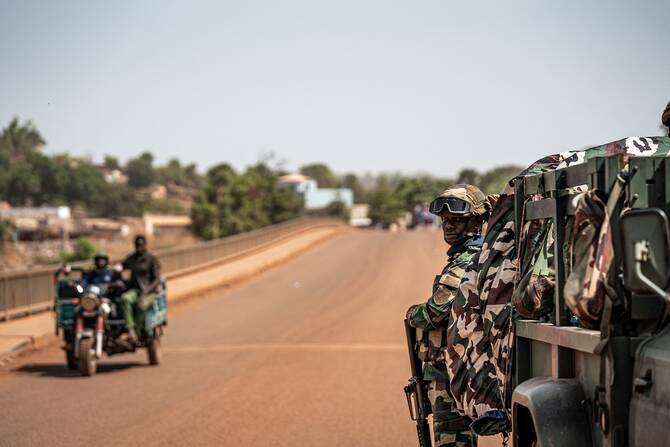

BAMAKO: Islamist militants hit two more military installations on Wednesday and Thursday, Mali’s army said, the latest in a quick spate of attacks that the insurgents say have killed hundreds of soldiers and underscored their gains.
Ground and air reinforcements were being mobilized on Thursday morning to respond to an attack on a security post in Mahou, located in eastern Mali near the border with Burkina Faso, an army statement said.
The attack was claimed by Jama’a Nusrat ul-Islam wa Al-Muslimin (JNIM), an Al Qaeda-linked Islamist militant group active in Mali and Burkina Faso. Information on a death toll was not immediately available.
A military spokesman did not respond to a request for comment.
On Wednesday afternoon, “armed terrorists” struck a military camp in Tessit, near the border with Burkina Faso and Niger, and Mali’s military sent in aerial reinforcement, a separate statement said.
There has been no claim of responsibility for that attack, though security analysts said it could have been perpetrated by fighters from the Islamic State branch active in the Sahel region.
“The camp was attacked, and there was a violent exchange of fire. We learned that the attackers had taken control of the camp, and the population was leaving Tessit,” said an official from the nearby town of Ouattagouna, who spoke on condition of anonymity for safety reasons.
Widespread attacks
Mali’s junta seized power following coups in 2020 and 2021, promising to restore security in a country that has grappled with jihadist militancy for more than a decade. But attacks continue in large swathes of the country.
An army statement on Thursday described “a resurgence of cowardly and barbaric attacks” in recent weeks and said it was responding with a “counter-offensive,” listing operations in six locations on Wednesday alone.
An attack on Sunday on a military base in Boulkessi, in central Mali near the frontier with Burkina Faso, killed dozens of soldiers, security sources told Reuters this week. JNIM said in a statement the death toll was more than 100 soldiers and mercenaries, with more than 20 others captured.
On Monday, JNIM said it targeted a military airport and Russian mercenaries in the northern city of Timbuktu, where residents described taking cover from explosions and gunfire.
Like neighboring Niger and Burkina Faso, Mali has cut military ties with Western nations and turned to Russia for support.
JNIM also claimed to have bombed Malian and Russian soldiers on the outskirts of Bamako on Wednesday, though Reuters could not independently confirm that incident and the army has not commented on it.
Consulting firm Control Risks said in a note on Thursday the claim was “reliable” and that further attacks on and near Bamako were likely as JNIM seeks to undermine Mali’s military rulers.