WASHINGTON: The Trump administration said Wednesday there is no viable path forward for California’s High-Speed Rail project and warned it may rescind $4 billion in government funding in the coming weeks.
The US Transportation Department released a 315-page report from the Federal Railroad Administration that cited missed deadlines, budget shortfalls and questionable ridership projections. One key issue cited is that California has not identified $7 billion in additional funding needed to build an initial 171-mile segment between Merced and Bakersfield, California.
USDOT gave California until mid-July to respond and then the administration could terminate the grants. Trump said last month the US government would not pay for the project.
The FRA report Wednesday said California had “conned the taxpayer out of its $4 billion investment, with no viable plan to deliver even that partial segment on time.”
The California High-Speed Rail System is a planned two-phase 800-mile system with speeds of up to 220 miles per hour that aims to connect San Francisco to Los Angeles/Anaheim and in the second phase extend north to Sacramento and south to San Diego.
The California High-Speed Rail Authority said it strongly disagrees with the administration’s conclusions “which are misguided and do not reflect the substantial progress made to deliver high-speed rail in California.”
It noted California, Governor Gavin Newsom’s budget proposal before the legislature extends at least $1 billion per year in funding for the next 20 years “providing the necessary resources to complete the project’s initial operating segment.”
The authority noted in May there is active civil construction along 119 miles in the state’s Central Valley.
Voters approved $10 billion for the project in 2008 but the costs have risen sharply. The Transportation Department under former President Joe Biden awarded the project about $4 billion.
The entire San Francisco-to-Los Angeles project was initially supposed to be completed by 2020 for $33 billion but has now jumped from $89 billion to $128 billion.
In 2021, Biden restored a $929 million grant for California’s high-speed rail that Trump had revoked in 2019 after the Republican president called the project a “disaster.”


Trump administration may rescind $4 billion for California High-Speed Rail project
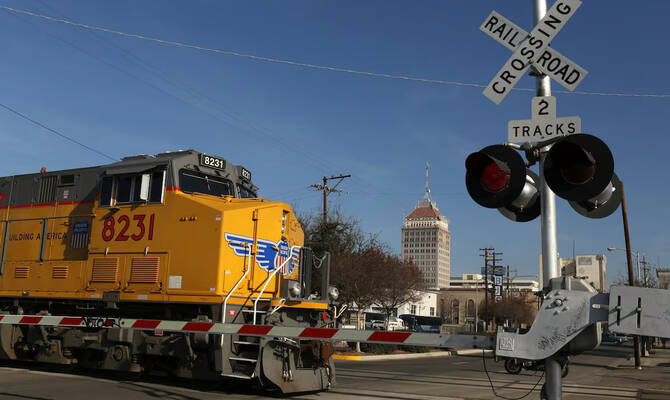
https://arab.news/mm9mn
Trump administration may rescind $4 billion for California High-Speed Rail project

- One key issue cited is that California has not identified $7 billion in additional funding needed to build an initial 171-mile segment between Merced and Bakersfield, California


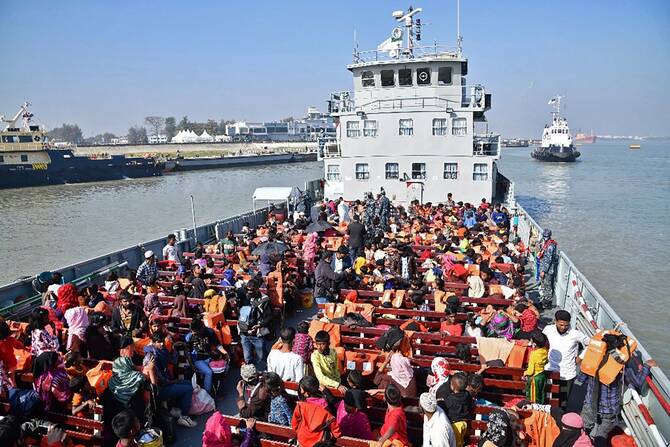
Bangladesh halts controversial relocation of Rohingya refugees to remote island
- Administration of ousted PM Sheikh Hasina spent about $350m on the project
- Rohingya refuse to move to island and 10,000 have fled, top refugee official says
DHAKA: When Bangladesh launched a multi-million-dollar project to relocate Rohingya refugees to a remote island, it promised a better life. Five years on, the controversial plan has stalled, as authorities find it is unsustainable and refugees flee back to overcrowded mainland camps.
The Bhasan Char island emerged naturally from river sediments some 20 years ago. It lies in the Bay of Bengal, over 60 km from Bangladesh’s mainland.
Never inhabited, the 40 sq. km area was developed to accommodate 100,000 Rohingya refugees from the cramped camps of the coastal Cox’s Bazar district.
Relocation to the island started in early December 2020, despite protests from the UN and humanitarian organizations, which warned that it was vulnerable to cyclones and flooding, and that its isolation restricted access to emergency services.
Over 1,600 people were then moved to Bhasan Char by the Bangladesh Navy, followed by another 1,800 the same month. During 25 such transfers, more than 38,000 refugees were resettled on the island by October 2024.
The relocation project was spearheaded by the government of former Prime Minister Sheikh Hasina, who was ousted last year. The new administration has since suspended it indefinitely.
“The Bangladesh government will not conduct any further relocation of the Rohingya to Bhasan Char island. The main reason is that the country’s present government considers the project not viable,” Mizanur Rahman, refugee relief and repatriation commissioner in Cox’s Bazar, told Arab News on Sunday.
The government’s decision was prompted by data from UN agencies, which showed that operations on Bhasan Char involved 30 percent higher costs compared with the mainland camps in Cox’s Bazar, Rahman said.
“On the other hand, the Rohingya are not voluntarily coming forward for relocation to the island. Many of those previously relocated have fled ... Around 29,000 are currently living on the island, while about 10,000 have returned to Cox’s Bazar on their own.”
A mostly Muslim ethnic minority, the Rohingya have lived for centuries in Myanmar’s western Rakhine state but were stripped of their citizenship in the 1980s and have faced systemic persecution ever since.
In 2017 alone, some 750,000 of them crossed to neighboring Bangladesh, fleeing a deadly crackdown by Myanmar’s military. Today, about 1.3 million of them shelter in 33 camps in the coastal Cox’s Bazar district, making it the world’s largest refugee settlement.
Bhasan Char, where the Bangladeshi government spent an estimated $350 million to construct concrete residential buildings, cyclone shelters, roads, freshwater systems, and other infrastructure, offered better living conditions than the squalid camps.
But there was no regular transport service to the island, its inhabitants were not allowed to travel freely, and livelihood opportunities were few and dependent on aid coming from the mainland.
Rahman said: “Considering all aspects, we can say that Rohingya relocation to Bhasan Char is currently halted. Following the fall of Sheikh Hasina’s regime, only one batch of Rohingya was relocated to the island.
“The relocation was conducted with government funding, but the government is no longer allowing any funds for this purpose.”
“The Bangladeshi government has spent around $350 million on it from its own funds ... It seems the project has not turned out to be successful.”


