



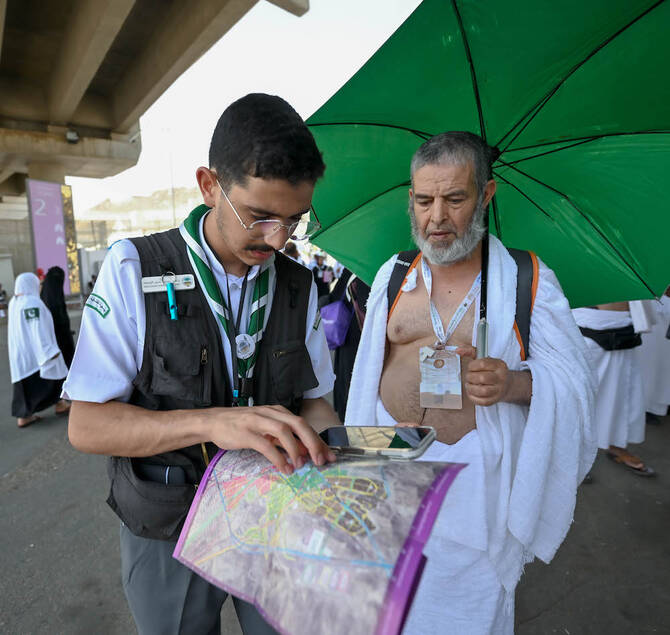
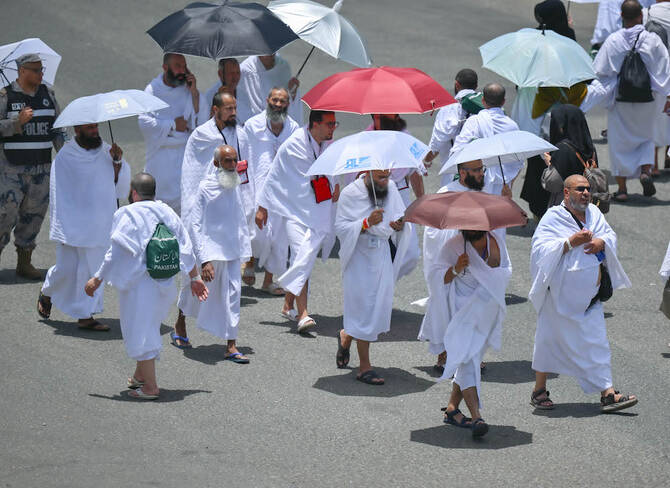
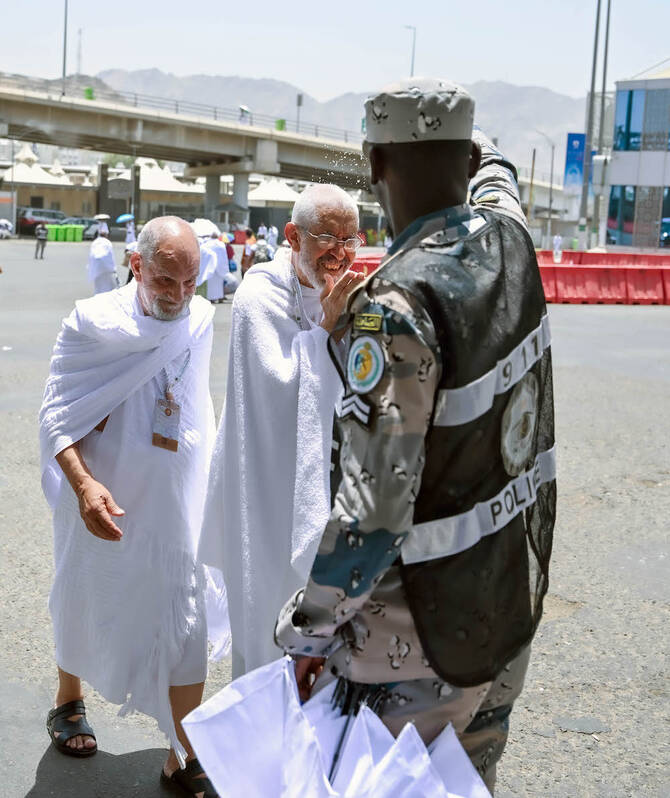



MINA: With the number of worshippers approaching two million, pilgrims on Wednesday arrived in Mina for the Day of Tarwiyah, preparing for the most important day of Hajj — the Day of Arafat — on June 5.
These pilgrims are following the steps of Prophet Mohammed by spending Tarwiyah Day in Mina on Wednesday this year, making their final preparations for the Standing at Arafat, the pinnacle of the annual pilgrimage, tomorrow.
In compliance with directives from King Salman and Crown Prince Mohammed bin Salman, various service sectors mobilized their capabilities to help the pilgrims perform Hajj rituals in tranquility and peace.
With more than 1.5 million pilgrims confirmed to have arrived from outside the Kingdom, the pilgrims’ movements into Mina proceeded smoothly in accordance with a comprehensive traffic plan. The plan covered all main routes and was supported by aerial security surveillance to ensure the orderly progression of this critical phase of the pilgrimage.
In weather conditions of about 41°C, the ministry urged all pilgrims to familiarize themselves with its hospitals and medical centers should they require health assistance, wherever they are in the holy sites, emphasizing that everything is available to ensure their health and safety.
On the first day in Mina, known as the Day of Tarwiyah, pilgrims typically spend the night there in preparation for their journey to Arafat the next day. With their prayers shortened, they devote their time to supplicating Allah and chanting the Talbiyah — a proclamation of their intention to perform the pilgrimage solely for the sake of the Almighty. This is traditionally recited aloud and in groups upon entering the state of ihram.
The relevant security and health authorities, alongside other government and private organisations, had earlier intensified their plans and preparations to ensure the smooth performance of Hajj rituals, all under the direct supervision and close monitoring of the Saudi leadership.
Khalid Al-Tala, the spokesperson for the Saudi Ministry of Health, provided key updates during a press conference on June 3, highlighting several pioneering health initiatives launched for the current Hajj season.
Among the most notable is the use of drone technology to accelerate the delivery of medical aid to remote areas — an innovative approach the ministry says is the first of its kind globally.
Al-Tala said that the current health status of pilgrims was reassuring, with no recorded cases of epidemics or major health concerns reported to date.
As of the seventh day of Dhu Al-Hijjah, the ministry has delivered more than 98,000 health services, including emergency care, surgical procedures, and intensive treatments.
He further announced the establishment of three additional field hospitals, providing a combined capacity of 1,200 beds. The ministry has also set up 71 emergency response points, deployed 900 ambulances, and added 11 medical evacuation aircraft to support healthcare operations during the pilgrimage.
Advanced medical services have also been activated, including the use of extracorporeal membrane oxygenation technology and virtual health consultations. The ministry’s 937 call center operates round the clock in numerous languages to assist pilgrims.
Since the beginning of the Hajj season, Al-Tala said, more than 1.4 million pilgrims have benefited from preventive health services at entry points, provided in coordination with various medical mission clinics.
The spokesman said that their medical teams have successfully performed 16 open-heart surgeries, 148 cardiac catheterizations, and handled 62 cases of heat exhaustion.
He added that, with the participation of more than 50,000 medical and technical personnel, bed capacity has been increased by 60 percent compared with last year.
Speaking to Arab News, Fatima Al-Sayed, an Egyptian pilgrim, said that the organization and services provided by the Saudi authorities in Mina are truly commendable.
“From the moment we arrived, we have felt a strong sense of care and preparedness. The tents are well equipped, clean and air-conditioned, ensuring our comfort in the heat,” she said.
Al-Sayed added that medical services are readily available, security personnel are visible and helpful, and food and water are distributed efficiently.
“The crowd management and transportation arrangements are smooth, especially given the large number of pilgrims. We are deeply grateful for the efforts made to ensure our safety and to help us perform our rituals with ease and peace of mind.” she said.
Situated between Makkah and Muzdalifah, Mina lies about seven kilometers northeast of the Grand Mosque. It is part of the Haram, or sacred boundary, and is encircled by mountains to the north and south. It is uninhabited throughout the year, except during the Hajj season, when it becomes a focal point of the pilgrimage.
On the Makkah side, Mina is bordered by the Jamarat area, while on the opposite side it adjoins the Valley of Muhassir.
Muhassir gets its name from a significant historical incident — it is believed to be where the elephant of Abraha the Abyssinian halted during his failed attempt to destroy the Kaaba around the year 570 — an event known in Islamic tradition as the Year of the Elephant, which coincides with the birth year of the Prophet Muhammad.


