Pakistan reports second death of 2025 from deadly brain-eating amoeba

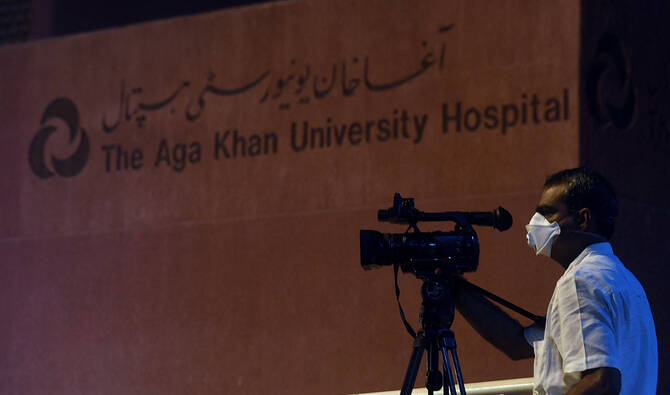
A cameraman wears a protective facemasks as he films outside the Aga Khan University Hospital in Karachi. (AFP/File)
Short Url
Updated 04 June 2025
Follow

Pakistan reports second death of 2025 from deadly brain-eating amoeba

  • Naegleria fowleri, with a 98 percent fatality rate, spreads when contaminated water enters through the nose
  • Victim, a Karachi resident, used water at home and nearby mosque for ablution, says Sindh government

KARACHI: A 23-year-old man died in Pakistan’s southern port city of Karachi this week after contracting Naegleria fowleri, the Sindh Health Department said on Wednesday, marking the second death of the year from the deadly brain-eating amoeba.

Naegleria fowleri, commonly known as the brain-eating amoeba, has a fatality rate of over 98 percent. It is transmitted when contaminated water enters the body through the nose and cannot be spread from person to person.

Pakistan has witnessed a rise in Naegleria fowleri cases in recent years, with more than 100 reported deaths since the first confirmed infection in 2008. Five fatalities were recorded in 2024 alone.

In the latest case the deceased, a resident of Karachi’s Orangi Town area, was hospitalized on May 30 after suffering from symptoms on May 28. He died on June 3 after the presence of Naegleria fowleri was confirmed in the patient on June 1. 

“Upon investigation, it was noted that the patient had not participated in any water-related activities,” the Sindh Health Department said. “His only exposure was regular use of water at home and use of water at a nearby local mosque to perform ablution.”

Symptoms of Naegleria fowleri infection include severe headache, altered sense of taste, high fever, sensitivity to light, nausea and vomiting. Death typically occurs within five to seven days of infection.

The health department confirmed this was the second death in Pakistan from Naegleria fowleri in 2025. The first death was reported in March when a 36-year-old woman died from the same disease. She was also a resident of Karachi. 

A 2021 study by the Sindh Health Department found that 95 percent of water samples in Karachi, Sindh’s provincial capital, were unfit for human consumption.

Experts say the contamination leads to the spreading of the brain-eating amoeba among the city’s residents.


Pakistan, ADB sign $730 loan agreements to boost SOE reforms, energy infrastructure

Updated 25 December 2025
Follow

Pakistan, ADB sign $730 loan agreements to boost SOE reforms, energy infrastructure

  • Both sign $330 million Power Transmission Strengthening Project and $400 million SOE Transformation Program loan agreements
  • Economic Affairs Division official says Transmission Project will secure Pakistan’s energy future by strengthening national grid’s backbone

KARACHI: Pakistan and the Asian Development Bank (ADB) on Thursday signed two loan agreements totaling $730 million to boost reforms in state-owned enterprises (SOEs) and energy infrastructure in the country, the bank said.

The first of the two agreements pertains to the SOE Transformation Program worth $400 million while the second loan, worth $330 million, is for a Power Transmission Strengthening Project, the lender said. 

The agreements were signed by ADB Country Director for Pakistan Emma Fan and Pakistan’s Secretary of Economic Affairs Division Humair Karim. 

“The agreements demonstrate ADB’s enduring commitment to supporting sustainable and inclusive economic growth in Pakistan,” the ADB said. 

Pakistan’s SOEs have incurred losses worth billions of dollars over the years due to financial mismanagement and corruption. These entities, including the country’s national airline Pakistan International Airlines, which was sold to a private group this week, have relied on subsequent government bailouts over the years to operate.

The ADB approved the $400 million loan for SOE reforms on Dec. 12. It said the program seeks to improve governance and optimize the performance of Pakistan’s commercial SOEs. 

Karim highlighted that the Power Transmission Strengthening Project will enable reliable evacuation of 2,300 MW from Pakistan’s upcoming hydropower projects, relieve overloading of existing transmission lines and enhance resilience under contingency conditions, the Press Information Department (PID) said. 

“The Secretary emphasized that both initiatives are transformative in nature as the Transmission Project will secure Pakistan’s energy future by strengthening the backbone of the national grid whereas the SOE Program will enhance transparency, efficiency and sustainability of state-owned enterprises nationwide,” the PID said. 

The ADB has supported reforms by Pakistan to strengthen its public finance and social protection systems. It has also undertaken programs in the country to help with post-flood reconstruction, improve food security and social and human capital. 

To date, ADB says it has committed 764 public sector loans, grants and technical assistance totaling $43.4 billion to Pakistan.