Three Saudi twin pairs unite to serve pilgrims at Hajj

1 / 5
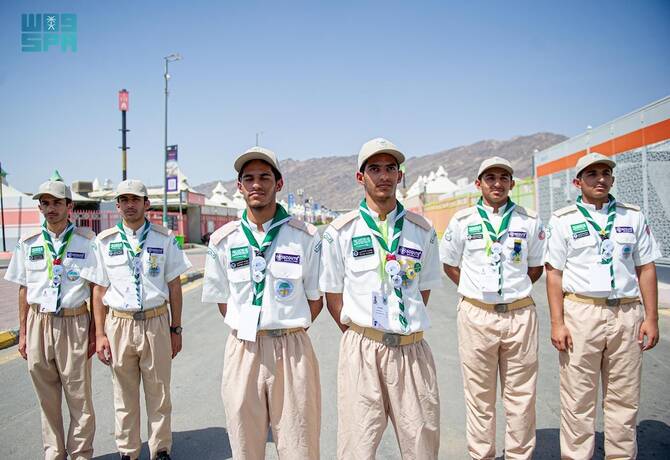
The six young scouts are of the Civil Development Association in Riyadh’s Al-Rabie neighborhood are united in their dedication to serving pilgrims. (SPA)
2 / 5
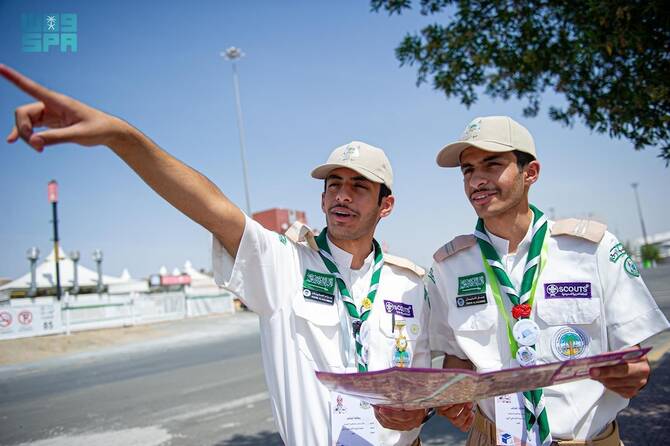
The six young scouts are of the Civil Development Association in Riyadh’s Al-Rabie neighborhood are united in their dedication to serving pilgrims. (SPA)
3 / 5
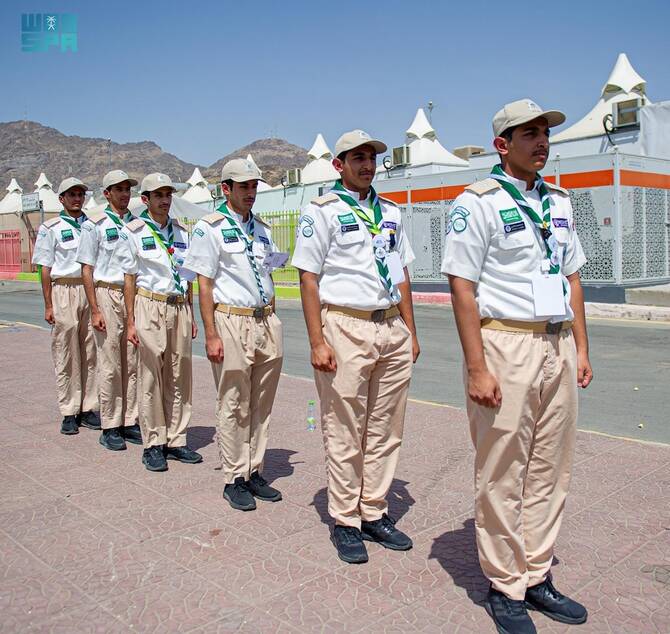
The six young scouts are of the Civil Development Association in Riyadh’s Al-Rabie neighborhood are united in their dedication to serving pilgrims. (SPA)
4 / 5
The six young scouts are of the Civil Development Association in Riyadh’s Al-Rabie neighborhood are united in their dedication to serving pilgrims. (SPA)
5 / 5
The six young scouts are of the Civil Development Association in Riyadh’s Al-Rabie neighborhood are united in their dedication to serving pilgrims. (SPA)
Short Url
Updated 04 June 2025
Follow

Three Saudi twin pairs unite to serve pilgrims at Hajj

  • These six young men are united in their dedication to serving pilgrims, according to the Saudi Press Agency

MAKKAH: In a rare and coincidental alignment, this year’s public service camps organized by the Saudi Arabian Scouts Association for Hajj have brought together three sets of Saudi twins.

Hailing from the scout group of the Civil Development Association in Riyadh’s Al-Rabie neighborhood, these six young men are united in their dedication to serving pilgrims, according to the Saudi Press Agency.

The twins — Hussam and Issam Saeed Al-Qarni, Azzam and Ammar Suleiman Al-Sulaiman, and Walid and Muhannad Abdul-Hakim Al-Otaibi — are bound not only by family ties and similar appearances, but also by a shared passion for scouting and commitment to volunteer work and pilgrim service.

Hussam and Issam said: “Scouting was not just a passing activity, but a life path chosen with conviction from a young age.”

They emphasized they were raised to love their country, and that scouting has allowed them to express this through guiding pilgrims, providing first aid, and offering various forms of assistance.

They also stressed that “every moment during the pilgrimages is a new lesson in patience, compassion, and discipline.”

Azzam and Ammar said that the experience has deepened their bond, adding with pride: “We thought we knew each other well, but in the atmosphere of the pilgrimages and under the pressure of tasks, we discovered new dimensions of cooperation and interdependence.

“We work as a team, complementing each other, and everything we do is for the comfort of the pilgrim, whom we consider our guest. It is our duty to provide them with the utmost comfort.”

Walid and Muhannad Abdul-Hakim Al-Otaibi expressed their profound pride in participating, describing it as life-changing. “Today, we are not only serving, but also learning how to stand calmly in the midst of a crowd, how to take initiative without expecting thanks, and how scouting can be a comprehensive educational field,” they said.

“Being here together, two brothers and twins, experiencing the same thing and sharing every detail, is something we will carry with us for the rest of our lives.”


Amr Moussa: Saudi Arabia and Egypt must lead Arabs for true peace

Updated 5 sec ago
Follow

Amr Moussa: Saudi Arabia and Egypt must lead Arabs for true peace

RIYADH: Amr Moussa, former Arab League secretary-general, has called for the establishment of an effective Arab leadership led by Saudi Arabia and Egypt, in partnership with Jordan, to unify regional positions and negotiate on the Palestinian cause and broader regional future.

During a panel discussion at the King Fahd National Library in Riyadh on Thursday evening, Moussa stressed this was “both vital and achievable” and emphasized the primary goal should be the establishment of a fully sovereign and effective Palestinian state: “True peace is only that which protects all parties … we need genuine peace, not a facade or a superficial justification,” he said.

Such a state must be “responsible for security and peace in the Middle East alongside its neighbors,” rather than a fragile entity, he added.

Moussa underlined that achieving this objective first requires the Arab world to demonstrate the capacity for unified and decisive action. “Are we as Arabs truly capable of being ‘we,’ or has that moment passed?” he asked.

He said the firm positions taken by Saudi Arabia and Egypt in rejecting forced displacement and calling for an end to aggression “underscore that it is possible to assert ‘no’ when the Arab stance is justified.”

Warning of the severe consequences of maintaining the status quo, he added: “If things continue this way … there will inevitably be something akin to October 7 again, because injustice breeds resistance.”

He placed full responsibility on Israel, saying it “bears complete responsibility for the chaos and destruction.”

On a practical mechanism to implement a unified Arab stance, Moussa proposed that Saudi Arabia and Egypt take the lead in establishing a diplomatic baseline, representing their “yeses and noes” in consultation with other Arab states. This framework, he said, would counter any attempts to impose unjust solutions under labels such as the new international “Peace Council,” which might “demand Palestinian concessions on Palestinian land.”

On whether peace was possible with the current Israeli government, which he described as “not committed to peace,” Moussa said: “There are other Israelis who speak the language of peace.” He urged efforts to “identify and support them to create a political alternative within Israel.”

He said the first thing Palestinians should do is hold comprehensive Palestinian elections as soon as possible, utilizing technology to ensure all Palestinians took part, including those in Jerusalem, to select a new leadership “with strong negotiating legitimacy.”

Moussa also warned that the challenges “are not limited to Palestine,” saying the Arab world faces interconnected crises in Syria, Yemen, Sudan, Lebanon and Libya, alongside shifts in the international order and the race for space.

“The issue of our future (requires) reviving a new Arab world,” capable of actively shaping that future rather than being marginalized, the former secretary-general concluded.