

Five things to know about the St Catherine monastery in Egypt's Sinai

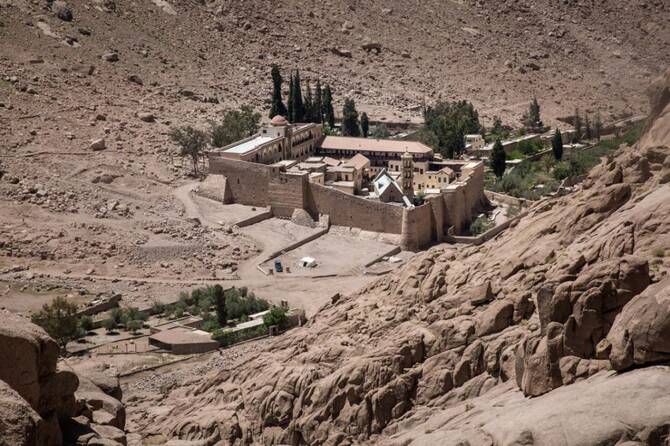
A picture taken on April 16, 2017 shows a general view of the Monastery of St. Catherine in Egypt's south Sinai. (AFP)
Short Url
Updated 04 June 2025
Follow

Five things to know about the St Catherine monastery in Egypt's Sinai

  • The monastery was founded by Byzantine Emperor Justinian in the sixth century at the biblical site of the burning bush at the foot of Mount Sinai
  • According to UNESCO, "the entire area is of immense spiritual significance" to Christianity, Islam and Judaism

CAIRO: Nestled in the Sinai mountains, the ancient St Catherine's Monastery has been the centre of recent tensions after an Egyptian court ruled last week that it sat on state-owned land.

Dating back to the sixth century BC, the UNESCO World Heritage Site is the world's oldest continuously inhabited monastery, attracting hundreds of pilgrims and tourists every year.

Following warnings from the authorities and Orthodox Church in Greece that the ruling threatens the monastery's status, a government delegation is travelling from Athens to Cairo on Wednesday to discuss the situation.

The monastery was founded by Byzantine Emperor Justinian in the sixth century at the biblical site of the burning bush at the foot of Mount Sinai, where Moses was believed to have received the 10 commandments, according to the world's three major monotheistic religions.

It was named for Saint Catherine of Alexandria, whose remains are housed in the church, along with rare iconography and manuscripts.

It is headed by the Archbishop of Mount Sinai and Raithu, under the ecclesiastical jurisdiction of the Greek Orthodox Patriarchate of Jerusalem.

According to UNESCO, "the entire area is of immense spiritual significance" to Christianity, Islam and Judaism.

The organisation says the monastery is "the property of the Greek Orthodox Church and belongs to the Archdiocese of Sinai".

Last Wednesday, an Egyptian appeals court ruled that the monastery "is entitled to use" the land and the archaeological religious sites dotting the area, all of which "the state owns as public property".

The ruling, only a brief of which has been published by Egyptian media, has drawn criticism from the Orthodox patriarchates in Athens, Jerusalem and Istanbul.

Archbishop Ieronymos, head of the Greek Orthodox church in Athens, warned the monastery's property could now be "seized and confiscated".

Egypt has defended the court ruling, saying it "consolidates" the site's sacred status.

President Abdel Fattah al-Sisi said Egypt was "fully committed to preserving the unique and sacred religious status of Saint Catherine's monastery", in a phone call with Greek Prime Minister Kyriakos Mitsotakis.

Mitsotakis meanwhile emphasised the importance of "preserving the pilgrimage and Greek Orthodox character of the monastery".

The delegation from Athens is expected to lay out its position on Wednesday.

According to Greece's state news agency, that position "is supported by a UNESCO document, which proves that Egypt had acknowledged in writing since 2002 that the ownership of the land and buildings belongs to the Greek Orthodox Church and the Archdiocese of Sinai".

Construction began in March 2021 in the Saint Catherine area, which includes the eponymous town and a nature reserve, for a government megaproject known as the 'Great Transfiguration' of Saint Catherine.

The project aims to bring upwards of a million tourists a year to the serene mountain village.

Its many construction projects include an events hall, hundreds of hotel rooms and a new residential area housing hundreds of units.

Observers say the project has harmed the reserve's ecosystem and threatened both the monastery and the local community.

According to a report by World Heritage Watch, the project has "destroyed the integrity of this historical and biblical landscape".

UNESCO in 2023 requested that Egypt "halt the implementation of any further development projects", conduct an impact evaluation and develop a conservation plan.

The government, which is campaigning for former tourism and antiquities minister Khaled al-Enany to head UNESCO from October, said in January that 90 percent of the project was complete.

The peaks and valleys around Saint Catherine attract large groups of hikers, peaking at 2,000 visitors to Mount Sinai in a single day last December, local authorities reported.

The area, 1.5 kilometres (one mile) above sea level, is particularly popular with both Egyptians and foreign tourists seeking a reprieve from overcrowded Red Sea resorts elsewhere in Sinai.

The area is home to the Jabaliya tribe, whose name derives from the Arabic word for "mountain".

Said to be the descendants of the Roman soldiers who came to guard the monastery in its early days, they maintain a close connection to Saint Catherine, with many working as tour guides today.

For decades, they have been calling for better infrastructure, including reliable water supply, emergency services and telecommunications coverage to improve their work and daily life.

According to World Heritage Watch, they are currently outnumbered by the thousands of labourers building the megaproject.



Filipinos master disaster readiness, one roll of the dice at a time

Updated 29 December 2025
Follow

Filipinos master disaster readiness, one roll of the dice at a time

  • In a library in the Philippines, a dice rattles on the surface of a board before coming to a stop, putting one of its players straight into the path of a powerful typhoon

MANILA: In a library in the Philippines, a dice rattles on the surface of a board before coming to a stop, putting one of its players straight into the path of a powerful typhoon.
The teenagers huddled around the table leap into action, shouting instructions and acting out the correct strategies for just one of the potential catastrophes laid out in the board game called Master of Disaster.
With fewer than half of Filipinos estimated to have undertaken disaster drills or to own a first-aid kit, the game aims to boost lagging preparedness in a country ranked the most disaster-prone on earth for four years running.
“(It) features disasters we’ve been experiencing in real life for the past few months and years,” 17-year-old Ansherina Agasen told AFP, noting that flooding routinely upends life in her hometown of Valenzuela, north of Manila.
Sitting in the arc of intense seismic activity called the “Pacific Ring of Fire,” the Philippines endures daily earthquakes and is hit by an average of 20 typhoons each year.
In November, back-to-back typhoons drove flooding that killed nearly 300 people in the archipelago nation, while a 6.9-magnitude quake in late September toppled buildings and killed 79 people around the city of Cebu.
“We realized that a lot of loss of lives and destruction of property could have been avoided if people knew about basic concepts related to disaster preparedness,” Francis Macatulad, one of the game’s developers, told AFP of its inception.
The Asia Society for Social Improvement and Sustainable Transformation (ASSIST), where Macatulad heads business development, first dreamt up the game in 2013, after Super Typhoon Haiyan ravaged the central Philippines and left thousands dead.
Launched six years later, Master of Disaster has been updated this year to address more events exacerbated by human-driven climate change, such as landslides, drought and heatwaves.
More than 10,000 editions of the game, aimed at players as young as nine years old, have been distributed across the archipelago nation.
“The youth are very essential in creating this disaster resiliency mindset,” Macatulad said.
‘Keeps on getting worse’ 
While the Philippines has introduced disaster readiness training into its K-12 curriculum, Master of Disaster is providing a jolt of innovation, Bianca Canlas of the Department of Science and Technology (DOST) told AFP.
“It’s important that it’s tactile, something that can be touched and can be seen by the eyes of the youth so they can have engagement with each other,” she said of the game.
Players roll a dice to move their pawns across the board, with each landing spot corresponding to cards containing questions or instructions to act out disaster-specific responses.
When a player is unable to fulfil a task, another can “save” them and receive a “hero token” — tallied at the end to determine a winner.
At least 27,500 deaths and economic losses of $35 billion have been attributed to extreme weather events in the past two decades, according to the 2026 Climate Risk Index.
“It just keeps on getting worse,” Canlas said, noting the lives lost in recent months.
The government is now determining if it will throw its weight behind the distribution of the game, with the sessions in Valenzuela City serving as a pilot to assess whether players find it engaging and informative.
While conceding the evidence was so far anecdotal, ASSIST’s Macatulad said he believed the game was bringing a “significant” improvement in its players’ disaster preparedness knowledge.
“Disaster is not picky. It affects from north to south. So we would like to expand this further,” Macatulad said, adding that poor communities “most vulnerable to the effects of climate change” were the priority.
“Disasters can happen to anyone,” Agasen, the teen, told AFP as the game broke up.
“As a young person, I can share the knowledge I’ve gained... with my classmates at school, with people at home, and those I’ll meet in the future.”