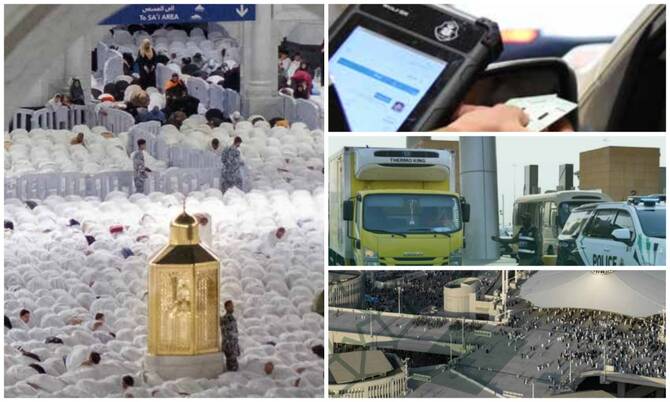
Saudi Interior Ministry issues Hajj safety and security guide

Saudi Arabia’s Ministry of Interior on Tuesday published a comprehensive guide designed to ensure the safety, security and smooth movement of pilgrims during Hajj. (MOI)
Short Url
Updated 03 June 2025
Follow

Saudi Interior Ministry issues Hajj safety and security guide

  • It provides detailed instructions for pilgrims, including directions to the Grand Mosque in Makkah and maps of routes to key ritual sites
  • It also highlights peak times at the mosque, guidance on the use of vehicles and explains crowd-management protocols

RIYADH: Saudi Arabia’s Ministry of Interior on Tuesday published a comprehensive guide designed to ensure the safety, security and smooth movement of pilgrims during Hajj.

It provides detailed instructions for the pilgrimage experience, including directions to the Grand Mosque in Makkah and maps of pedestrian routes and walkways leading to key ritual sites such as the Tawaf and Sa’i zones.

To help manage the crowds and ensure orderly movement of pilgrims, the guide highlights peak times within the Grand Mosque and its courtyards, as well as guidance on the use of vehicles during Hajj season.

It also explains crowd-management protocols, and stresses the important need for all pilgrims to adhere to designated grouping times when performing rituals during the various stages of the pilgrimage, including Tawaf, Sa’i and the stoning of the Jamarat.

The ministry said the guide is designed to help pilgrims perform their rituals safely, easily and with peace of mind, the Saudi Press Agency reported. It reiterated that official regulations require all pilgrims performing Hajj to have a permit, and warned of penalties for any person who breaks these rules.

Citizens and residents were urged to comply with all Hajj-related regulations and report any violations by calling 911 in the regions of Makkah, Madinah, Riyadh and the Eastern Province, or 999 in other parts of the Kingdom.

Click here to view the Hajj guide online. Hajj begins on Wednesday, June 4, and concludes on Monday, June 9.


Saudi Arabia’s Sharaan and Wadi Nakhlah nature reserves win Dark Sky recognition

Updated 25 December 2025
Follow

Saudi Arabia’s Sharaan and Wadi Nakhlah nature reserves win Dark Sky recognition

  • The two reserves in AlUla join more than 250 locations worldwide that are protected from light pollution
  • AlUla Manara and AlGharameel Nature Reserve, also both in AlUla, received Dark Sky Park designations last year

ALULA: Two more nature reserves in Saudi Arabia’s AlUla have won recognition as Dark Sky Places, joining more than 250 locations worldwide that are protected from light pollution.

The official accreditation of Sharaan National Park and Wadi Nakhlah reserves from the DarkSky International builds on AlUla’s 2024 achievement, when AlUla Manara and AlGharameel Nature Reserve became the first sites in the Kingdom and the Gulf region to receive Dark Sky Park designations.

The latest recognition further strengthens AlUla’s position as a leading global destination for night sky protection and astronomical tourism, said the Royal Commission for AlUla (RCU) in a statement carried by the Saudi Press Agency (SPA).

Dark Sky International also announced the recognition in an earlier report, noting that the Sharaan and Wadi Nakhlah’s combined area of 6,146 square kilometers reflects the “expanded scope of environmental protection efforts aimed at preserving AlUla’s pristine night skies and reducing light pollution across a vast geographical area.”

DarkSky International works to reduce light pollution in both urban and rural areas and to raise global awareness of the importance of protecting the night sky.

AlUla’s natural isolation from urban light sources, combined with ideal atmospheric conditions, makes it a world-class destination for stargazing, astronomy education, and immersive dark-sky experiences.  (SPA)


AlUla’s protected areas are located in the heart of northwest Arabia, near the ancient oasis city of AlUla in Madinah Province.

“Towering sandstone cliffs, labyrinthine canyons, tranquil basins, and volcanic formations create a dramatic setting where geological diversity, cultural heritage, and thriving biodiversity converge beneath exceptionally dark, open skies,” Dark Sky said.

Scientists have noted that AlUla’s natural isolation from urban light sources, combined with ideal atmospheric conditions, makes it a world-class destination for stargazing, astronomy education, and immersive dark-sky experiences. 

With the phased development of its reserves, AlUla is now ranked 3rd globally in the Dark Sky Park category, solidifying its status as one of the world’s premier destinations for astronomical discovery.

The RCU reaffirmed its commitment to protecting the natural environment, preserving the night sky, and promoting sustainable tourism, further positioning AlUla as a leading global destination for astronomy, scientific research, and advanced environmental experiences, in line with AlUla Vision and the Kingdom’s Vision 2030.