

Mongolia PM resigns after anti-corruption protests

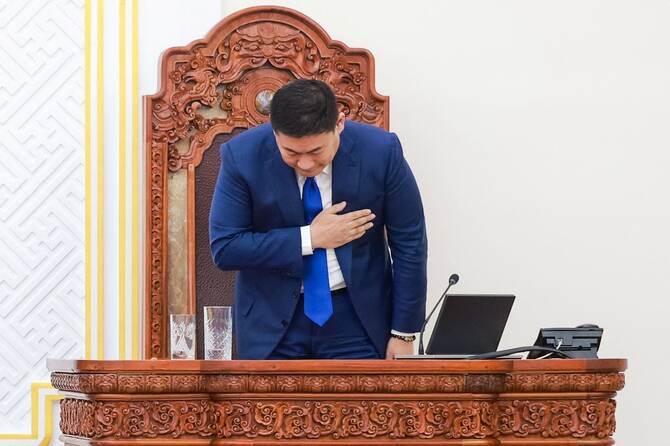
Mongolia's Prime Minister Luvsannamsrain Oyun-Erdene takes a bow after losing his position in a vote in Ulaanbaatar, Mongolia. (AFP)
Short Url
Updated 03 June 2025
Follow

Mongolia PM resigns after anti-corruption protests

  • Luvsannamsrain Oyun-Erdene resigned on Tuesday saying: “It was an honor to serve my country and people in times of difficulties, including pandemics, wars, and tariffs"

ULAANBAATAR: Mongolian Prime Minister Luvsannamsrain Oyun-Erdene resigned on Tuesday following weeks of anti-corruption protests in the country’s capital.
The landlocked democracy in northern Asia has battled deep-seated corruption for decades, with many arguing that wealthy elites are hoarding the profits of a years-long coal mining boom at the expense of the general population.
Frustrations have flared since last month as public suspicions over the supposedly lavish lifestyles of the prime minister’s family have fueled persistent demonstrations in the capital Ulaanbaatar.
Oyun-Erdene announced his resignation on Tuesday after losing a confidence vote among lawmakers, according to a parliamentary statement.
“It was an honor to serve my country and people in times of difficulties, including pandemics, wars, and tariffs,” he said after the result of the secret ballot was announced to parliament.
He will remain as caretaker prime minister until his successor is appointed within 30 days.
Dozens of young people gathered on the square outside the parliament building on Tuesday, holding white placards reading “Resignation is easy” — a popular slogan at recent protests.
Several voiced pride that they had taken a stand against what they described as deeply embedded corruption and social injustice.
“The youth protest has achieved great results. I’m so proud of the future of Mongolia,” participant Unur Sukhbaatar, a 37-year-old political economy researcher, told AFP.
“The public wants more stable governance with ethical politicians... protesting and unifying our voice for systemic change (shows) that Mongolian democracy is alive,” he told AFP.
Some counter-protesters — overwhelmingly older than their pro-opposition counterparts — have also turned out to support Oyun-Erdene in recent weeks.

Julian Dierkes, a Mongolia expert at Germany’s University of Mannheim, said he “(didn’t) expect any successor to adopt substantially different policies” from Oyun-Erdene, including on corruption.
His ouster “may mean the resurgence of factional politics in his party” after years of comparative stability at the top of Mongolian politics, Dierkes told AFP.
Oyun-Erdene has denied the corruption allegations, and in an address to parliament before the vote, blamed “major, visible and hidden interests” for waging an “organized campaign” to bring down the government.
He had also warned of political instability and economic chaos if forced out of power.
But it was not enough as only 44 lawmakers voted to retain confidence in him, with 38 against.
That did not reach the 64-vote threshold required from the 126-seat parliament, prompting Oyun-Erdene to stand down.

The move pushed the country’s fractious political scene into further uncertainty.
Mongolia had been ruled by a three-way coalition government since elections last year resulted in a significantly reduced majority for Oyun-Erdene’s Mongolian People’s Party (MPP).
But the MPP evicted the second-largest member, the Democratic Party (DP), from the coalition last month after some younger DP lawmakers backed calls for Oyun-Erdene’s resignation.
DP lawmakers walked out of the parliamentary chamber during the confidence ballot.
Munkhnaran Bayarlkhagva, a political analyst and former adviser on Mongolia’s National Security Council, said protesters had effectively helped force a vote on “the legitimacy of the (country’s) political system.”
“The Mongolian Generation Z showed they are willing and able to be a politically engaged, mature and active electorate,” he told AFP.
“The Mongolian political establishment had no choice but to comply to retain popular support.”

Sandwiched between regional giants China and Russia, Mongolia was a communist state during the Cold War, but has transformed into a democracy since the collapse of the Soviet Union.
Since Oyun-Erdene took power in 2021, Mongolia’s ranking in Transparency International’s Corruption Perceptions Index has dropped.
Concerns over the economy and rising living costs have also stoked unrest.
The protests against Oyun-Erdene began in May following accusations of lavish spending by his son, whose fiancee was reportedly seen with expensive gifts on social media.
“Parliament showed they can put the public interest above party needs,” small business owner Erchissaran Ganbold, 28, told AFP at Tuesday’s protest.
“This demonstration is a strong reminder for politicians to be accountable and transparent in the future.”


China foreign minister blasts Middle East war, urges US to manage ties

Updated 57 min 3 sec ago
Follow

China foreign minister blasts Middle East war, urges US to manage ties

  • Wang Yi: ‘A strong fist does not mean strong reason. The world cannot return to the law of the jungle’

BEIJING: China’s top diplomat condemned on Sunday the war in the Middle East and urged the United States to iron out its differences with Beijing.
Foreign Minister Wang Yi told a press conference in the Chinese capital that the war, which was sparked by US and Israeli strikes on Iran, “should never have happened.”
“A strong fist does not mean strong reason. The world cannot return to the law of the jungle,” he told reporters.
He was speaking during China’s annual political gathering, which began this week, known as the “Two Sessions.”
The parallel meetings of China’s parliament and political consultative body are closely watched for clues as to the priorities of top leaders, in the face of a precarious geopolitical landscape
Wang addressed a range of issues, including a trade war with the United States, regional tensions in the South China Sea, as well as wars in the Middle East and Ukraine.
“This year is indeed a big year for Sino-US relations,” Wang said.
‘Manage differences’
Ties between China and the United States have been strained since US President Donald Trump returned to the White House last year, followed by a trade war that saw the two countries impose tit-for-tat tariffs on each other’s products.
“We observe certain country erecting tariff barriers and pursuing decoupling and supply chain disruption,” Wang said on Sunday.
“These actions are akin to trying to extinguish a fire with fuel. Ultimately, they will backfire and harm itself.”
While China and the United States “cannot change each other,” he said, “we can change the way we interact with each other.”
Wang urged both sides to “create a suitable environment, manage existing differences, and eliminate unnecessary interference.”
But a wide range of disagreements remain.
Beijing has blasted US and Israeli military strikes on Iran, with which it has diplomatic and trade ties.
It has in particular condemned the killing of the country’s supreme leader Ayatollah Ali Khamenei.
Wang also maintained that China’s relations with Moscow, which have been criticized by Western countries for sustaining the war in Ukraine, remained “steadfast and unshakeable.”
China ‘gym’
China has sought to profit off Trump’s volatile foreign policies, positioning itself as a reliable alternative to once traditional US allies.
Leaders from France, Canada, Finland and the United Kingdom, among others, have flocked to Beijing, recoiling from Trump’s bid to seize Greenland and tariff threats against fellow NATO members.
Wang welcomed the visits on Sunday, saying “we have noticed that more and more insightful Europeans agree that China is not a competitor, but a global partner.”
“We welcome our European friends to step out of the ‘small attic’ of protectionism and come to the ‘gym’ of the Chinese market, where they can strengthen their muscles and enhance their competitiveness,” he said.
In the spirit of warming relations, China has doled out visa-free travel agreements to around 50 countries including France, Germany, and the United Kingdom.
Beijing has also agreed to reduced tariffs with Ottawa and London in their exports to China.
Wang also addressed relations between China and Japan, which have been locked in a spat after comments by Prime Minister Sanae Takaichi in November that Tokyo could intervene militarily in any attack on self-ruled Taiwan.
Takaichi’s comments enraged Beijing, which views Taiwan as its territory and has not ruled out taking by force.
Wang emphasized on Sunday that Beijing “will never allow anyone or any force to separate Taiwan … from China once again.”
He warned Japan against “repeating the same disastrous mistakes,” adding that China “will never allow anyone to stand up for colonialism,” in an apparent reference to Tokyo’s actions during World War II.
The issue of Taiwan, he insisted, is “at the heart of China’s core interests” and “a red line that must not be crossed or trampled on.”