UAE Team Emirates-XRG combines vision with victory on World Bicycle Day

1 / 2
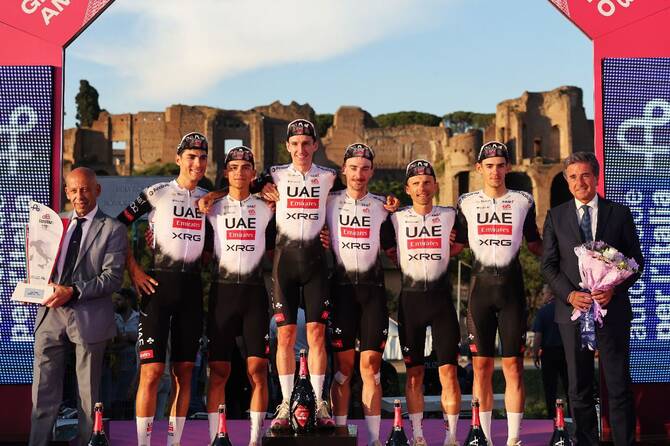
Emirati squad received two prestigious nominations from the Union Cycliste Internationale. supplied
2 / 2
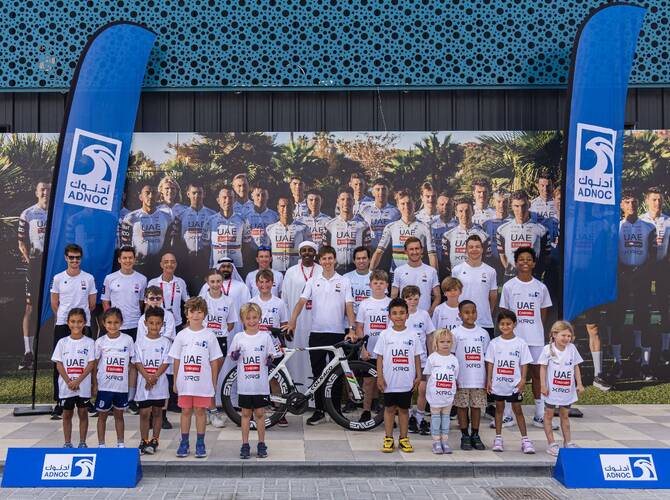
Emirati squad received two prestigious nominations from the Union Cycliste Internationale. supplied
Short Url
Updated 03 June 2025
Follow

UAE Team Emirates-XRG combines vision with victory on World Bicycle Day

  • The UAE Team Emirates-XRG Academy has already reached over 700 schoolchildren through more than 80 hours of in-school coaching

ABU DHABI: UAE Team Emirates-XRG celebrated more than just race wins on World Bicycle Day on Tuesday.

The Emirati squad, a dominant force in the professional peloton, continues to make waves away from competitive events with major strides in community engagement and sustainability — efforts which are earning global recognition.

This week, the team received two prestigious nominations from the Union Cycliste Internationale — the Cycling for All Award for their youth-focused UAE Team Emirates-XRG Academy and the Climate Action Award for their ongoing “Road to Net-Zero” initiative. Both will be presented later this month at the UCI Mobility & Bike City Forum in Copenhagen.

“As we celebrate World Bicycle Day, we’re incredibly proud to see our work recognized on the global stage with nominations for both the UCI Cycling for All Award and the UCI Climate Action Award,” said Mauro Gianetti, team principal and CEO.

“These honors reflect our deep commitment to growing the sport at a grassroots level and ensuring sustainability remains at the heart of everything we do.”

Launched in 2025, the UAE Team Emirates-XRG Academy has already reached over 700 schoolchildren through more than 80 hours of in-school coaching. The program is set to expand to an additional 1,300 students by the end of the year, underlining the team’s aim of nurturing cycling talent across Abu Dhabi and beyond.

“The UAE Team Emirates-XRG Academy, Powered by ADNOC, is central to this vision, helping us inspire the next generation of cyclists and create meaningful change in our communities,” Gianetti added. “I’d like to sincerely thank ADNOC for their unwavering support. Without them, this wouldn’t be possible. The opportunities ahead are endless — for our team, for young riders and for the continued development of cycling across the region.”

While their community work garners headlines, the team’s racing form in 2025 has been just as impressive. UAE Team Emirates-XRG has already captured landmark victories at the Tour of Flanders and Liege–Bastogne–Liege, alongside podium finishes at Milano-Sanremo, Paris-Roubaix, and the Giro d’Italia. The run continues a dominant stretch that began last season, reinforcing their status as one of the sport’s elite outfits.

“The growth of the team over the past eight years has been extraordinary,” Gianetti said. “Our success is driven by the talent and dedication of our riders, the expertise of our staff, and the incredible support from the leadership of the country, our partners, and fans. Cycling is continuing to grow rapidly in the UAE, and that momentum is something we are proud to contribute to every day.”


From Jeddah to the world stage: Bader Idrees and Saudi Arabia’s tennis rise

Updated 25 December 2025
Follow

From Jeddah to the world stage: Bader Idrees and Saudi Arabia’s tennis rise

RIYADH: As tennis continues to gain momentum throughout Saudi Arabia, several local players are beginning to emerge on the national and international scene. One of them is Saudi national team player Bader Idrees, whose journey mirrors the Kingdom’s evolving relationship with the sport.

Idrees’ first exposure to tennis came at a time when the local game was still developing. His interest began in early 2010 after watching his older sister train regularly.

“I was five years old when I used to watch my older sister playing tennis every day,” he told Arab News. “One of her coaches recommended that I try it out, and from the first hit, I fell in love with the sport.”

Now 20 years old, Idrees finds himself progressing alongside a country that is investing heavily in tennis. Over the past three months alone, Saudi Arabia has hosted the Six Kings Slam, the WTA Finals, and the Next Gen ATP Finals, an indication of its growing ambitions on the global tennis stage.

A defining moment in Idrees’ development came at the 2025 WTA Finals, where he reached a personal milestone in his role as a hitting partner for some of the world’s best players.

“It was one of the best experiences I’ve had so far,” he said. “To actually see the players and train with them was an eye-opening experience for me.”

The exposure offered by hosting elite tournaments has had a direct impact on aspiring Saudi athletes, providing valuable insight into the professional game.

“Seeing how players prepare for matches — from how they behave off the court to actually practicing on the court — was an amazing experience,” he said.

Beyond individual growth, Idrees believes the broader sporting ecosystem benefits from welcoming international events to the Kingdom.

“Hosting these events motivates every Saudi athlete,” Idrees said. “Foreign players get to know the country and the players who represent it, and it pushes us to perform better knowing that the world is watching.”

That motivation has translated into concrete goals. Idrees is planning a busy start to the year, with four international tournaments scheduled for January.

“I feel very positive about what I’ve accomplished so far, so hopefully I can kick off with a strong start in 2026.”

Despite recent progress, Idrees credits his early development at home as the foundation of his success.

“I don’t think I would be at this level if I weren’t in Saudi Arabia, and if I didn’t meet my coach Wajih there, who played a big role in my journey,” Idrees said.

To further advance his career, he later relocated to Cairo, where increased competition and exposure helped accelerate his development.

“That experience, combined with my coach’s motivation, made me believe I could truly go pro,” he said.

The journey was not without challenges. Idrees reflected on the limitations that once existed in the local tennis landscape.

“Tennis has grown massively in Saudi Arabia over the last few years,” he said. “But before that, we didn’t always have the best facilities or infrastructure. That’s why seeing the progress now makes me happy.”

Today, that transformation is happening at a rapid pace — something Idrees notices each time he returns home from international competition.

“Month by month,” as he puts it.

Whether in Riyadh, Jeddah, or Dammam, the changes are increasingly visible. Looking ahead, Idrees is optimistic about the next generation of Saudi players.

“I wouldn’t be surprised to see the kids playing at the under-10 and under-12 level find themselves in the top 500 or 300 within the next 10 years,” he said. “I see the discipline and motivation in them, and it truly is something special.”

He is also realistic about his own development compared with today’s young talents.

“I wasn’t at this level at 10, 12 years old,” he admitted. “Training with kids at that age now, I’m genuinely impressed. It’s why I’m feeling very positive about their future.”

With growing infrastructure, elite-level exposure, and rising ambition, Idrees’ story represents more than personal achievement. It highlights how Saudi Arabia’s expanding role as a host of global sporting events is reshaping its tennis landscape — and how a new generation of players may be poised to make an impact on the world stage in the years ahead.