

Over 200 inmates escape Karachi prison after earthquake, confirms Sindh Police

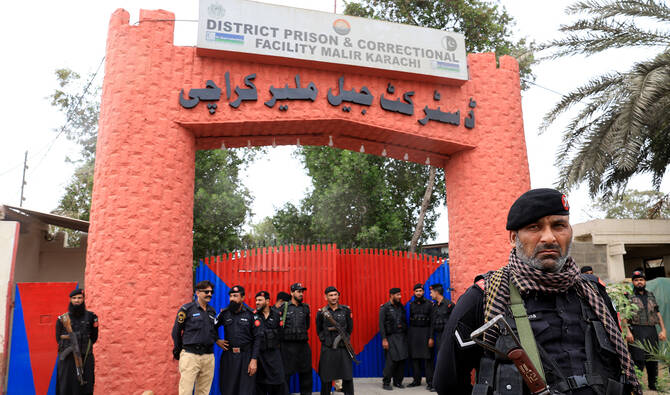
Paramilitary soldiers stand outside the district Malir jail after dozens of prisoners escaped from the jail on the outskirts of Karachi, Pakistan, on June 3, 2025. (REUTERS)
Short Url
Updated 03 June 2025
Follow

Over 200 inmates escape Karachi prison after earthquake, confirms Sindh Police

  • Sindh’s top cop confirms one prisoner was killed on Monday night as police attempted to maintain order during chaos
  • Prisoners managed to escape outer gate of Malir prison after it was damaged by tremors, says Sindh home minister

KARACHI: Around 213 inmates managed to escape from the Malir prison in Karachi last night after they were shifted outside their cells due to safety concerns when the city was shaken by tremors, Sindh’s top police officer said on Tuesday, confirming that one prisoner had also been killed.

Sindh Home Minister Zia-ul-Hasan Lanjar told reporters earlier that inmates at the Malir prison in Karachi panicked when tremors shook the city on Monday night. He said it became difficult to prevent around 1,000 inmates from escaping through the outer gate of the jail, which had been damaged by the quake. 

“The incident occurred when prisoners were temporarily moved out of their barracks due to safety concerns,” Inspector-General Sindh Ghulam Nabi Memon told Arab News. 

“Taking advantage of the chaos, around 1,000 inmates gathered at the jail’s main gate and 213 prisoners managed to force the gate open and flee.”

Memon said 78 of the prisoners who had managed to flee were re-arrested by police. In his interaction with reporters on Monday night, Lanjar confirmed that no “hardened criminal” had managed to escape the jail following the late-night chaos. 

Memon said Malir prison houses small-time offenders, particularly those involved in narcotics and its consumption.

“The escapees were mostly from this category and their mob mentality played a role in escaping the jail,” he said. 

He confirmed Lanjar’s statement that one prisoner had been killed as police attempted to maintain order following the jailbreak. The Sindh home minister had also said five persons, which included both prisoners and police officials, were injured in the clashes.


Pakistan organizes second phase of Hajj training for 2026 pilgrims in Islamabad

Updated 4 sec ago
Follow

Pakistan organizes second phase of Hajj training for 2026 pilgrims in Islamabad

  • Training sessions held to inform pilgrims of various stages of Hajj, precautionary measures, obligatory acts, says state media 
  • Pilgrims told to improve their physical fitness, keep essential travel documents and vaccination cards ready ahead of Hajj 2026

ISLAMABAD: Pakistan’s Ministry of Religious Affairs organized the second phase of Hajj training for 2026 pilgrims in Islamabad today, Sunday, state media reported. 

Pakistan’s religion ministry kicked off the first phase of the mandatory Hajj trainings last Sunday in Islamabad and other cities. The ministry said the trainings were made mandatory to ensure that intending pilgrims are fully aware of Hajj rituals and administrative procedures. 

“Ministry of Religious Affairs and Interfaith Harmony organized second phase of Hajj training session for pilgrims in Islamabad today,” state broadcaster Radio Pakistan reported. 

It said the primary objective of the program was to provide awareness about the various stages of the pilgrimage, necessary precautionary measures and the obligatory acts of both Hajj and Umrah.

“Pilgrims were advised to improve their physical fitness by walking 2 to 3 kilometers daily and keep essential travel documents including original passport, CNIC, flight ticket, visa copies and vaccination cards ready,” the state media said. 

Intending pilgrims were strictly warned against carrying prohibited items such as narcotics, naswar (smokeless tobacco), cigarettes and unverified medicines.

Saudi Arabia has allocated Pakistan a quota of 179,210 pilgrims for Hajj 2026, of which around 118,000 seats have been reserved under the government scheme while the remainder will be allocated to private tour operators.

Under Pakistan’s Hajj scheme, the estimated cost of the government package ranges from Rs1,150,000 to Rs1,250,000 ($4,049.93 to $4,236), subject to final agreements with service providers.