

Pakistan earmarks $3.5 billion for development projects in upcoming budget

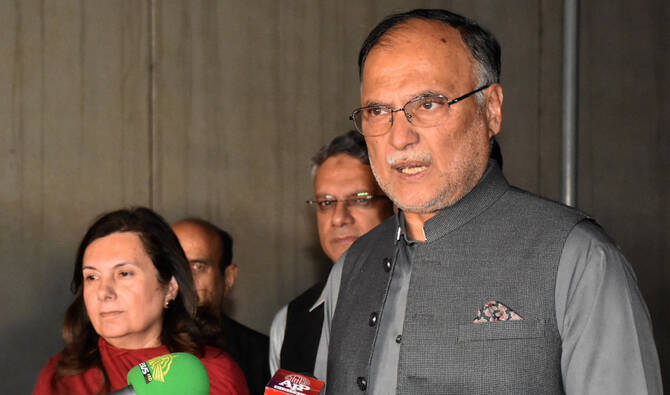
Pakistan’s Planning Minister Ahsan Iqbal speaks during a media briefing in Lahore on June 1, 2025. (Facebook/@ahsaniqbal.pk/File)
Short Url
Updated 02 June 2025
Follow

Pakistan earmarks $3.5 billion for development projects in upcoming budget

  • The budget for fiscal year 2025-26 will be announced in the National Assembly on June 10
  • Pakistan’s annual inflation rose to 3.5% in May, though macroeconomic outlook has improved

ISLAMABAD: Pakistan’s Planning Minister Ahsan Iqbal said on Monday that the Finance Division has allocated Rs1 trillion ($3.5 billion) for development projects in the upcoming budget for fiscal year 2025-26.

The 2025–26 budget is expected to be presented by Finance Minister Muhammad Aurangzeb in Pakistan’s lower house of parliament on June 10, following the Eid Al-Adha holidays, after the government postponed an earlier date of June 2.

Providing the breakdown $3.5 billion development budget, Iqbal said Rs664 billion ($2.3 billion) would be allocated to infrastructure projects, including energy, water, transport, physical planning and housing.

“Prime Minister Shehbaz Sharif has directed that Rs120 billion ($426.7 million) be allocated for N25 Chaman-Quetta-Karachi Expressway,” he said at a press conference in Islamabad.

“Rs150 billion ($533.3 million) are for social sectors, special areas, including Azad Jammu and Kashmir and Gilgit-Baltistan, have been allocated Rs63 billion ($223.9 million), and merged [tribal] districts in Khyber Pakhtunkhwa have been allocated Rs70 billion ($248.4 million).”

Similarly, Rs53 billion ($188.3 million) have been earmarked for science and information technology, Rs9 billion ($32.2 million) for governance and reform projects, and Rs11 billion ($39.1 million) for production sectors, according to the minister.

“The majority [of allocation] is for water, power and highway sector,” he added.

Late last month, Iqbal said Pakistan’s defense spending would be hiked in the upcoming budget as the military would “certainly require” more financial resources to defend the country against India. But neither Iqbal nor any other government official has so far shared any figures. Pakistan’s defense budget currently stands at Rs2.122 trillion ($7.53 billion).

The remarks came days after Pakistan and India attacked each other with missiles, drones and artillery in their worst conflict in decades that killed around 70 people on both sides. The two nations agreed to a ceasefire on May 10 after four days of hostilities sparked by a militant attack on tourists in Indian-administered Kashmir in April.

Pakistan’s annual inflation rate rose to 3.5% in May, though the country’s macroeconomic outlook has improved in recent months, supported by a stronger current account balance, increased remittances and declining inflation.

Authorities remain cautious as they aim to build on recent economic stabilization, guide the country toward gradual growth, and reaffirm their commitment to ongoing economic reforms.


Pakistani, Bangladeshi officials discuss trade, investment and aviation as ties thaw

Updated 28 December 2025
Follow

Pakistani, Bangladeshi officials discuss trade, investment and aviation as ties thaw

  • Pakistan and Bangladesh were once one nation, but they split in 1971 as a result of a bloody civil war
  • Ties between Pakistan, Bangladesh have warmed up since last year and both nations have resumed sea trade

ISLAMABAD: Pakistan's High Commissioner to Bangladesh Imran Haider on Sunday met Chief Adviser Muhammad Yunus in Dhaka, the latter's office said on, with the two figures discussing trade, investment and aviation.

Pakistan and Bangladesh were once one nation, but they split in 1971 as a result of a bloody civil war, which saw the part previously referred to as East Pakistan seceding to form the independent nation of Bangladesh.

Ties between Pakistan and Bangladesh have warmed up since former prime minister Sheikh Hasina’s ouster as a result of a student-led uprising in August 2024. Relations remain frosty between Dhaka and New Delhi over India’s decision to grant asylum to Hasina.

Pakistan has attempted to forge closer ties with Bangladesh in recent months and both South Asian nations last year began sea trade, followed by efforts to expand government-to-government commerce.

"During the meeting, both sides discussed ways to expand cooperation in trade, investment, and aviation as well as scaling up cultural, educational and medical exchanges to further strengthen bilateral relations between the two South Asian nations," Yunus's office said in a statement on X.

In 2023-24 Pakistan exported goods worth $661 million to Bangladesh, while its imports were only $57 million, according to the Trade Development Authority of Pakistan. In Aug. this year, the Pakistani and Bangladeshi commerce ministries signed a memorandum of understanding to establish a Joint Working Group on Trade, aiming to raise their bilateral trade volume to $1 billion in the financial year that began in July.

The Pakistani high commissioner noted that bilateral trade has recorded a 20 percent growth compared to last year, with business communities from both countries actively exploring new investment opportunities, according to the statement.

He highlighted a significant increase in cultural exchanges, adding that Bangladeshi students have shown strong interest in higher education opportunities in Pakistan, particularly in medical sciences, nanotechnology, and artificial intelligence. Haider also said that Dhaka-Karachi direct flights are expected to start in January.

"Chief Adviser Professor Muhammad Yunus welcomed the growing interactions between the two countries and emphasized the importance of increased visits as well as cultural, educational and people-to-people exchanges among SAARC (South Asian Association for Regional Cooperation) member states," the statement read.

"Professor Yunus also underscored the need to further boost Bangladesh–Pakistan trade and expressed hope that during Mr. Haider’s tenure, both countries would explore new avenues for investment and joint venture businesses."