

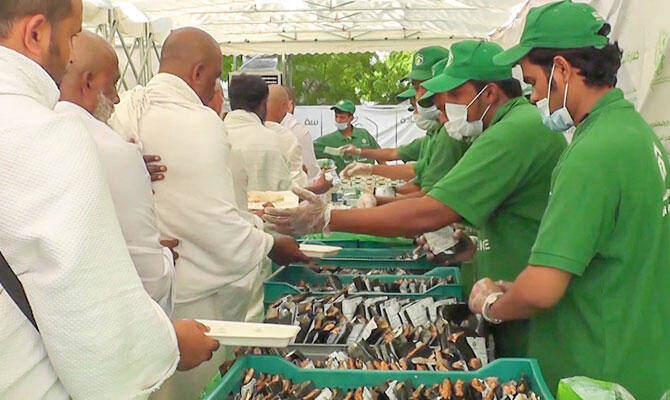

MAKKAH: As Saudi Arabia gears up for another Hajj season, an intricate web of preparation is unfolding across Makkah, in which catering services are a critical backbone of the operation.
The Kingdom’s comprehensive approach to serving Islam’s pilgrims combines early strategic planning, seamless inter-agency coordination, and technological innovation to ensure millions can perform their sacred duties safely and comfortably.
Officials have unveiled the scope of this year’s food service operation: 380 catering companies working in concert to deliver up to 12 million meals during the pilgrimage.
The service is a logistical challenge that extends far beyond simply feeding crowds — it is about maintaining food safety, nutritional quality and operational efficiency under extraordinary circumstances, alongside the smart transition to electric cooking in the kitchens of the holy sites, contributing to improved food quality, enhanced safety, and reduced environmental risks in one of the greatest rituals of the Islamic world.
Mohammed Al-Sharif, who heads the association responsible for catering at Makkah’s holy sites, emphasized the government’s commitment to pilgrim welfare.
“The leadership has spared no expense in serving the guests of pilgrims,” he said, noting the direct oversight provided by Makkah’s municipal authorities.
The preparation process has been methodical and intensive. Six planning meetings addressed potential obstacles and elevated service standards.
He explained that the meetings were held to assess preparations, address obstacles, and tackle challenges in a way that contributes to raising the quality of services provided.
Al-Sharif highlighted the productive partnership with the ministry of health in establishing comprehensive food safety oversight systems. This collaboration has resulted in extensive training programs for quality control supervisors at all catering companies.
These preparations involve simulation exercises by catering contractors, carried out in the presence of security personnel and regulatory officials, as stress tests for the entire food service system.
The virtual trials are designed to identify and resolve any potential operational weaknesses before the pilgrimage officially commences.
He also noted that the municipality in Makkah, in cooperation with the ministry of commerce, verified food stocks and confirmed their readiness.
He concluded his statement by emphasizing that all agencies are working at full capacity to provide the best services to pilgrims.
Meanwhile, Dr. Ibrahim Al-Saini, who owns catering companies, confirmed that preparations are proceeding at full pace, emphasizing the efforts of all relevant authorities to provide the best and finest services to pilgrims and working day and night for their comfort and care for their food.
“The conditions during Hajj differ fundamentally from the rest of the year,” he said, highlighting the distinct operational requirements between different phases of the pilgrimage — from the Day of Arafat and Muzdalifah to the extended period in Mina.
He pointed out that the Kingdom, under the leadership of King Salman and Crown Prince Mohammed bin Salman, continues to develop the Hajj system year after year, whether through distributing locations to Hajj companies in studied ways, or through improving crowd management mechanisms and organizing traffic flow, which reflects on service quality and pilgrim safety.
Al-Saini described the process of providing food and drink as a “major challenge,” but the new systems that allowed food preparation in advance in model kitchens in Makkah and later transporting it to the holy sites for cooking and serving directly contributed to improving meal quality and distribution efficiency.
Al-Saini highlighted developments witnessed in kitchens at the holy sites, where kerosene gas was replaced with electric cooking, leading to improved safety levels and cooking speed, and reducing environmental and health risks.
He praised national efforts to serve pilgrims, confirming that the repeated successes achieved each year are the fruit of advance planning, integration between different agencies, and continuous commitment to innovation in providing the best services to pilgrims.


