

Pakistan reports first-ever polio case in northern Gilgit-Baltistan, bringing 2025 tally to 11

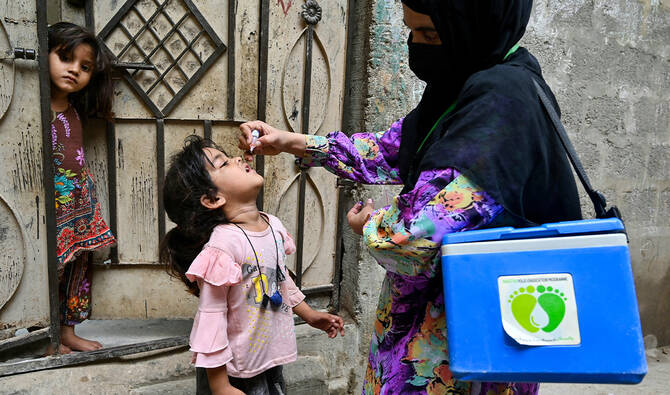
A health worker administers polio drops to a child for vaccination on the first day of a nationwide week-long poliovirus eradication campaign in Karachi, Pakistan, on May 26, 2025. (AFP/File)
Short Url
Updated 02 June 2025
Follow

Pakistan reports first-ever polio case in northern Gilgit-Baltistan, bringing 2025 tally to 11

  • Pakistan concluded a nationwide polio vaccination campaign on June 1
  • Pakistan, Afghanistan are only countries where polio remains endemic

KARACHI: Pakistan has detected the first-ever polio virus case in the northern Gilgit-Baltistan region, bringing this year’s tally to 11 cases, the polio eradication program said on Monday.

Polio is a paralyzing disease that has no cure. Multiple doses of the oral polio vaccine and completion of the routine vaccination schedule for all children under the age of 5 are essential to provide children high immunity against the disease.

Pakistan and Afghanistan are the last two countries in the world where polio remains endemic. The country reported 74 polio cases in 2024.

“The Regional Reference Laboratory for Polio Eradication at the National Institute of Health has confirmed a new case of wild poliovirus in District Diamer, Gilgit-Baltistan,” the polio eradication program said in a statement.

“This is the first case of wild poliovirus reported from Gilgit-Baltistan and the eleventh confirmed case in Pakistan this year.”

Pakistan concluded a nationwide polio vaccination campaign on June 1. The drive had aimed to inoculate 45 million children under the age of five across 159 districts of the country.

In the early 1990s, Pakistan reported around 20,000 polio cases annually. By 2018, that number had dropped to just eight. In 2021, only one case was reported, and six cases were recorded in 2023.

Pakistan’s polio eradication program began in 1994, but efforts have been repeatedly undermined by misinformation and resistance from some religious hard-liners. These groups claim that immunization is a foreign plot to sterilize Muslim children or a cover for Western espionage.

Militant groups have also frequently attacked polio vaccination teams and the security personnel assigned to protect them.

Last week, a Pakistani police officer was killed when gunmen opened fire on a team of health workers conducting a door-to-door polio vaccination campaign in the southwestern Balochistan province.

Pakistan to begin first phase of Hajj 2026 trainings from today

Updated 18 sec ago
Follow

Pakistan to begin first phase of Hajj 2026 trainings from today

  • Training programs to be held in phases across Pakistan till February, says religion ministry
  • Saudi Arabia allocated Pakistan a total quota of 179,210 pilgrims for Hajj 2026

ISLAMABAD: Pakistan’s religious affairs ministry has said that it will begin the first phase of mandatory Hajj 2026 training for pilgrims intending to perform the pilgrimage from today, Thursday.

The one-day Hajj training programs will be held in phases across the country at the tehsil level until February. The ministry directed intending pilgrims to bring their original identity cards and the computerized receipt of their Hajj application to attend the training sessions.

“Pilgrims should attend the one-day training program according to their scheduled date,” Pakistan’s Ministry of Religious Affairs (MoRA) said in a statement.

The ministry said training schedules are being shared through the government’s Pak Hajj 2026 mobile application as well as via SMS. It added that details of the schedule are also available on its website.

According to the ministry, training programs will be held in Abbottabad on Jan. 2; Ghotki, Thatta and Kotli on Jan. 3; and Tando Muhammad Khan and Khairpur on Jan. 4.

Hajj training sessions will be held in Rawalakot, Badin and Naushahro Feroze on Jan. 5, while pilgrims in Fateh Jang, Dadu and Tharparkar will receive the training on Jan. 6.

The ministry said training programs will be conducted in Umerkot and Larkana on Jan. 7, followed by sessions in Mirpurkhas, Shahdadkot and Mansehra on Jan. 8.

Pakistan’s religious affairs ministry has previously said these trainings will be conducted by experienced trainers and scholars using multimedia.

It said the training has been made mandatory to ensure that intending pilgrims are fully aware of Hajj rituals and administrative procedures.

Saudi Arabia has allocated Pakistan a quota of 179,210 pilgrims for Hajj 2026, of which around 118,000 seats have been reserved under the government scheme, while the remainder will be allocated to private tour operators.

Under Pakistan’s Hajj scheme, the estimated cost of the government package ranges from Rs1,150,000 to Rs1,250,000 ($4,049.93 to $4,236), subject to final agreements with service providers.