

Explosions caused 2 bridges in western Russia to collapse, officials say

1 / 2
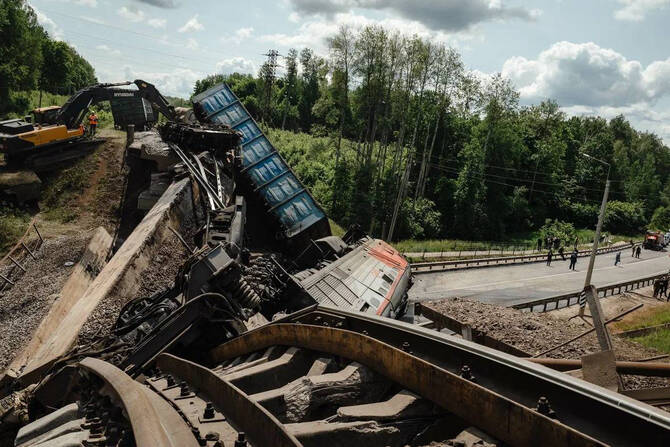
This handout photograph posted on the Telegram account of Kursk region acting governor Alexander Khinshtein on June 1, 2025 shows a damaged freight train at the site of a railway bridge collapse in the Kursk region. (Telegram/@Hinshtein)
2 / 2
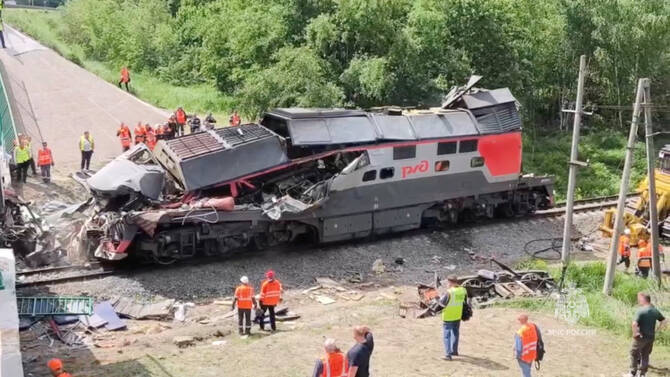
​ Specialists of emergency services work at the scene, after a road bridge collapsed onto railway tracks derailing an approaching train in the Bryansk region, Russia, on June 1. (Russian Emergencies Ministry/Handout via REUTERS) ​
Short Url
Updated 02 June 2025
Follow

Explosions caused 2 bridges in western Russia to collapse, officials say

  • 7 people were killed in the first incident, in which a bridge in Bryansk region collapsed on top of a passenger train
  • Hours later, officials said a second train derailed when the bridge beneath it collapsed in nearby Kursk region

Explosions caused two bridges to collapse and derailed two trains in western Russia overnight, officials said Sunday, without saying what had caused the blasts. In one of the incidents, seven people were killed and dozens were injured.
The first bridge, in the Bryansk region on the border with Ukraine, collapsed on top of a passenger train on Saturday, causing the casualties. The train’s driver was among those killed, state-run Russian Railways said.

In that collapse, a freight train was thrown off its rails onto the road below as the explosion collapsed the bridge, local acting Gov. Alexander Khinshtein said Sunday. The crash sparked a fire, but there were no casualties, he said.

Russia’s Investigative Committee, the country’s top criminal investigation agency, said in a statement that explosions had caused the two bridges to collapse, but did not give further details. Several hours later, it edited the statement, which was posted on social media, to remove the words “explosions” but did not provide an explanation.
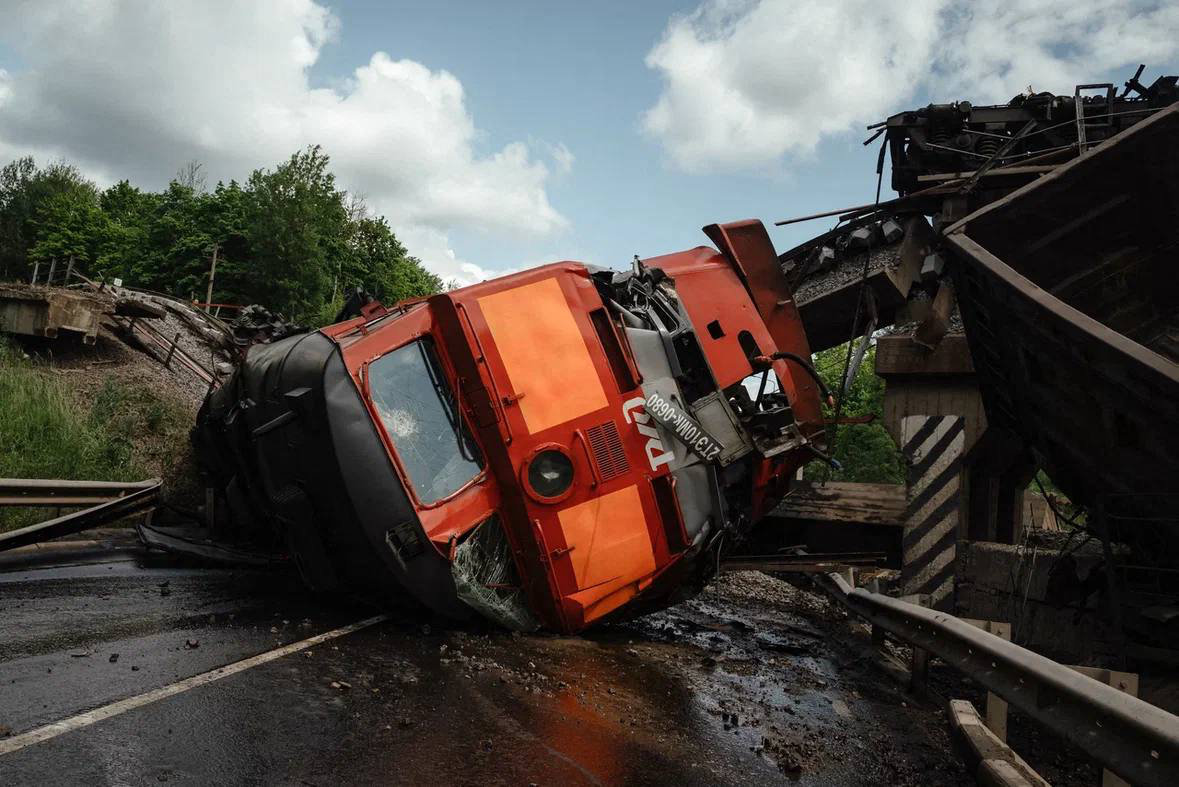


This handout photograph posted on the Telegram account of Kursk region acting governor Alexander Khinshtein on June 1, 2025 shows a damaged freight train at the site of a railway bridge collapse in the Kursk region. (Telegram/@Hinshtein)

The committee said that it would be investigating the incidents as potential acts of terrorism.
Rescue workers cleared debris from both sites, while some of those injured were transported to Moscow for treatment. Photos posted by government agencies in Bryansk appeared to show train carriages ripped apart and lying amid fallen concrete from the collapsed bridge. Other footage on social media was apparently taken from inside vehicles on the road that had managed to avoid driving onto the bridge before it collapsed.
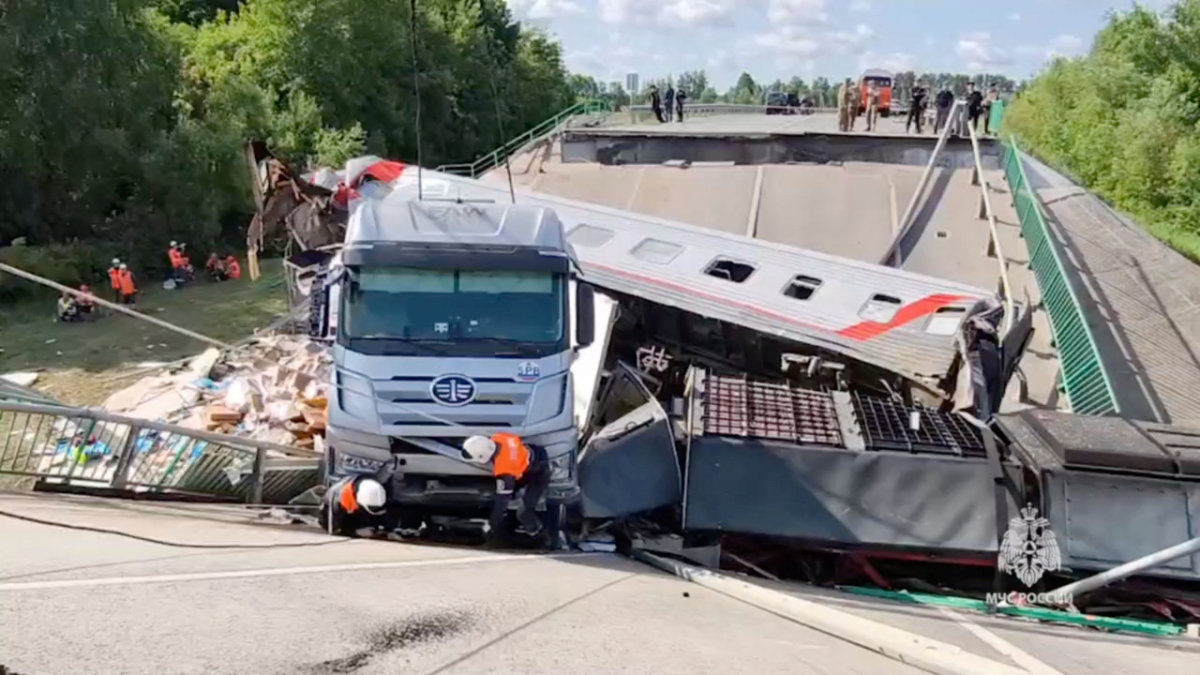


Specialists of emergency services work at the scene, after a road bridge collapsed onto railway tracks derailing an approaching train in the Bryansk region, Russia, on June 1. (Russian Emergencies Ministry/Handout via REUTERS)

Bryansk regional Gov. Alexander Bogomaz announced three days of mourning for the victims, starting Monday.
Damage to railway tracks was also found Sunday by inspectors working on the line elsewhere in the Bryansk region, Moscow Railway said in a statement. It did not say whether the damage was linked to the collapsed bridges.
In the past, some officials have accused pro-Ukrainian saboteurs of attacking Russia’s railway infrastructure. The details surrounding such incidents, however, are limited and cannot be independently verified.
Ukraine’s military intelligence, known by the Ukrainian abbreviation GUR, said Sunday that a Russian military freight train carrying food and fuel had been blown up on its way to Crimea. It did not claim the attack was carried out by GUR or mention the bridge collapses.
The statement said Moscow’s key artery with the Russian-occupied Zaporizhzhia region and Crimea has been destroyed.
Russia forces have been pushing into the region of Zaporizhzhia in eastern Ukraine since Moscow’s full-scale invasion in February 2022. Russia took Crimea and annexed it in 2014.


US NATO envoy says allies must ‘pull weight’ after Czech defense cut

Updated 6 sec ago
Follow

US NATO envoy says allies must ‘pull weight’ after Czech defense cut

PRAGUE, March 12 : The United States’ ambassador to ‌NATO said on Thursday that all allies must “pull their weight,” after Czech lawmakers approved a 2026 budget that cuts defense outlays.
Czech Prime Minister ​Andrej Babis’ government, in power since December, pushed a revamped budget through the lower house on Wednesday evening which cut the defense ministry’s allocation versus a previous proposal to 154.8 billion crowns ($7.31 billion), or 1.73 percent of gross domestic product.
That is below a NATO target of 2 percent of GDP already expected before alliance members pledged last year in the Hague ‌to raise defense spending ‌to 3.5 percent of GDP plus ​1.5 percent ‌on ⁠other defense-relevant investments ​over ⁠the next decade.
The Czech Finance Ministry says total defense spending in the budget will reach 2.07 percent of GDP, but the country’s budget watchdog has warned that includes money earmarked elsewhere, like for the transport ministry for road projects, that may not be recognized by NATO.
“All Allies must pull their weight and ⁠honor The Hague Defense Commitment,” US Ambassador to ‌NATO Matthew Whitaker said on X ‌on Thursday with a picture of ​a news headline on the Czech ‌budget approval.
“These numbers are not arbitrary. They are about ‌meeting the moment — and the moment requires 5 percent as the standard. No excuses, no opt-outs.”
European NATO countries are under pressure to raise defense spending amid the Ukraine-Russia war ‌and at US President Donald Trump’s urging.
Babis, whose populist ANO party won elections last year, said ⁠in February ⁠the country was “certainly not” on the path to raising core defense spending to the 3.5 percent target, saying there was a different focus, like on health care.
The budget watchdog on Thursday reiterated “strong doubts” that some spending deemed defense in this year’s budget would meet NATO’s definition.
President Petr Pavel, a former NATO official, has also said defense cuts risked a loss of trust from allies — but has signalled he would not veto the budget.
US Ambassador to Prague Nicholas Merrick said last ​week the Czech Republic may ​slip to the bottom of NATO’s defense-spending ranks.