

Chile president to ramp up decarbonization, pressure on Israel as term winds down

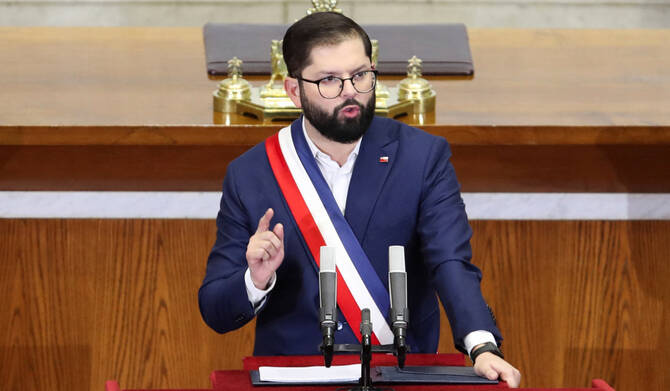
Chile's President Gabriel Boric speaks during his annual address at the National Congress building in Valparaiso, Chile June 1, 2025. (REUTERS)
Short Url
Updated 01 June 2025
Follow

Chile president to ramp up decarbonization, pressure on Israel as term winds down

  • Boric, an outspoken critic of Israel, had recently recalled military personnel from Chile’s embassy in the country and summoned the ambassador for questioning

VALPARAISO, Chile: Chile’s President Gabriel Boric said on Sunday that he will accelerate renewable energy efforts and step up pressure against Israel over its war in Gaza among other initiatives during his government’s last nine months in office.
In a wide-ranging three-hour speech from Congress in the coastal city of Valparaiso that marked his last annual address, Boric also discussed crime, infrastructure, the economy and abortion rights.
In comments that sparked the largest amount of cheers and jeers from opposite sides of Congress, Boric said he will introduce a law to ban imports from what he called “illegally occupied territories” and back efforts by Spain for an arms embargo against Israel.
Boric, an outspoken critic of Israel, had recently recalled military personnel from Chile’s embassy in the country and summoned the ambassador for questioning.
Chile’s government will also introduce an “accelerated decarbonization” bill that aims to boost investment in renewable energy sources, help end coal-powered thermoelectric plants and move the country’s 2040 goal to decarbonize the electric grid up to 2035.
Boric added that a bill to speed up the permitting process for new projects was weeks away from being approved, a long-awaited request by miners, renewable energy companies and other investors. Its goal is to cut permitting times by 30 percent to 70 percent, Boric said.
“Investment projects won’t develop to their full potential if we don’t modernize and speed up permitting,” Boric said, while also touting his plan to expand lithium mining, led by state copper giant Codelco.
Critics have rebuked Boric for not making major reforms he promised as a candidate, and for failing to see through a rewrite of the dictatorship-era constitution that was knocked back twice by voters.
Boric appeared to recognize the complaints, while defending his record.
“Have we achieved everything we wanted, with the depth we wanted? No, but we have made progress in that direction, with the conditions under which we had to govern,” he said.


Bolivia and Israel to restore ties severed over the war in Gaza

Updated 5 sec ago
Follow

Bolivia and Israel to restore ties severed over the war in Gaza

  • Paz's government eased visa restrictions on American and Israeli travelers last month
  • The Bolivian foreign ministry said its top diplomat would meet his Israeli counterpart in Washington later Tuesday to discuss the revival of bilateral ties

LA PAZ, Bolivia: Bolivia's new right-wing government said Tuesday that it would restore diplomatic relations with Israel, the latest sign of the dramatic geopolitical realignment underway in the South American country that was once among the most vocal critics of Israeli policies toward Palestinians.
The Bolivian foreign ministry said its top diplomat would meet his Israeli counterpart in Washington later Tuesday to discuss the revival of bilateral ties, which Bolivia's previous left-wing government severed two years ago over Israel's devastating campaign against Hamas in Gaza.
Bolivia said the effort came as part of a new foreign policy strategy under conservative President Rodrigo Paz aimed at “rebuilding Bolivia's international prestige, opening new economic opportunities and strengthening alliances that directly benefit the country and our citizens abroad."
Bolivian Foreign Minister Fernando Aramayo is in the midst of a whirlwind trip to Washington for meetings with American officials as his government works to warm long-chilly relations with the United States and unravel nearly two decades of hard-line, anti-Western policies under the Movement Toward Socialism, or MAS, party that left Bolivia economically isolated and diplomatically allied with China, Russia and Venezuela.
Paz's government eased visa restrictions on American and Israeli travelers last month.
In announcing his expected meeting with Aramayo on Monday, Israeli Foreign Minister Gideon Saar thanked Bolivia for scrapping Israeli visa controls and said he spoke to Paz after the center-right senator's Oct. 19 election victory to express “Israel’s desire to open a new chapter” in relations with Bolivia.
Paz entered office last month, ending the dominance of the MAS party founded by Evo Morales, the charismatic former coca-growing union leader who became Bolivia's first Indigenous president in 2006. Not long after taking power, Morales sent Israel's ambassador packing and cozied up to Iran over their shared enmity toward the U.S. and Israel.
When protests over Morales' disputed 2019 reelection prompted him to resign under pressure from the military, a right-wing interim government took over and restored full diplomatic relations with the U.S. and Israel as it sought to undo many of Morales’ popular policies.
But 2020 elections brought the MAS party back to power with the presidency of Luis Arce, who in 2023 once again cut ties with Israel in protest over its military actions in Gaza.
Other left-wing Latin American countries, like Chile and Colombia, soon made similar moves, recalling their ambassadors and joining South Africa’s genocide case against Israel before the United Nations’ highest judicial body.