

British FM says Morocco’s autonomy plan for W. Sahara ‘most credible’ solution

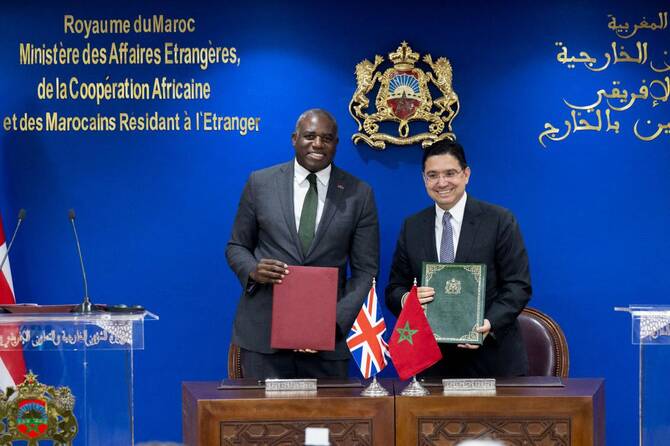
Britain's Foreign Secretary David Lammy (L) and his Moroccan counterpart Nasser Bourita sign agreements in Rabat, June 1, 2025. (AFP)
Short Url
Updated 01 June 2025
Follow

British FM says Morocco’s autonomy plan for W. Sahara ‘most credible’ solution

  • Britain previously backed self-determination for the disputed Western Sahara, which Morocco claims as an integral part of its kingdom
  • Spain and Germany now officially back the Moroccan autonomy plan, while France last summer recognized Morocco’s sovereignty over the territory

RABAT: British Foreign Minister David Lammy said on Sunday that Morocco’s autonomy plan for the territory of Western Sahara was the “most credible” solution to the decades-long dispute, reversing London’s long-standing position.
Western Sahara, a mineral-rich former Spanish colony, is largely controlled by Morocco but has been claimed in its entirety for decades by the pro-independence Polisario Front, which is backed by Algeria.
Morocco has been campaigning for broad support for its autonomy plan after obtaining US recognition of Morocco’s sovereignty over the disputed territory in 2020, in exchange for the normalization of diplomatic relations with Israel.
“The United Kingdom considers Morocco’s autonomy proposal submitted in 2007 as the most credible, viable and pragmatic basis for a lasting resolution of the dispute,” Lammy told reporters in Rabat.
Britain previously backed self-determination for the disputed territory, which Morocco claims as an integral part of its kingdom.

The United Kingdom considers Morocco’s autonomy proposal submitted in 2007 as the most credible, viable and pragmatic basis for a lasting resolution of the dispute

UK Foreign Minister David Lammy

Moroccan foreign minister Nasser Bourita welcomed the shift, saying the new British position contributed “greatly to advancing this momentum and promoting the UN path toward a definitive and mutually acceptable solution based on the autonomy initiative.”
Rabat’s push for support for its autonomy plan has seen success.
Spain and Germany now officially back the Moroccan autonomy plan, while France last summer recognized Morocco’s sovereignty over the territory.
“This year is a vital window of opportunity to secure a resolution before we reach 50 years of the dispute in November,” said Lammy.
The foreign minister also said it encouraged “relevant parties to engage urgently and positively with the United Nations-led political process.”
The United Nations considers Western Sahara a “non-self-governing territory” and has had a peacekeeping mission there since 1991, whose stated aim is to organize a referendum on the territory’s future.
But Rabat has repeatedly ruled out any vote where independence is an option, instead proposing an autonomy plan.
The ceasefire collapsed in mid-November 2020 after Moroccan troops were deployed to the far south of the territory to remove separatists blocking the only route to Mauritania — a route they claimed was illegal, as it did not exist in 1991.
The UN Security Council is calling for negotiations without preconditions, while Morocco insists they focus solely on its autonomy plan.
“The only viable and durable solution will be one that is mutually acceptable to the relevant parties and is arrived at through compromise,” added Lammy.
In a joint statement, the United Kingdom noted that its export credit agency, UK Export Finance, may consider supporting projects in the Sahara as part of its commitment to mobilize 5 billion British pounds (approximately 5.9 billion euros) for new economic initiatives in Morocco.


What to know about the search for the Brown University shooting suspect

Updated 17 December 2025
Follow

What to know about the search for the Brown University shooting suspect

  • The video from more than hour before the attack shows the suspect running at times in quiet residential streets near campus

PROVIDENCE, R.I.: With the Brown University shooter still on the loose Tuesday, authorities released new video of a suspect and police fanned out to Providence schools to reassure parents, kids and teachers as investigators pushed for new evidence that might help them crack the case.
Here’s a look at what to know about the attack and the search:
Search on after new video and description of suspect
Authorities released a video timeline and a slightly clearer image of the man suspected in Saturday’s attack in an engineering building classroom, where two students were killed and nine were wounded. The video from more than hour before the attack shows the suspect running at times in quiet residential streets near campus.
In videos previously made public, the suspect’s face was masked or turned away and authorities were only able to give a vague description of him as having a stocky build and about 5 feet, 8 inches (173 centimeters) tall.
The gunman fired more than 40 rounds from a 9 mm handgun, a law enforcement official told The Associated Press on the condition of anonymity because they weren’t authorized to discuss the investigation publicly.
Police have asked the public for tips, and said they had received about 200 by Tuesday. Col. Oscar Perez, the Providence police chief, asked the public Tuesday to look at their camera systems in the area where the person was walking to review any footage that goes back a week.
Authorities on Sunday released a different person of interest after determining he wasn’t behind the attack, which happened in a first-floor classroom where students were cramming for an exam. Providence police spokeswoman Kristy dosReis said the man’s detention didn’t affect the ongoing investigation.
Police fan out to local schools
Tensions remain high in Providence. Ten state troopers were assigned to support the local police sent to beef up security at schools, district Superintendent Javier Montañez said. The district said it canceled after-school activities, sporting events and field trips this week “out of an abundance of caution.”
The attack and the shooter’s escape also have raised questions about campus security, including a lack of security cameras, and led to calls for better locks on campus doors. But some said what they called the real issue needs to be addressed.
“The issue isn’t the doors, it’s the guns,” said Zoe Kass, a senior who fled the engineering building Saturday.
Authorities have said that one reason they lacked video of the shooter was because Brown’s older engineering building doesn’t have many cameras.
University defends response
Brown President Christina Paxson defended the university’s response, saying it was deeply committed to the safety, security and well-being of its students. She also said the campus is equipped with 1,200 cameras.
“I have been deeply saddened by people questioning that,” she said Tuesday. “As time goes on, there is a natural instinct to assign responsibility for tragic events like this. Anxiety here is very natural, but the shooter is responsible.”
Paxson said the university has two security systems. One system is activated at a time of emergency and sent out text messages, phone calls and emails that, in this shooting, reached 20,000 individuals. The other system features three sirens across campus, but Paxson said that would not be activated in an active shooter situation.
“Those get activated when there is a broad scale emergency, and we want people to rush into buildings,” she said. “In the case of an active shooter, activating that system could have caused people to rush into Barus and Holley.”
When pressed by a reporter who noted the university website says the sirens can be used when there is an active shooter, Paxson reaffirmed she didn’t think it would be used in that situation.
“It depends on the circumstances and where the active shooter would be but you don’t want to ever get people rushing into buildings that might be the site of an active shooter,” she said.
Details about the victims emerge
Two of the wounded students had been released from the hospital as of Tuesday, Brown spokeswoman Amanda McGregor said. Of the seven others, one remained in critical condition, five were in critical but stable condition and one was in stable condition, Providence Mayor Brett Smiley said.
One of the wounded, 18-year-old freshman Spencer Yang of New York City, told the New York Times and the Brown Daily Herald there was a scramble after the gunman entered the room. Yang said he wound up on the ground and was shot in the leg.
The students who died were MukhammadAziz Umurzokov, an 18-year-old freshman from Brandermill, Virginia, and Ella Cook, a 19-year-old sophomore from a suburb of Birmingham, Alabama.
Jacob Spears, 18, a freshman from Evans, Georgia, was shot in the stomach, “but through sheer adrenaline and courage, he managed to run outside, where he was aided by others,” according to a GoFundMe site organized for him.
Durham Academy, a private K-12 school in Durham, North Carolina, confirmed that a recent graduate, Kendall Turner, was wounded.