

PM Sharif announces 25% federal development share for insurgency-hit Balochistan

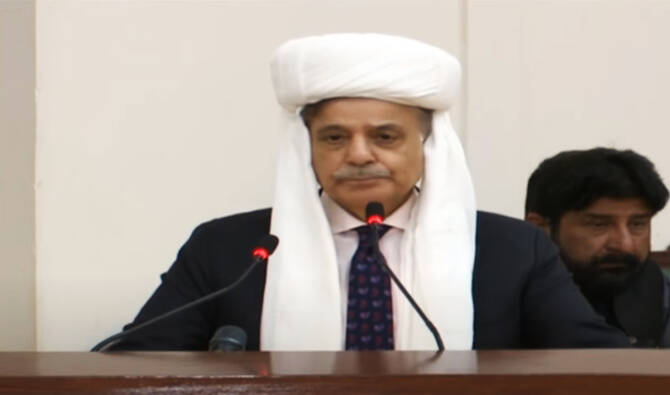
The screengrab taken from a livestream shows Prime Minister Shehbaz Sharif addressing a grand jirga, an assembly of provincial elders and influential figures, in Quetta, Pakistan, on May 31, 2025. (Screengrab/PTV News)
Short Url
Updated 31 May 2025
Follow

PM Sharif announces 25% federal development share for insurgency-hit Balochistan

  • The prime minister calls for efforts to bring back ‘misguided’ individuals who have joined militant groups
  • He recognizes Balochistan’s history of economic deprivations but says ‘terrorists’ know nothing but brutality

ISLAMABAD: Prime Minister Shehbaz Sharif on Saturday said Pakistan’s restive southwestern province of Balochistan will receive 25% share from the Public Sector Development Program (PSDP) in the upcoming budget, as the government continues to grapple with a decades-long separatist insurgency that has surged in recent years.

Balochistan, Pakistan’s largest but least populated province, is strategically significant as the centerpiece of the multibillion-dollar China-Pakistan Economic Corridor (CPEC), a major infrastructure development and regional connectivity initiative linking western China to the Arabian Sea.

While the state touts CPEC as a game-changer for the region’s development, Baloch separatist groups accuse the government of exploiting the province’s vast mineral resources without benefiting the local population. Officials reject the narrative, pointing to ongoing investments in various sectors aimed at improving livelihoods.

Sharif announced the allocation while addressing a grand jirga, an assembly of provincial elders and influential figures alongside top military leadership, in Quetta, where he reaffirmed the government’s commitment to Balochistan’s development.

“I think that PSDP will be of Rs1,000 billion [in the next budget],” he told the gathering. “So, out of this [amount], a fund of approximately Rs250 billion is for Balochistan alone. That is, 25% of the total federal PSDP for Balochistan.”

The PSDP is Pakistan’s central development program used to fund infrastructure, energy, education and other long-term public investment projects across the country.

It includes both federal initiatives and financial support for provincial projects, particularly in underdeveloped regions like Balochistan.

The prime minister said the allocation was the province’s “right.”

“Along with this,” he continued, “these resources should be used transparently, whether it is Gwadar, whether it is Pasni, whether it is Chaman, whether it is Killa Saifullah, whether it is Quetta, whether it is Jhal Magsi or any other areas,” he continued. “Every single penny there should be used honestly for the development and prosperity of the people.”

Addressing the challenge of militancy in the province, Sharif said efforts must continue to bring back “misguided” individuals who had joined militant groups.

He acknowledged Balochistan’s history of economic deprivation, while reiterating that those engaged in violence offer no solutions.

“Terrorists do not know anything but brutality,” he said.

Calling for national unity, Sharif maintained: “Let’s sit together and talk. It is only by sitting together that a family becomes strong and prosperous. No evil eye can harm a united household.”

Pakistan’s seafood exports to China rise 24% to $240 million in 2025

Updated 31 December 2025
Follow

Pakistan’s seafood exports to China rise 24% to $240 million in 2025

  • The Chinese embassy cites strong growth in agricultural trade with Pakistan
  • Islamabad aims to expand food exports amid effort to boost foreign reserves

ISLAMABAD: Pakistan’s seafood exports to China rose 24% year-on-year to $240 million in the first 11 months of 2025, the Chinese embassy in Islamabad said on Wednesday, highlighting growing agricultural trade between the two countries.

China is one of Pakistan’s largest seafood export markets, alongside destinations such as Thailand, Vietnam and countries in the Middle East. Pakistan exports fish, shrimp and other marine products sourced from coastal areas in Balochistan and Sindh, including Gwadar, Pasni and Karachi, with shipments typically consisting of frozen fish, frozen shrimp and a smaller volume of processed seafood.

The figure cited by the Chinese embassy fits into a longer upward trend, supported by rising Chinese demand, improvements in cold-chain logistics and market access approvals for Pakistani exporters.

“Pakistan’s seafood exports to China hit [nearly] $240 million from Jan-Nov 2025, soaring by 24% compared with the same period in 2024, which fully shows the strong vitality of the agricultural trade between China & Pakistan,” the embassy said. “[China looks] forward to more export of high-quality Pakistani products to China in the future.”

China is Pakistan’s closest regional ally and a key destination for its agricultural and food exports, which Islamabad has been seeking to expand to bolster foreign exchange earnings.

The two countries enjoy strong strategic and economic cooperation, with Chinese support seen as vital to Pakistan’s efforts to diversify its export base beyond textiles and reduce reliance on external financing.

Beijing and Islamabad are also working closely on energy and infrastructure projects as part of broader efforts to enhance regional connectivity and support industrial development in Pakistan.