Pakistan to set up maritime chamber to boost blue economy, promote greener ports

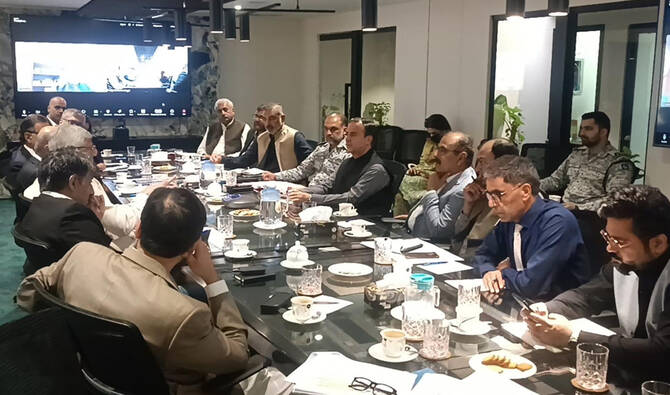
Federal Minister for Maritime Affairs, Junaid Anwar Chaudhry (fifth right), speaks during a meeting with Pakistan Business Council Forum in Karachi, Pakistan, on May 31, 2025. (PID)
Short Url
Updated 31 May 2025
Follow

Pakistan to set up maritime chamber to boost blue economy, promote greener ports

  • Maritime minister says new chamber will unite industry to drive sustainable growth and long-term economic resilience
  • Pakistan aims to grow its blue economy through sustainable use of ocean resources for jobs and ecosystem health

KARACHI: The Pakistan government on Saturday announced the creation of a new Maritime Chamber of Commerce and Industry (MCCI) to promote sustainable development in the country’s coastal and marine sectors, saying the initiative would help strengthen the country’s blue economy while addressing rising climate risks at its ports.

Addressing the Pakistan Business Council Forum, Federal Minister for Maritime Affairs Junaid Anwar Chaudhry said Pakistan’s coastal zones were increasingly exposed to environmental challenges such as rising sea levels, extreme weather events and marine degradation.

The new chamber, he noted, would serve as a specialized platform for uniting stakeholders from across the maritime spectrum to pursue greener policies and long-term economic resilience.

“This chamber will not only support investment and innovation in the maritime sector but also prioritize sustainability at ports, promote green technologies and foster carbon reduction strategies,” he told the participants of the forum.

Pakistan is striving to strengthen blue economy by ensuring the sustainable use of ocean resources for economic growth, jobs and ecosystem health.

This requires the authorities to enhance the potential of its ports, fisheries, logistics and marine services while reducing environmental harm.

The new chamber is expected to provide a unified institutional voice for sectors ranging from shipping to coastal tourism, helping to align business incentives with climate adaptation goals.

Pakistan has been pushing to modernize its port infrastructure and expand its role in regional trade by improving cargo handling, digitalizing port operations and encouraging public-private partnerships.

The country has also invited landlocked Central Asian states to use its ports to access global markets, aiming to position itself as a regional trade hub.

The Pakistan Business Council welcomed the announcement, calling the new chamber a critical step toward building a climate-resilient and economically vibrant maritime economy.

Pakistan moves to digitize payments for 10 million women under flagship poverty initiative

Updated 5 sec ago
Follow

Pakistan moves to digitize payments for 10 million women under flagship poverty initiative

  • BISP Official says accounts will be linked to phones to boost financial inclusion and curb payment deductions
  • Over 1.9 million SIMs issued as the nationwide rollout continues across provinces ahead of the March deadline

ISLAMABAD: Pakistan’s flagship poverty alleviation initiative, the Benazir Income Support Program (BISP), plans to equip 10 million women with digital bank accounts linked to their phone numbers within four months in one of the largest such exercises in the world, one of its top officials said on Wednesday.

Launched in 2008, the initiative is named after the late former prime minister Benazir Bhutto and has a budget of Rs716 billion ($2.5 billion) during the current fiscal year. Through its Benazir Kafaalat — or financial assistance — program, BISP provides quarterly stipends of Rs13,500 ($48) to around 10 million women.

In an exclusive interview with Arab News, BISP Secretary Amir Ali Ahmed said the opening of digital bank accounts for the beneficiaries was part of Prime Minister Shehbaz Sharif’s initiative related to a cashless economy and digital transformation of the country.

“I’m glad to share that 10 million bank accounts, wallet accounts were created,” he said. “This is a follow-up of the same exercise whereby now 10 million SIMs are being distributed.

“It is significant to share that the entire beneficiary network that we have is female-centric,” he continued. “So these are 10 million female accounts that have been created.”

Ahmed said the process of issuing mobile phone SIM cards to BISP beneficiaries had started on November 17 and would be completed by March next year.

“Let me share that this is one of the largest such exercises to be conducted in the world which is female-centric, linked with financial inclusion and financial empowerment.”

The BISP official added that out of the more than 10 million beneficiaries, only five to 10 percent had bank accounts, but nearly 90 to 95 percent were excluded from the system.

He said they were being linked to the banking system with cellphone SIMs that are being distributed with the help of the IT ministry, Pakistan Telecommunication Authority, National Database and Registration Authority and telecom companies across the country.

“We feel that this initiative of the government of Pakistan will not only result in financial empowerment of our beneficiaries, it will also result in financial inclusion of a segment which was not part of the banking sector in Pakistan,” he said, adding that the move will also lead to transparency.

In the past, there have been complaints of women not getting their full payment from bank officials in the absence of their own accounts, but Ahmed said this was going to change.

“They will be free from any exploitation at the agent networks, the queues that one would witness, the complaints of corruption or deductions that would emerge,” he continued.

According to official data, more than 1.9 million SIMs have so far been issued for BISP beneficiaries across the country.

The province of Punjab leads the rollout with 810,597 SIMs, followed by Sindh with 523,629 and Khyber Pakhtunkhwa with 371,427 SIMs.

In other regions, Azad Jammu and Kashmir has received 59,617, Balochistan 82,826, Gilgit-Baltistan 45,184, and Islamabad 4,508 SIMs.