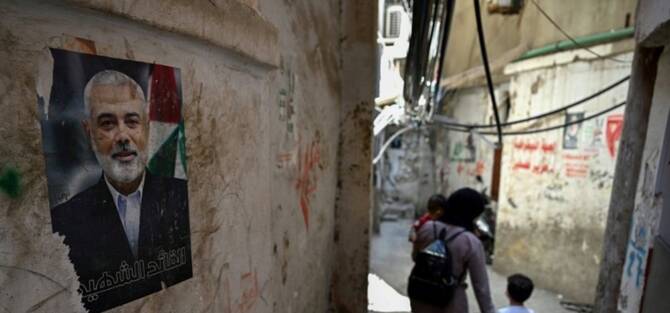
BEIRUT: Lebanese official media said an Israeli strike killed one person in the south on Saturday despite a six-month-old ceasefire, as Israel said it targeted a Hezbollah militant.
The state-run National News Agency (NNA) said a man was killed when an Israeli drone targeted his car as he was heading to pray at a mosque in Deir Al-Zahrani, about 20 kilometers (12 miles) from the Israeli border.
Israel has continued to bomb Lebanon despite the November 27 truce that sought to halt more than a year of hostilities with Hezbollah including two months of open war.
The Israeli army said the strike killed a regional commander “of Hezbollah’s rocket array.”
It charged that during the conflict, the operative “advanced numerous projectile attacks... and was involved recently in efforts to reestablish Hezbollah’s terrorist infrastructure” in south Lebanon.
Under the terms of the ceasefire, Hezbollah fighters were to pull back north of the Litani River, some 30 kilometers (20 miles) from the border, and dismantle military infrastructure to its south.
Israel was to withdraw all forces from Lebanon but it has kept troops in five areas it deems “strategic.”
The Lebanese army has deployed in the south and has been dismantling Hezbollah infrastructure.

Israel strike on south Lebanon kills one
Short Url
https://arab.news/6sm9z
Israel strike on south Lebanon kills one
- The Israeli army said the strike killed a regional commander “of Hezbollah’s rocket array"
UN makes first visit to Sudan’s El-Fasher since its fall, finding dire conditions
- Paramilitary force overran the city in October committing widespread atrocities
- UN team visited Saudi Hospital where RSF massacred hundreds of people
CAIRO: A UN humanitarian team visited El-Fasher in Sudan’s Darfur region for the first time since a paramilitary force overran the city in October, carrying out a rampage that is believed to have killed hundreds of people and sent most of the population fleeing.
The hours-long visit gave the UN its first glimpse into the city, which remains under control of the Rapid Support Forces. The team found hundreds of people still living there, lacking adequate access to food, medical supplies and proper shelter, the UN said Wednesday.
“It was a tense mission because we’re going into what we don’t know … into a massive crime scene,” Denise Brown, the UN humanitarian coordinator for Sudan, said of Friday’s visit.
For the past two months, El-Fasher has been nearly entirely cut off from the outside world, leaving aid groups unsure over how many people remained there and their situation. The death toll from the RSF takeover, which came after a more than a year-long siege, remains unknown.
Survivors among the more than 100,000 people who fled El-Fasher reported RSF fighters gunning down civilians in homes and in the streets, leaving the city littered with bodies. Satellite photos have since appeared to show RSF disposing of bodies in mass graves or by burning them.
Brown said “a lot of cleaning up” appeared to have taken place in the city over the past two months. The UN team visited the Saudi Hospital, where RSF fighters reportedly killed 460 patients and their companions during the takeover.
“The building is there, it’s clearly been cleaned up,” Brown said of the hospital. “But that doesn’t mean by any stretch of the imagination that this story has been wiped clean because the people who fled, fled with that story.”
El-Fasher lacks shelters and supplies
El-Fasher, the capital of North Darfur state, had been the last stronghold of the Sudanese military in the Darfur region until the RSF seized it. The RSF and the military have been at war since 2023 in a conflict that has seen multiple atrocities and pushed Sudan into one of the world’s worst humanitarian crises.
The UN team visiting El-Fasher focused on identifying safe routes for humanitarian workers and conducted only an initial assessment on the situation on the ground, with more teams expected to enter, Brown said.
“Villages around El-Fasher appeared to be completely abandoned. We still believe that people are being detained and that there are people who are injured who need to be medically evacuated,” said Brown, citing the initial UN findings.
The exact number of people still living in the city is hard to determine, but Brown said they’re in the hundreds and they lack supplies, social services, some medications, education and enough food.
They are living in deserted buildings and in shelters they erected using plastic sheets, blankets and other items grabbed from their destroyed homes. Those places lack visible toilets and access to clean drinking water.
The first charity kitchen to operate since the city’s fall opened Tuesday in a school-turned- shelter, according to the Nyala branch of the local aid initiative Emergency Response Rooms (ERR). The charity kitchen will be operated by ERR Nyala, serving daily meals, food baskets, and shelter supplies. More community kitchens are expected to open across 16 displacement centers, sheltering at least 100 people.
The UN team found a small open market operating while they were in the city, selling limited local produce such as tomatoes and onions. Other food items were either unavailable or expensive, with the price of one kilogram (2.2 pounds) of rice reaching as high as $100, Brown said.
‘Paralyzed’ health care system
Mohamed Elsheikh, spokesperson for the Sudan Doctors Network, told The Associated Press Wednesday that medical facilities and hospitals in El-Fasher are not operating in full capacity.
“El-Fasher has no sign of life, the health care system there is completely paralyzed. Hospitals barely have access to any medical aid or supplies,” he added.
Brown described the situation in El-Fasher as part of a “pattern of atrocities” in this war that is likely to continue in different areas.
The United States has accused the RSF of committing genocide in Darfur during the war, and rights groups said the paramilitaries committed war crimes during the siege and takeover of El-Fasher, as well as in the capture of other cities in Darfur. The military has also been accused of rights violations.
The hours-long visit gave the UN its first glimpse into the city, which remains under control of the Rapid Support Forces. The team found hundreds of people still living there, lacking adequate access to food, medical supplies and proper shelter, the UN said Wednesday.
“It was a tense mission because we’re going into what we don’t know … into a massive crime scene,” Denise Brown, the UN humanitarian coordinator for Sudan, said of Friday’s visit.
For the past two months, El-Fasher has been nearly entirely cut off from the outside world, leaving aid groups unsure over how many people remained there and their situation. The death toll from the RSF takeover, which came after a more than a year-long siege, remains unknown.
Survivors among the more than 100,000 people who fled El-Fasher reported RSF fighters gunning down civilians in homes and in the streets, leaving the city littered with bodies. Satellite photos have since appeared to show RSF disposing of bodies in mass graves or by burning them.
Brown said “a lot of cleaning up” appeared to have taken place in the city over the past two months. The UN team visited the Saudi Hospital, where RSF fighters reportedly killed 460 patients and their companions during the takeover.
“The building is there, it’s clearly been cleaned up,” Brown said of the hospital. “But that doesn’t mean by any stretch of the imagination that this story has been wiped clean because the people who fled, fled with that story.”
El-Fasher lacks shelters and supplies
El-Fasher, the capital of North Darfur state, had been the last stronghold of the Sudanese military in the Darfur region until the RSF seized it. The RSF and the military have been at war since 2023 in a conflict that has seen multiple atrocities and pushed Sudan into one of the world’s worst humanitarian crises.
The UN team visiting El-Fasher focused on identifying safe routes for humanitarian workers and conducted only an initial assessment on the situation on the ground, with more teams expected to enter, Brown said.
“Villages around El-Fasher appeared to be completely abandoned. We still believe that people are being detained and that there are people who are injured who need to be medically evacuated,” said Brown, citing the initial UN findings.
The exact number of people still living in the city is hard to determine, but Brown said they’re in the hundreds and they lack supplies, social services, some medications, education and enough food.
They are living in deserted buildings and in shelters they erected using plastic sheets, blankets and other items grabbed from their destroyed homes. Those places lack visible toilets and access to clean drinking water.
The first charity kitchen to operate since the city’s fall opened Tuesday in a school-turned- shelter, according to the Nyala branch of the local aid initiative Emergency Response Rooms (ERR). The charity kitchen will be operated by ERR Nyala, serving daily meals, food baskets, and shelter supplies. More community kitchens are expected to open across 16 displacement centers, sheltering at least 100 people.
The UN team found a small open market operating while they were in the city, selling limited local produce such as tomatoes and onions. Other food items were either unavailable or expensive, with the price of one kilogram (2.2 pounds) of rice reaching as high as $100, Brown said.
‘Paralyzed’ health care system
Mohamed Elsheikh, spokesperson for the Sudan Doctors Network, told The Associated Press Wednesday that medical facilities and hospitals in El-Fasher are not operating in full capacity.
“El-Fasher has no sign of life, the health care system there is completely paralyzed. Hospitals barely have access to any medical aid or supplies,” he added.
Brown described the situation in El-Fasher as part of a “pattern of atrocities” in this war that is likely to continue in different areas.
The United States has accused the RSF of committing genocide in Darfur during the war, and rights groups said the paramilitaries committed war crimes during the siege and takeover of El-Fasher, as well as in the capture of other cities in Darfur. The military has also been accused of rights violations.
© 2025 SAUDI RESEARCH & PUBLISHING COMPANY, All Rights Reserved And subject to Terms of Use Agreement.


