

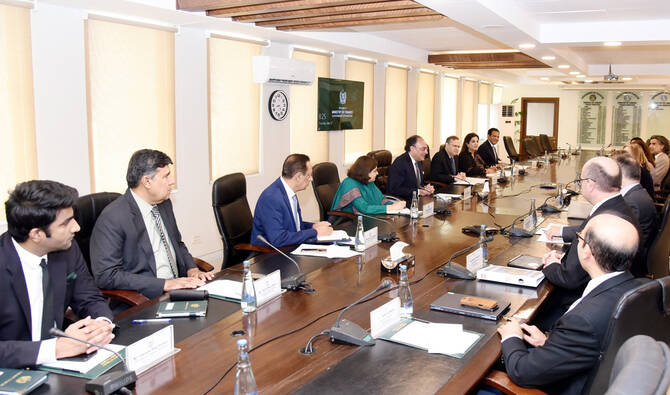

KARACHI: Pakistan’s Finance Minister Muhammad Aurangzeb on Friday called for a merit-based approach to global development financing, urging international lenders to rise above political considerations during a meeting with incoming and outgoing World Bank country directors in Islamabad.
The meeting followed weeks of diplomatic friction between nuclear-armed rivals India and Pakistan, which escalated into a four-day military standoff involving fighter jets, missiles, drones and artillery fire.
Amid the tensions, Indian authorities lobbied the International Monetary Fund (IMF) to halt the disbursement of a $1 billion tranche to Pakistan, saying the funds could finance Islamabad’s military activities.
IMF officials later dismissed the concerns, emphasizing the disbursement mechanisms ensured transparency and that IMF support was intended to stabilize developing economies’ balance of payments, with the funds directed to central banks rather than governments.
“The Minister ... highlighted the recent successful completion of the International Monetary Fund (IMF) review and the subsequent $1 billion disbursement under the Extended Fund Facility (EFF), along with additional resources made available through the Resilience and Sustainability Facility (RSF),” said a statement circulated by the finance ministry after the meeting.
“He noted that development finance must be guided by merit and objective assessment, rising above political considerations to ensure sustainable progress,” it added.
Aurangzeb also praised the World Bank’s longstanding support for Pakistan’s economy, especially in times of fiscal stress, and reiterated Islamabad’s commitment to deepening collaboration with the institution.
He extended a warm welcome to Bolormaa Amgaabazar, the new World Bank Country Director for Pakistan, while commending her predecessor, Najy Benhassine, for his contributions during his tenure.
A key point of discussion was the World Bank’s 10-year Country Partnership Framework (CPF), a strategic agreement designed to guide development cooperation through targeted investments in Pakistan’s critical sectors.
The CPF, finalized during Benhassine’s tenure, will now be overseen by Amgaabazar and aims to unlock $20 billion for the country.
Aurangzeb highlighted the importance of effective implementation of the framework to fully leverage the Bank’s institutional, technical and financial support.
The meeting reaffirmed mutual commitment to strengthening Pakistan’s economic resilience and advancing inclusive development through strategic partnerships, the finance ministry said.


