Germany hopes for EU deal on sending failed asylum seekers to third countries, minister says

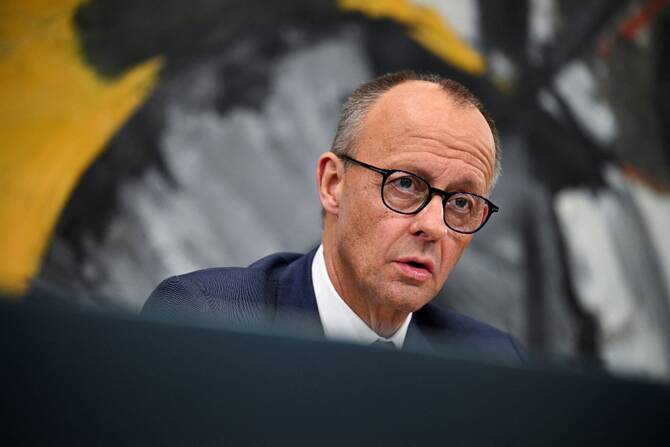
German Chancellor Friedrich Merz at a press conference at the chancellery in Berlin, Germany. (Reuters)
Short Url
Updated 31 May 2025
Follow

Germany hopes for EU deal on sending failed asylum seekers to third countries, minister says

  • The EU’s executive Commission proposed a scheme that would let member states reject asylum applications from migrants who passed through a “safe” third country on their way to the bloc

BERLIN: Germany’s interior minister is hoping the European Union can reach a bloc-wide agreement on sending failed asylum seekers who cannot go home to safe countries near their original homelands.
Chancellor Friedrich Merz’s conservatives won February’s national election on a promise to bring down immigration levels, which opinion polls showed many voters regarded as being out of control, although numbers have been falling for over a year.
In an interview with the Welt am Sonntag newspaper published on Saturday, Interior Minister Alexander Dobrindt said the approach of using third countries could work only if there was a Europe-wide consensus.
“We need third countries that are prepared to take migrants who are objectively unable to return to their home countries,” he told the newspaper.
Earlier this month, the EU’s executive Commission proposed a scheme that would let member states reject asylum applications from migrants who passed through a “safe” third country on their way to the bloc. The proposals, criticized by rights groups, have yet to be adopted by national governments or the European Parliament.
“No individual EU member state can create this model on its own: it will have to happen on an EU level,” Dobrindt said. “We are preparing the foundations for that right now.”
Dobrindt’s initial promises to tighten border controls on taking office angered neighbors who protested at plans to return to their territory those migrants found not to have a right to enter Germany.
An Italian plan to process asylum seekers picked up at sea in Albania has stalled amid Italian court challenges.
A scheme by Britain, which is not an EU member, under its previous Conservative government to send asylum seekers who arrived in Britain without permission to Rwanda was scrapped by Prime Minister Keir Starmer when he took office last year.


Russia-ally Touadera seeks third term in Central African Republic

Updated 1 sec ago
Follow

Russia-ally Touadera seeks third term in Central African Republic

BANGUI: Central African Republic President Faustin-Archange Touadera is seeking a third term in an election on Sunday, campaigning on security gains after signing deals with rebel groups and enlisting support from Russian mercenaries and Rwandan ​forces.
He faces six opposition candidates including Anicet-Georges Dologuele, a former prime minister and runner-up in the 2020 election, but is likely to win in part due to his control over state institutions, analysts say.
Such a result would likely further the interests of Russia, which has traded security assistance for access to resources including gold and diamonds. Touadera is also offering access to the country’s lithium and uranium reserves to anyone interested.
The 68-year-old mathematician took power in 2016 after the worst crisis in the chronically unstable country’s history, when three years of intercommunal strife forced a fifth of the population to flee their homes, either internally or abroad.
Touadera has signed peace deals this year with several rebel groups, while ‌others have been ‌weakened in the face of Russian mercenaries and troops from Rwanda deployed to ‌shore ⁠up Touadera’s ​government as ‌well as UN peacekeepers.
“During the 10 years that we have been working together, you yourselves have seen that peace is beginning to return, starting from all our borders and reaching the capital,” Touadera told a rally at a stadium in the capital Bangui this month.
His opponents, meanwhile, have denounced a constitutional referendum in 2023 that scrapped the presidential term limit, saying it was proof Touadera wants to be president for life.
They have also accused him of failing to make significant progress toward lifting the 5.5 million population out of poverty.
“The administrative infrastructure has been destroyed and, as you know, the roads are in a ⁠very poor state of repair,” Dologuele told a recent press conference.
“In short, the Central African economy is in ruins.”
SECURITY THREATS REMAIN DESPITE PEACE DEALS
The presidential ‌contest is taking place alongside legislative, regional and municipal elections, with provisional results ‍expected to be announced by January 5.
If no ‍candidate gets more than 50 percent of the vote, a presidential runoff will take place on February 15, while legislative ‍runoffs will take place on April 5.
A smooth voting process could reinforce Touadera’s claim that stability is returning, which was buttressed last year with the UN Security Council’s lifting of an arms embargo and the lifting of a separate embargo on diamond exports.
“The fact that these measures were lifted, it shows that we’re gradually getting back to normal. Or at least that’s the narrative,” said Romain ​Esmenjaud, associate researcher at the Institut Francais de Geopolitique.
The peace deals are credited with a decline in violence in some areas and an expected boost in economic growth projections to 3 percent this ⁠year, according to the International Monetary Fund. US President Donald Trump’s administration has said the UN should hand security back to the government soon.
But serious security threats remain. Rebels have not fully disarmed, reintegration is incomplete, and incursions by combatants from neighboring Sudan fuel insecurity in the east.
Pangea-Risk, a consultancy, wrote in a note to clients that the risk of unrest after the election was high as opponents were likely to challenge Touadera’s expected victory.
“The election will take place in an atmosphere marked by heightened grievances over political marginalization, increasing repression, and allegations of electoral fraud,” said chief executive Robert Besseling.
Dologuele alleged fraud after he was recorded as winning 21.6 percent of the vote in 2020, when rebel groups still threatened the capital and prevented voting at 800 polling stations across the country, or 14 percent of the total. A court upheld Touadera’s win.
Paul-Crescent Beninga, a political analyst, said voters will be closely scrutinizing the voting and counting processes.
“If they do not go well, it gives those ‌who promote violence an excuse to mobilize violence and sow panic among the population of the Central African Republic. So that is why we must ensure that the elections take place in relatively acceptable conditions,” he said.