

‘Everything came crashing down’: US visa freeze shatters hopes of young Pakistani students

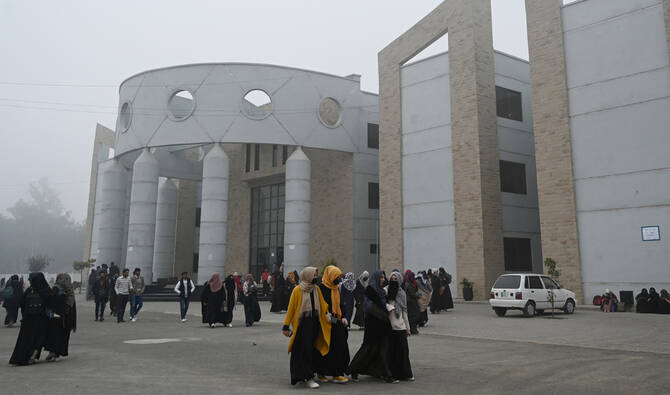
In this picture taken on January 17, 2024, students walk at the University of Mianwali campus in Mianwali, Punjab province. (AFP/File)
Short Url
Updated 31 May 2025
Follow

‘Everything came crashing down’: US visa freeze shatters hopes of young Pakistani students

  • Washington has temporarily suspended student and exchange visa appointments to expand social media vetting
  • Pakistani students say the move threatens their academic year and could cause them significant financial losses

ISLAMABAD: For many in Pakistan, the US visa freeze has felt like a devastating setback after years of academic effort and ambition, affected applicants and an education consultant said on Friday.

The suspension, ordered by US Secretary of State Marco Rubio earlier this week, halts new student and exchange visa appointments worldwide and is part of a broader policy under President Donald Trump’s administration to intensify screening of foreign nationals, including expanded social media vetting.

US embassies have been instructed to pause interviews while new guidelines are being finalized, as officials in Washington say the goal is to identify potential security risks amid a rise in campus activism following Israel’s war in Gaza, which has sharply polarized student opinion.

Trump’s critics argue, however, the measures are discriminatory and risk undermining access to American higher education for bright students from developing countries — long considered a cornerstone of the US advantage in global research and innovation.

“I had always dreamed of pursuing higher education in the United States and after months of preparation, hard work and dedication, I finally got accepted into New York University,” Mohammad Ibrahim, a student from Lahore, told Arab News over the phone.

“But just as I was preparing for the next big chapter of my life, everything came crashing down,” he continued, adding that due to the sudden visa ban imposed by the Trump administration, his plans have been put on hold.

Ibrahim said despite getting admission after meeting all the university requirements, he was now stuck in an uncertain situation, with nothing to do but wait, hope and keep trying to move forward, even when everything had suddenly gone beyond his control.

“It’s disappointing,” he said. “An entire year of my life feels like being wasted.”

Inayah Murtaza, an exchange program candidate from the same city, said the new US policy had led to delays in visa interviews and a ban on the exchange student program, leaving her and many others devastated.

“American higher education system provides excellent opportunities. However, the recent policies by the Trump administration are extremely devastating,” she said, adding the ban had hurt her both emotionally and financially.

For Malik Zalaid Hassan, from Sheikhupura, who had secured admission to study artificial intelligence at the University of California, the visa suspension was a huge setback.

“I won’t get my money back… I just lost a ton of money,” he told Arab News, emphasizing he had already paid thousands of dollars in tuition and housing fees.

“I really hope America does something about this and I really hope it changes because this has an impact on a lot of people,” he continued.

Mohammad Ayyan Akhtar, a counselor at UniGrad, an education consultancy firm in Lahore, said the visa appointments ban had placed many students in a heart-wrenching situation.

“It includes their financial losses, and on top of everything, their academic loss is a big concern,” he said.

“The Trump administration should lift [the ban] as early as possible to save the loss of hundreds of Pakistani students [of their] academic year,” he added.


Pakistan to promote mineral sector at Saudi forum this month with 13 companies

Updated 02 January 2026
Follow

Pakistan to promote mineral sector at Saudi forum this month with 13 companies

  • Delegation will take part in the Future Minerals Forum in Riyadh from Jan. 13-15
  • Petroleum minister will lead Pakistan, participate in a 90-minute country session

ISLAMABAD: Around 13 Pakistani state-owned and private companies will attend the Future Minerals Forum (FMF) in Saudi Arabia from Jan. 13 to 15, an official statement said on Friday, as the country seeks to ramp up global engagement to develop its mineral resources.

The FMF is an international conference and investment platform for the mining sector, hosted by mineral-rich countries to attract global investors, companies and governments.

Petroleum Minister Ali Pervaiz Malik confirmed Pakistan’s participation in a meeting with the Saudi envoy, Nawaf bin Said Al-Malki.

Pakistan hosts one of the world’s largest copper-gold zones. The Reko Diq mine in southwestern Balochistan, with an estimated 5.9 billion tons of ore, is partly owned by Barrick Gold, which calls it one of the world’s largest underdeveloped copper-gold deposits. Its development is expected to boost Pakistan’s struggling economy.

“Upon an invitation of the Government of the Kingdom of Saudi Arabia, the Federal Minister informed the Ambassador that Pakistan will fully participate in the upcoming Future Minerals Forum (FMF), scheduled to be held in Riyadh later this month,” Pakistan’s Press Information Department (PID) said in an official statement.

The Pakistani minister will lead his country’s delegation at the FMF and take part in a 90-minute country showcase session titled “Unleashing Potential: Accelerating Pakistan’s Mineral Revolution” along with local and foreign investors.

Pakistan will also establish a dedicated pavilion to highlight the vast potential of its rich geological landscape to the global mineral community.

The Saudi envoy welcomed Pakistan’s decision to participate in the forum and discussed enhancing bilateral cooperation in the minerals and energy sectors during the meeting.

According to the statement, he highlighted the potential for cooperation between Saudi Arabia and Pakistan in the minerals and energy sectors, expressing confidence that the FMF would provide a platform to expand collaboration.
Pakistan’s mineral sector, despite its rich reserves of salt, copper, gold and coal, contributes only 3.2 percent to the country’s GDP and just 0.1 percent to global mineral exports.

However, many countries, including the United States, have shown interest in Pakistan’s underdeveloped mineral sector, particularly in copper, gold and other critical resources.

In October, Pakistan dispatched its first-ever shipment of rare earth and critical minerals to the United States, according to a Chicago-based US public relations firm’s report.