

Syrian minister says lifting of economic sanctions offers hope for recovery

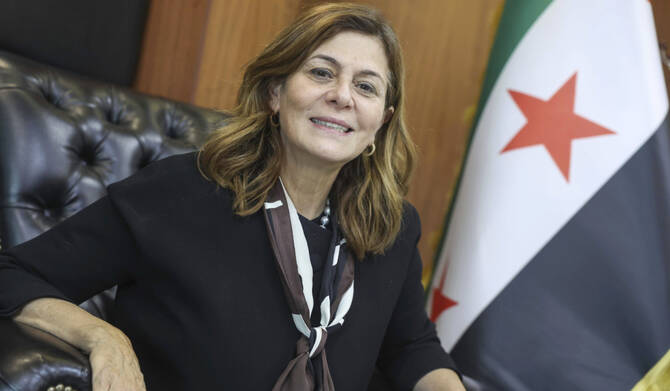
Syrian Minister of Social Affairs and Labor Hind Kabawat, speaks during an interview with the Associated Press, in Damascus, Syria, Monday, May 12, 2025. (AP)
Short Url
Updated 30 May 2025
Follow

Syrian minister says lifting of economic sanctions offers hope for recovery

  • Hind Kabawat: Govt to launch ‘temporary schools’ for the children of refugees returning to their home areas

DAMASCUS: The lifting of economic sanctions on the Syrian Arab Republic will allow the government to begin work on daunting tasks that include fighting corruption and bringing millions of refugees home, Hind Kabawat, the minister of social affairs and labor, told The Associated Press on Friday.

Kabawat is the only woman and the only Christian in the 23-member cabinet formed in March to steer the country during a transitional period after the ouster of former President Bashar Assad in December.
Her portfolio will be one of the most important as the country begins rebuilding after nearly 14 years of civil war.
She said moves by the US and the EU in the past week to at least temporarily lift most of the sanctions that had been imposed on Syria over the decades will allow that work to get started.
Before, she said, “we would talk, we would make plans, but nothing could happen on the ground because sanctions were holding everything up and restricting our work.”
With the lifting of sanctions, they can move to “implementation.”
One of the first programs the new government is planning to launch is “temporary schools” for the children of refugees and internally displaced people returning to their home areas.
Kabawat said that it will take time for the easing of sanctions to show effects on the ground, particularly since unwinding some of the financial restrictions will involve complicated bureaucracy.
“We are going step by step,” she said.
“We are not saying that anything is easy — we have many challenges — but we can’t be pessimistic. We need to be optimistic.”
The new government’s vision is “that we don’t want either food baskets or tents after five years,” Kabawat said, referring to the country’s dependence on humanitarian aid and many displacement camps.
That may be an ambitious target, given that 90 percent of the country’s population currently lives below the poverty line, according to the UN.
The civil war that began in 2011 also displaced half the country’s pre-war population of 23 million people.
The UN’s refugee agency, UNHCR, estimates that about half a million have returned to Syria since Assad was ousted.
But the dire economic situation and battered infrastructure have also dissuaded many refugees from coming back.
The widespread poverty also fed into a culture of public corruption that developed in the Assad era, including solicitation of bribes by public employees and shakedowns by security forces at checkpoints.
Syria’s new leaders have pledged to end corruption, but they face an uphill battle. Public employees make salaries far below the cost of living, and the new government has so far been unable to make good on a promise to hike public sector wages by 400 percent.
“How can I fight corruption if the monthly salary is $40 and that is not enough to buy food for 10 days?” Kabawat asked.
Syria’s new rulers, led by President Ahmad Al-Sharaa, have been under scrutiny by Western countries over the treatment of Syrian women and religious minorities.
In March, clashes between government security forces and pro-Assad armed groups spiraled into sectarian revenge attacks on members of the Alawite sect to which Assad belongs. Hundreds of civilians were killed.
The government formed a committee to investigate the attacks, which has not yet reported its findings.
Many also criticized the transitional government as giving only token representation to women and minorities.
Apart from Kabawat, the Cabinet includes only one member each from the Druze and Alawite sects and one Kurd.
“Everywhere I travel … the first and last question is, ‘What is the situation of the minorities?’” Kabawat said.
“I can understand the worries of the West about the minorities, but they should also be worried about Syrian men and women as a whole.”
She said the international community’s priority should be to help Syria build its economy and avoid the country falling into “chaos.”
Despite being the only woman in the Cabinet, Kabawat said “now there is a greater opportunity for women” than under Assad and that “today there is no committee being formed that does not have women in it.”
“Syrian women have suffered a lot in these 14 years and worked in all areas,” she said.
“All Syrian men and women need to have a role in rebuilding our institutions.”
She called for those wary of President Al-Sharaa to give him a chance.
The West has warmed to the new president — particularly after his recent high-profile meeting with US President Donald Trump.


Syrian military tells civilians to evacuate contested area east of Aleppo amid rising tensions

Updated 15 January 2026
Follow

Syrian military tells civilians to evacuate contested area east of Aleppo amid rising tensions

  • Syria’s military has announced it will open a “humanitarian corridor” for civilians to evacuate from an area in Aleppo province
  • This follows several days of intense clashes between government forces and the Kurdish-led Syrian Democratic Forces

DAMASCUS: Syria’s military said it would open a corridor Thursday for civilians to evacuate an area of Aleppo province that has seen a military buildup following intense clashes between government and Kurdish-led forces in Aleppo city.
The army’s announcement late Wednesday — which said civilians would be able to evacuate through the “humanitarian corridor” from 9 a.m. to 5 p.m. Thursday — appeared to signal plans for an offensive in the towns of Deir Hafer and Maskana and surrounding areas, about 60 kilometers (40 miles) east of Aleppo city.
The military called on the Kurdish-led Syrian Democratic Forces and other armed groups to withdraw to the other side of the the Euphrates River, to the east of the contested zone.
Syrian government troops have already sent troop reinforcements to the area after accusing the SDF of building up its own forces there, which the SDF denied. There have been limited exchanges of fire between the two sides, and the SDF has said that Turkish drones carried out strikes there.
The government has accused the SDF of launching drone strikes in Aleppo city, including one that hit the Aleppo governorate building on Saturday shortly after two Cabinet ministers and a local official held a news conference there.
The tensions in the Deir Hafer area come after several days of intense clashes last week in Aleppo city that ended with the evacuation of Kurdish fighters and government forces taking control of three contested neighborhoods. The fighting killed at least 23 people, wounded dozens more, and displaced tens of thousands.
The fighting broke out as negotiations have stalled between Damascus and the SDF, which controls large swaths of northeast Syria, over an agreement to integrate their forces and for the central government to take control of institutions including border crossings and oil fields in the northeast.
Some of the factions that make up the new Syrian army, which was formed after the fall of former President Bashar Assad in a rebel offensive in December 2024, were previously Turkiye-backed insurgent groups that have a long history of clashing with Kurdish forces.
The SDF for years has been the main US partner in Syria in fighting against the Daesh group, but Turkiye considers the SDF a terrorist organization because of its association with the Kurdistan Workers’ Party, or PKK, which has waged a long-running insurgency in Turkiye. A peace process is now underway.
Despite the long-running US support for the SDF, the Trump administration has also developed close ties with the government of interim Syrian President Ahmad Al-Sharaa and has pushed the Kurds to implement the integration deal. Washington has so far avoided publicly taking sides in the clashes in Aleppo.
The SDF in a statement warned of “dangerous repercussions on civilians, infrastructure, and vital facilities” in case of a further escalation and said Damascus bears “full responsibility for this escalation and all ensuing humanitarian and security repercussions in the region.”
Adm. Brad Cooper, commander of US Central Command, said in a statement Tuesday that the US is “closely monitoring” the situation and called for “all parties to exercise maximum restraint, avoid actions that could further escalate tensions, and prioritize the protection of civilians and critical infrastructure.” He called on the parties to “return to the negotiating table in good faith.”
Al-Sharaa blasts the SDF
In a televised interview aired Wednesday, Al-Sharaa praised the “courage of the Kurds” and said he would guarantee their rights and wants them to be part of the Syrian army, but he lashed out at the SDF.
He accused the group of not abiding by an agreement reached last year under which their forces were supposed to withdraw from neighborhoods they controlled in Aleppo city and of forcibly preventing civilians from leaving when the army opened a corridor for them to evacuate amid the recent clashes.
Al-Sharaa claimed that the SDF refused attempts by France and the US to mediate a ceasefire and withdrawal of Kurdish forces during the clashes due to an order from the PKK.
The interview was initially intended to air Tuesday on Shams TV, a broadcaster based in Irbil — the seat of northern Iraq’s semi-autonomous Kurdish region — but was canceled for what the station initially said were technical reasons.
Later the station’s manager said that the interview had been spiked out of fear of further inflaming tensions because of the hard line Al-Sharaa took against the SDF.
Syria’s state TV station instead aired clips from the interview on Wednesday. There was no immediate response from the SDF to Al-Sharaa’s comments.