

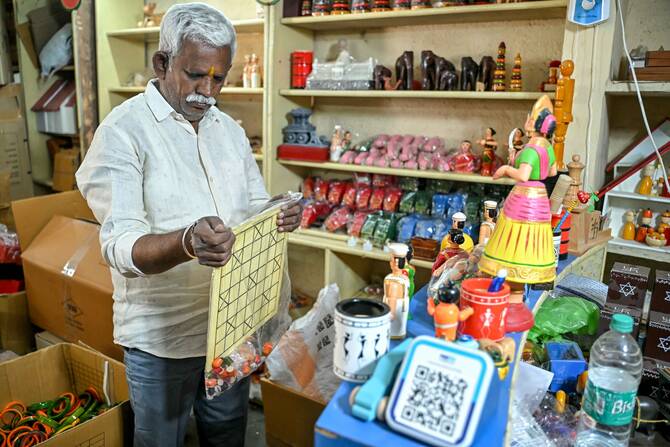

NEW DELHI: For as long as he can remember, the wooden toys of Channapatna have been a part of Suhel Parvez’s life.
As family members carefully tended the centuries-old art of toy making, Parvez grew up watching unique colors and intricate designs come to life.
“I have been brought up seeing these, because in our home (in) every place they worked on this,” Parvez told Arab News.
Today, the 35-year-old is one of a few thousand local artisans working to keep the craft alive.
“I am the fifth-generation artisan, and we are continuing the legacy of our ancestors who started this,” he said.
In the southern Indian state of Karnataka, thanks to a traditional form of toy-making that can be traced back to the 18th century, Channapatna is popularly known as the “toy town,” or “gombegala ooru.” According to local artisans, the craft started in the region after Tipu Sultan, the Muslim ruler of the kingdom of Mysore, asked artists from Persia to train the locals.
From dolls to spinning tops, Channapatna’s toys are carved from local ivory wood and dipped in bright colors made from natural ingredients, such as turmeric and indigo. While they were once all hand-carved, artisans have since begun to use some machines to keep the industry competitive.
In India, the craft is protected as a geographical indication, or GI, which is a form of intellectual property under the World Trade Organization.
The toys — popular for their long-lasting quality — have also made international headlines throughout the years. In 2010 they experienced a boom after former US First Lady Michelle Obama bought some during one of her visits to New Delhi.
In 2025, as wooden toys regain popularity across the world due to their eco-friendly qualities, craftsmen like Parvez are seeing new opportunities opening up.
“Many countries are boycotting plastic material, and for child safety people are moving slowly towards wooden toys. We have good opportunities in coming years,” Parvez said.
His Bharath Arts and Crafts unit produces traditional toys the region is known for, and also more modern versions of those often used for educational purposes.
“We don’t involve any chemical process in that … right from sourcing tools (to the) end, final product, this will be a 100 percent chemical-free process,” he added, referring to the Channapatna toys.
“Apart from that we have one more (type) known as modern toys or educational toys which are made out of synthetic colors which are non-toxic.”
While Parvez and his fellow craftsmen have exported their products to the US, UK and Australia, he says the Middle East and Africa are emerging markets for the wooden toys of southern India.
“We have very good markets (in the) Middle East and African countries — these are the emerging opportunities for us,” he said.
These days, Channapatna’s toy making industry mostly comprises seasoned artisans, those who have been in the field for decades, according to local craftsman Srinivasa Kariappa.
“Those who are working in the industry have at least 15 or 20 years of experience, new people are not joining,” he told Arab News.
The 37-year-old, who runs Harsha Industries, believes that there is still time to welcome new people to preserve the tradition.
“Handwork is important in Channapatna toys,” he said. “The government should open a training center where a new set of people can come and join the toy industry. We need new families and people to join the industry and expand (it).”


