

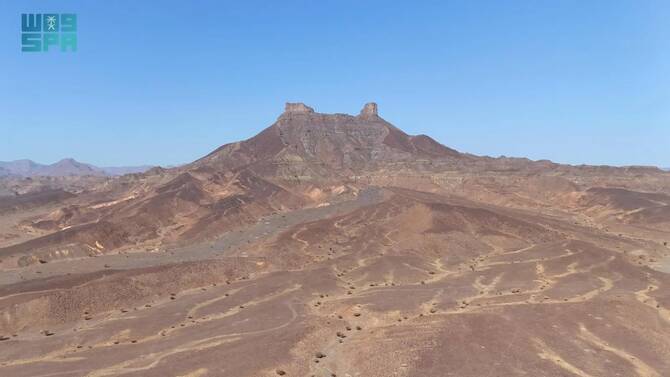

AlUla: Rising from the landscape north of Madinah, Mount Al-Fahlatain has served as a geographical beacon and spiritual waypoint for more than a thousand years.
The landmark, on the historic route to AlUla, bears witness to one of Islam’s most significant military expeditions — the Prophet Muhammad’s journey to Tabuk in 9 A.H.
The mountain’s name tells its own story. Two colossal rocks crown its summit, their silhouette resembling the horns of a bull — “fahl” in Arabic, giving rise to “Al-Fahlatain,” or “the two bulls.”
The sacred site has been documented meticulously by historians and travelers.
Ali Al-Samhudi’s work, “Wafa Al-Wafa Bi Akhbar Dar Al-Mustafa,” places the location precisely one day’s march from Madinah, describing twin peaks sheltering underlying rock formations. Firuzabadi reinforced its historical significance in “Al-Maghanim Al-Mutaba fi Ma’alim Taba,” cataloging it among the landmarks witnessed by the Prophet’s army on their way to Tabuk.
Mohammed Ibn Abdullah Al-Mawlawi provided additional detail in “Rihlat Al-Shita Wa Al-Sayf,” positioning the twin peaks on the mountain’s western flank alongside the main thoroughfare. Al-Suwaidi offered an alternative etymology in “Al-Nafha Al-Miskiyya Fi Al-Rihla Al-Makkiyya,” suggesting the name reflects the mountain’s solitary stance in the landscape, isolated like a bull among grazing camels.
Historian and Islamic history researcher Fouad Al-Maghamsi identifies Mount Al-Fahlatain — sometimes called Faifa Al-Fahlatain — as strategically positioned near Shajwa village, northwest of Madinah.
With an elevation of 1,084 meters, the mountain commands sweeping views across the surrounding plains, bordered by complementary ridges and highlands.
Al-Maghamsi said the site functioned as a vital rest station along the Syrian Hajj route, known as Darb Al-Hajj Al-Shami, earning local appellations including “Antar’s Fortress” and “Antar’s Stable.”
Archaeological evidence such as building foundations and service facilities suggests a sophisticated infrastructure designed to support the thousands of pilgrims and merchants who annually traversed these routes.
The Syrian Hajj route encompasses diverse terrain rich with sites linked to prophetic biography and pilgrimage heritage.


