

Pakistan criminalizes child marriages in Islamabad despite opposition from Council of Islamic Ideology

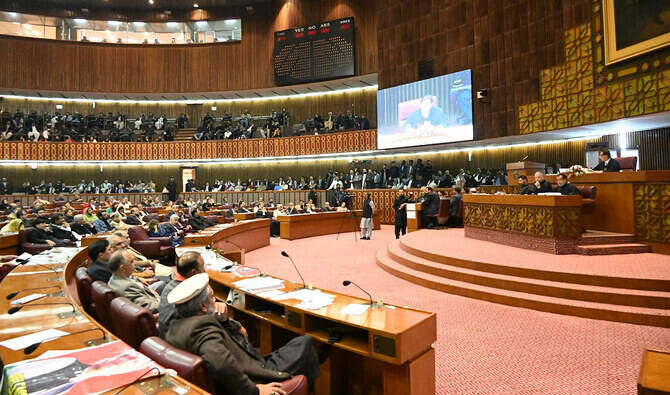
In this handout photo, taken and released by the Government of Pakistan, members of Pakistan’s lower house of parliament attend the National Assembly meeting in Islamabad on March 1, 2024. (Photo courtesy: X/@NAofPakistan/File)
Short Url
Updated 30 May 2025
Follow

Pakistan criminalizes child marriages in Islamabad despite opposition from Council of Islamic Ideology

  • Under the new law, the minimum age for marriage is set at 18 for both men and women in the federal capital
  • Prison terms of up to seven years have been introduced for those who facilitate or coerce children into early marriages

ISLAMABAD: Pakistani President Asif Ali Zardari on Friday signed into law a bill criminalizing child marriages in the federal capital of Islamabad, despite opposition from a constitutional body that advises the Pakistani government on the compatibility of laws with Islam.

The law criminalizes underage marriages and introduces strict penalties of up to seven years in prison for family members, clerics and marriage registrars who facilitate or coerce children into early marriages. Any sexual relations within a marriage involving a minor, regardless of consent, will be considered statutory rape, according to the law. An adult man who marries a girl under the legal age could face up to three years in prison.

Pakistan’s National Assembly had unanimously passed the Islamabad Capital Territory Child Marriage Restraint Bill tabled by Pakistan Peoples Party’s (PPP) Sharmila Faruqui on May 16. Under the new law, the minimum legal age for marriage for both men and women in Islamabad is 18. Previously, it was 16 for girls and 18 for boys.

However, the Council of Islamic Ideology this week declared the said bill “un-Islamic,” saying that clauses of the bill, such as fixing the age limit for marriage and declaring marriage below the age of 18 as child abuse and punishable, did not conform with Islamic injunctions.

“The Islamabad Capital Territory Child Marriage Restraint Bill, 2025 is assented to, as passed by the Parliament,” President Zardari was quoted as saying in a notification issued from his office.

In Pakistan, 29 percent of girls are married by the age of 18 and 4 percent marry before the age of 15, according to Girls Not Brides, a global coalition working to end child marriage. In comparison, five percent of boys marry before 18.

PPP Senator Sherry Rehman thanked the president for signing the bill into law “despite all pressure.”

“Proud moment for Pakistan,” she said on X. “Thank you to all the women and men who made this possible after a long journey of twists and turns.”

Pakistan ranks among the top 10 countries globally with the highest absolute number of women who were married or in a union before turning 18.
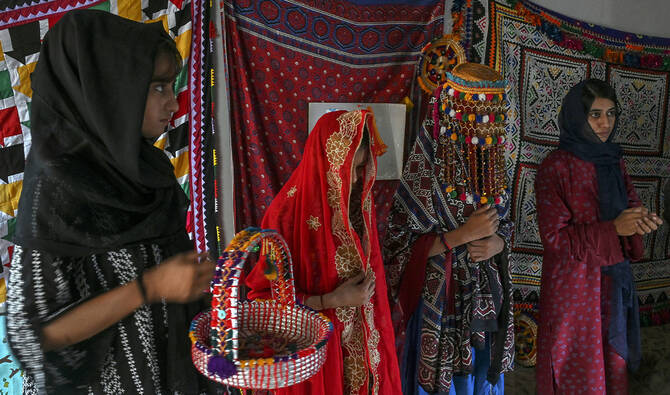


In this photograph taken on August 4, 2024 social workers at NGO Sujag Sansar take part in a theatre practice ahead of their performance, intending to create awareness on dangers of child-marriages at the NGO office in Johi, Dadu district of Sindh province. (AFP/File)

Girls who marry young are less likely to complete their education and are more vulnerable to domestic violence, abuse and serious health complications.

Pregnancy poses significantly higher risks for child brides, increasing the chances of obstetric fistulas, sexually transmitted infections and even maternal death. Teenagers are far more likely to die from childbirth-related complications than women in their twenties.


Pakistan PM, Azerbaijan president agree to boost cooperation in defense, energy and trade

Updated 07 November 2025
Follow

Pakistan PM, Azerbaijan president agree to boost cooperation in defense, energy and trade

  • PM Shehbaz Sharif was accompanied by Field Marshal Asim Munir during his meeting with Aliyev
  • Pakistan and Azerbaijan have been expanding cooperation through high-level visits and agreements

ISLAMABAD: Prime Minister Shehbaz Sharif and Azerbaijan President Ilham Aliyev on Friday agreed to further strengthen cooperation in defense, energy, trade and politics, said an official statement released in Islamabad.

The development took place during a meeting between the two leaders in Baku, which was also attended by Pakistan Army Chief Field Marshal Asim Munir.

Sharif and Munir are currently visiting the Central Asian state to attend the 50th Victory Day celebrations marking the end of Azerbaijan’s 44-day war with Armenia over Karabakh.

Pakistan and Azerbaijan have expanded cooperation this year through high-level visits and multiple agreements while reaffirming mutual support on regional and international issues.

“Both leaders reviewed bilateral relations and agreed to further strengthen their multifaceted cooperation in the areas of politics, trade and investment, energy, connectivity and defense,” the PM Office said in a statement.

During the meeting, Sharif thanked Aliyev for the invitation to the celebrations and congratulated the government and people of Azerbaijan.

He said Azerbaijan’s victory served as a “beacon of hope” for the people of Kashmir and Palestine.

Aliyev accepted Sharif’s invitation to visit Islamabad again and thanked Pakistan for its support in Azerbaijan’s struggle in the Karabakh region. He also praised Pakistan’s role in promoting regional stability in South Asia.

This marks Sharif’s fourth visit to Azerbaijan this year. 

In July, he met President Aliyev in Khankendi on the sidelines of the 17th ECO Summit, while in May he traveled to Baku as part of a broader economic diplomacy drive with Central Asian republics, offering them access to Pakistan’s southern ports in Karachi and Gwadar.

In addition to their long-standing fraternal ties, Pakistan and Azerbaijan maintain close cooperation in regional and international forums including the Organization of Islamic Cooperation, the Economic Cooperation Organization and the United Nations.

In July 2024, Azerbaijan announced a $2 billion investment in Pakistan during President Aliyev’s visit to Islamabad.

Earlier, in September 2023, Pakistan signed a contract to supply JF-17 Block III fighter jets to Azerbaijan, marking a significant step in strengthening defense cooperation.