As Russia intensifies attacks, Ukraine air defenses under strain

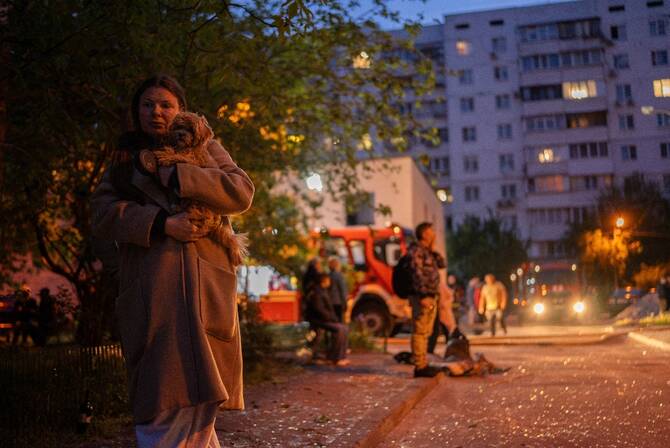
A woman carries her dog following a Russian attack on a residential building in Kyiv, Ukraine. (AP)
Short Url
Updated 30 May 2025
Follow

As Russia intensifies attacks, Ukraine air defenses under strain

  • Despite peace talks between Kyiv and Moscow, Russia has launched the heaviest assaults on Ukraine since the start of war with more than 900 drones and 90 missiles over last weekend alone

KYIV: A wave of massive Russian aerial attacks has stretched Ukraine’s air defenses, raising fears about Kyiv’s reliance on Western systems to protect its skies in the fourth year of Russia’s invasion.
As the two sides open peace talks and Kyiv pushes for an immediate ceasefire, Moscow has launched its heaviest air assaults of the war, pummelling Ukraine with more than 900 drones and 90 missiles in a three-day barrage last weekend.
Ukraine downed over 80 percent of the incoming projectiles, but more than a dozen people were killed.
Experts worry how long the country can fend off the nightly attacks if Russia maintains — or escalates — its strikes.
“Ukraine’s air defenses are stretched thin and cannot guarantee protection for all cities against persistent and sophisticated Russian attacks,” military analyst Franz-Stefan Gady told AFP.
Russia’s drone and missile attacks have become more complex — and harder to thwart — throughout the war.
Kyiv’s air force says around 40 percent of drones launched recently are decoys — cheaper dummy craft that mimic attack drones and are designed to exhaust and confuse air defenses.
Russia increasingly sets drones to fly at a higher altitude — above 2,000 meters (6,500 feet) — and then dive down onto targets.
“At that altitude, they’re more visible to our radars but unreachable for small arms, heavy machine guns and mobile fire teams,” air force spokesman Yuriy Ignat told RBK Ukraine.
In addressing the threat, Ukraine is trying to strike a balance between pressing the West to deliver new systems and not wanting to concern a war-weary public at home.
“There’s no need to panic,” a Ukraine military source told AFP.
“We’re using all air defense systems that are available in Ukraine now, plus helicopters and aircraft. We are fighting somehow,” they said.

Moscow has the capacity to fire 300 to 500 drones a day, Ukrainian President Volodymyr Zelensky said earlier this week.
“By scaling up the use of Shaheds, they are forcing us to resort to expensive options,” military analyst Sergiy Zgurets said, referring to the Iranian-designed drones that are packed with explosives to detonate as they crash into buildings.
“This is a war of attrition that must be based on economic grounds — we must shoot down Shaheds with less sophisticated alternatives,” he said.
Ukraine uses several tools to protect its skies — from advanced Western fighter jets and air defense batteries like the US-made Patriot anti-missile system, to small mobile air defense teams armed with guns.
New technology has also become vital, such as the electronic jamming of drones to make them drop from the sky.
Increasingly, interceptors are being deployed — smaller, cheaper drones that take on enemy drones mid-air.
“We are already using them. The question now is when we will be able to scale up,” Zelensky said of the interceptors.
He too sees the issue as one of economics.
“The question is no longer about production capacity... It is a financial issue,” he told journalists.

Beyond drones, Russia is also deploying super-fast ballistic missiles, which are much more difficult to intercept.
“The biggest vulnerability lies in defending against ballistic missiles,” said analyst Gady.
A midday strike last month on the northeastern city of Sumy killed at least 35 people, while a hit near a children’s playground in Zelensky’s home city of Kryvyi Rig left 19 dead, including nine children.
To fend off ballistic missile attacks, Ukraine relies on a small number of Patriot systems.
They are concentrated around Kyiv, leaving other areas more exposed than the relatively better-protected capital.
Gady said the current supply of missiles for them is “sufficient” given the level of Russian strikes at the moment.
“But it is generally insufficient when compared to Russian ballistic missile production.”
Ukraine also faces potential shortages given delays in US output, according to Zgurets, creating “gaps” in Ukraine’s “fight against enemy hypersonic targets and ballistics.”
Deliveries of other key Western systems are expected over the next 18 months, but uncertainty is high given President Donald Trump’s criticism of aid for Ukraine.
US packages approved under predecessor Joe Biden are trickling in, but Trump has not announced any fresh support.
“Delivering air defense systems to us means real protection for people — here and now,” Zelensky said in a recent call for Western backing.
On a visit to Berlin on Wednesday, he said: “Defending our cities requires constant support with air defense systems.”


Isolated Kremlin critics lament lost future at Nemtsov memorial

Updated 4 sec ago
Follow

Isolated Kremlin critics lament lost future at Nemtsov memorial

  • Hundreds used to flock to the makeshift memorial on the anniversary of his death
  • Since Russia ordered troops into Ukraine it has intensified a crackdown on dissent, with almost no opposition to the Kremlin visible on the street

MOSCOW: On a bridge next to the Kremlin on a drizzly Friday morning, a lone Russian police officer stood looking at the half-dozen bunches of flowers laying in memory of slain opposition figure Boris Nemtsov.
The symbolism was almost too much.
Four years into Moscow’s full-scale offensive on Ukraine, which has seen President Vladimir Putin eradicate all forms of dissent and usher in strict military censorship laws that have silenced his critics, few Russians dared, or wanted, to pay tribute.
Nemtsov, a longtime Putin opponent, was shot and killed on February 27 2015, meters from the Kremlin’s red walls. He was 55.
Hundreds used to flock to the makeshift memorial on the anniversary of his death, which came on Friday.
This year, there was barely a trickle. Those who turned up were visibly nervous.
“So few people, they’ve all forgotten,” lamented one elderly man, who refused to give his name.
“Everybody is afraid,” a woman standing nearby added.
Since Russia ordered troops into Ukraine it has intensified a crackdown on dissent, with almost no opposition to the Kremlin visible on the street.
AFP reporters on Friday morning saw only around a dozen mourners alongside Western ambassadors laying red carnations.
“Keep moving, don’t gather in a crowd, don’t block the way for other citizens,” a police officer said through a megaphone.
Three days after Russia launched its offensive on Ukraine in 2022, protesters had staged an impromptu rally against the war at the memorial on the anniversary of Nemtsov’s death.
Nemtsov’s supporters have always accused Chechen leader and key Putin ally Ramzan Kadyrov of ordering his killing.
Kadyrov has rejected the claims.
Five Chechens were convicted of a contract killing but investigators never said who it was ordered by.

- ‘Everything is persecuted’ -

For his followers, Nemtsov is a totemic figure in Russian political life — seen as a once-future leader who might have taken the country on a different path.
“I come here every year,” said 79-year-old scientist Sergei at the bridge on Friday.
“Russia should have had — though unfortunately it didn’t work out — a leader exactly like Nemtsov,” he told AFP, declining to give his surname.
“Right now everything here is suppressed, everything is persecuted, people are sitting in prisons.”
A physicist by education, Nemtsov rose to fame in the 1990s as a young, liberal provincial governor, and was widely tipped to take over from Boris Yeltsin.
He gave his hesitant backing to Putin when the ex-KGB spy was tapped to enter the Kremlin instead, but became an early — and fierce — opponent of what he cast as the Russian leader’s creeping authoritarianism.
He had largely lost popularity and was only a marginal figure in Russian politics when he was killed in 2015. Still, his murder shocked the country and the world.
“The hopes of the whole country were pinned on him — of all the people who wanted it to be free here,” said Olga Vinogradova, a 66-year-old volunteer who tends to the pop-up memorial to Nemtsov on the bridge.
“When this man was killed, naturally, all of us were, we were all just executed at that moment. Because our hopes were destroyed,” she said.
“With this memorial, we remind people that there was a different path for Russia. And that there was a real person who could have led us down this path.”

- ‘Forced out’ -

Nemtsov had strongly opposed Putin’s 2014 annexation of Crimea from Ukraine and Moscow’s military backing for pro-Russian separatists in eastern Ukraine.
He was also a close and early ally of Alexei Navalny, who died in 2024 in an Arctic prison in what his supports say was a poisoning.
Open opposition to the Kremlin is unheard of inside Russia since the first days of the Ukraine offensive — when riot police cracked down hard on the thousands that took to the streets to protest.
All major critics of the Kremlin are in exile, prison or dead.
Those that remain have been silenced.
“Many have been forced out of the country, some have been killed,” said Gleb, a 23-year-old photographer.
A movement or person like Nemtsov was “impossible” to imagine right now, he said.
Still, he held on to a slither of hope.
“But everything can change at any moment.”