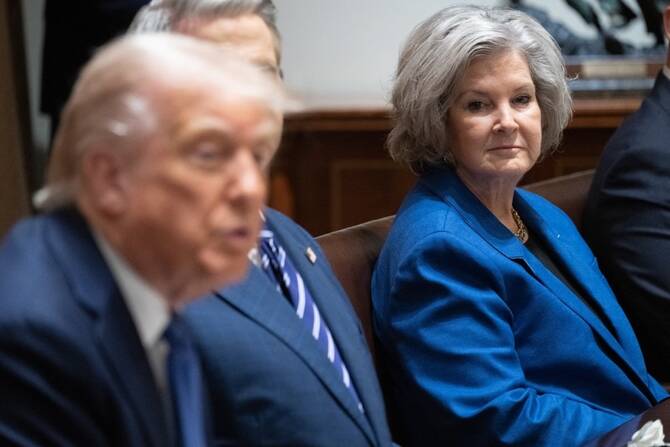
US federal authorities are investigating an effort to impersonate White House Chief of Staff Susie Wiles, the Wall Street Journal reported on Thursday, citing people familiar with the matter.
The report said Wiles had told associates that some of her cellphone contacts had been hacked, allowing the impersonator to access private phone numbers.
The incident affected her personal phone, not her government phone, the report said.
The Journal reported that in recent weeks, senators, governors, top US business executives and other figures received messages and calls from a person who claimed to be Wiles, citing the people familiar with the messages.
The White House and FBI did not immediately respond to requests for comment.
The White House has struggled with information security. A hacker who breached the communications service used by former Trump national security adviser Mike Waltz earlier this month intercepted messages from a broad swathe of American officials, Reuters reported recently.
And late last year, a White House official said the US believed that an alleged sweeping Chinese cyber espionage campaign known as Salt Typhoon targeted and recorded telephone calls of “very senior” American political figures.
As Wiles is a key Trump lieutenant and a lynchpin of the White House’s operation, the content of her personal phone would be of extraordinary interest to a range of foreign intelligence agencies and other hostile actors.
Wiles has reportedly been targeted by hackers at least once before, in the final months of Trump’s 2024 presidential campaign. At the time, hackers alleged by US authorities to be acting on behalf of Iran approached journalists and a political operative with a variety of messages sent to and from Wiles, some of which were eventually published.


US probes effort to impersonate White House Chief of Staff, WSJ reports
https://arab.news/9brw7
US probes effort to impersonate White House Chief of Staff, WSJ reports


South Sudan officers face court martial over civilian massacre
- The increasingly unstable country is seeing a surge of fighting between government and opposition forces
JUBA: South Sudanese soldiers, including two officers, will face a court martial over a civilian massacre last month, the army spokesman said Wednesday.
The increasingly unstable country is seeing a surge of fighting between government and opposition forces, much of it in eastern Jonglei state where at least 280,000 people have been displaced since December according to the UN.
At least 25 civilians, including women and children, were killed in Ayod County in Jonglei state on February 21, according to the opposition.
Army spokesman Lul Ruai Koang said that two officers, including a major, and several non-commissioned officers, had been arrested and would face charges in the capital Juba, “before they are arraigned before a competent military court martial.”
He said the deaths were attributed to “some elements” under Gen. Johnson Olony, who was filmed in January ordering troops to “spare no lives” in Jonglei.
Koang said the soldiers had “moved out without the knowledge or authorization of the division commander.”
He also said they had been part of a militia group allied to opposition forces, parts of which had not yet been fully integrated into the army.
Military integration was among the core principles of a peace agreement that ended South Sudan’s five-year civil war in 2018 between President Salva Kiir and his long-time rival, Riek Machar, but it was never implemented.
Koang said the army regretted the loss of lives, adding: “We would like to once again remind our forces that their mandate is to protect civilians and their property, not to do the opposite.”
It followed an impassioned plea from the Sudan and South Sudan Catholic Bishops’ Conference on recent civilian killings — in Ayod, and also in Abiemnom County near the Sudan border where at least 169 people were killed on Sunday.
“We implore you to deploy resources to protect vulnerable populations and foster a climate of dialogue and reconciliation instead of violence and revenge, consoling the bereaved and supporting the afflicted,” it said in a statement.


