WASHINGTON: Once again, President Donald Trump’s biggest policy plans were stopped in their tracks.
On Wednesday, an obscure but powerful court in New York rejected the legal foundation of Trump’s most sweeping tariffs, finding that Trump could not use a 1977 law to declare a national emergency on trade imbalances and fentanyl smuggling to justify a series of import taxes that have unsettled the world. Reordering the global economy by executive fiat was an unconstitutional end-run around Congress’ powers, the three-judge panel of Trump, Obama and Reagan appointees ruled in a scathing rebuke of Trump’s action.
The setbacks fit a broader pattern for a president who has advanced an extraordinarily expansive view of executive power. Federal courts have called out the lack of due process in some of Trump’s deportation efforts. His proposed income tax cuts, now working their way through Congress, are so costly that some of them can’t be made permanent, as Trump had wished. His efforts to humble Harvard University and cut the federal workforce have encountered legal obstacles. And he’s running up against reality as his pledges to quickly end the wars in Ukraine and Gaza have turned into slogs.
The laws of political gravity, the separation of powers and geopolitical realities are proving to be tougher to conquer than Trump will publicly admit. As various legal skirmishes play out, he may have to choose between bowing to the limits of his power or trying to ignore the judicial system.
“If the latter, we may have a constitutional crisis,” said University of Texas history professor H.W. Brands.
After a second federal court on Thursday found Trump’s tariffs to be improper, White House press secretary Karoline Leavitt said the Trump administration expects to prevail in its judicial appeals but also indicated that officials are exploring other laws to implement tariffs. A federal appeals court said Thursday the government can continue to collect the tariffs under the emergency powers law for now as the Trump administration challenges the ruling, though the government could be obligated to refund the money if the ruling is upheld.
Kevin Hassett, director of the White House National Economic Council, said there are two baseball caps in the room behind the Oval Office that say “Trump Always Wins” and Trump has been “right” about everything.
“Trump does always win these negotiations because we’re right,” Hassett said on Fox Business Network’s “Mornings with Maria.” “These activist judges are trying to slow down something right in the middle of really important negotiations.”
Part of Trump’s challenge lies in the nature of the job, in which only the thorniest of problems cross his desk. But there’s also the fact that Trump’s keen instincts for what plays well on TV don’t necessarily help with the nitty-gritty of policy details.
By unilaterally ordering tariffs, deportations and other actions through the White House, Trump is bypassing both Congress and the broader public, which could have given more popular legitimacy to his policy choices, said Princeton University history professor Julian Zelizer.
“The president is trying to achieve his goals outside normal legal processes and without focusing on public buy-in,” Zelizer said. “The problem is that we do have a constitutional system and there are many things a president can’t do. The courts are simply saying no. The reality is that many of his boldest decisions stand on an incredibly fragile foundation.”
As Trump sees it, his tariffs would solve genuine problems. His “Liberation Day” taxes on imports would close persistent trade imbalances with other countries, with his 10 percent baseline tariff providing a stream of revenue to help offset the trillions of dollars in federal borrowing that would be created by his planned income tax cuts.
But when the financial markets panicked and the interest charged on US debt shot up, Trump backtracked and ratcheted down many of his tariffs to 10 percent while negotiations began to take place.
Treasury Secretary Scott Bessent suggested this had been the plan all along to force new trade negotiations. But Trump shortly undercut him by saying on the White House South Lawn that he backed down because the financial markets were getting “yippy” — a reminder that Trump’s own improvizatory and disruptive style can upend any working policy process.
Trump still has tariffs in place on autos, steel and aluminum. Those are tied to the premise that imports would create national security risks based on previous investigations under Section 232 of the Trade Expansion Act of 1962. He could use other laws to start new investigations or temporarily impose tariffs, but the White House is more focused at the moment on challenging the court rulings.
“What is unprecedented is Trump asserting authority under a 1977 statute that had never been used for tariffs, not just for targeted tariffs, but the largest tariffs since the 1930s,” said Peter Harrell, a fellow at the Carnegie Endowment for International Peace who served in the Biden White House. “That’s what is unprecedented and unusual.”
Harrell said Trump could re-create many of his tariffs using other laws but “it would require more work and be a much more orderly process.”
Rice University history professor Douglas Brinkley said Trump’s sense of the presidency relies on a deep misreading of the office. He mistakenly assumes that the tariffs used in the 19th century to fund a much smaller federal government would now be able to pay for a much larger federal government. But he also assumes that power flows to and from him, rather than from institutions and the rule of law.
“He doesn’t seem to realize that anytime he doesn’t listen to the court orders that he’s making an anti-American statement,” Brinkley said. “It’s telling people that I’m bigger than the American Constitution, that judges are just errand boys for me.”
The Trump White House blamed its latest setback on the US Court of International Trade.
White House trade adviser Peter Navarro said in a Bloomberg News interview that the judicial branch was part of the problem, keeping Trump from delivering on his promises.
“We’ve got courts in this country who are basically engaged in attacks on the American people,” Navarro said. “The president ran on stopping the fentanyl poisoning, stopping international trade unfair practices from stealing our factories and jobs. And courts keep getting in the way of that.”


![]()

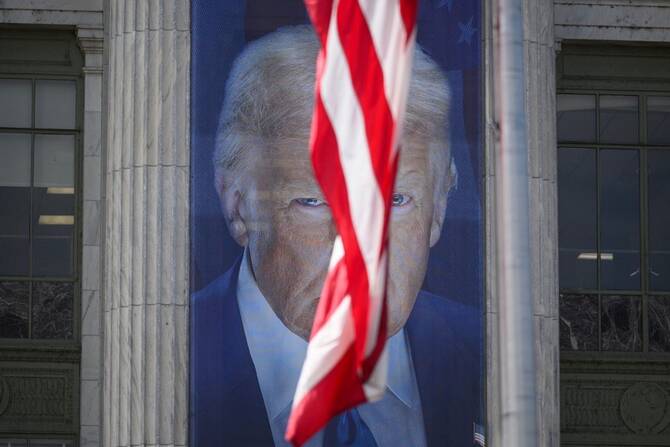
Trump’s big plans on trade and more run up against laws of political gravity, separation of powers
Short Url
https://arab.news/znnc2
Trump’s big plans on trade and more run up against laws of political gravity, separation of powers
- he laws of political gravity, the separation of powers and geopolitical realities are proving to be tougher to conquer than Trump will publicly admit


Latest updates




Recommended


© 2026 SAUDI RESEARCH & PUBLISHING COMPANY, All Rights Reserved And subject to Terms of Use Agreement.