
CAMBRIDGE, Massachusetts: Harvard graduates celebrated commencement on Thursday at a pivotal time for the Ivy League school, cheering speakers who emphasized maintaining a diverse and international student body and standing up for truth in the face of attacks by the Trump administration.
Harvard’s battles with Trump over funding and restrictions on teaching and admissions presented another challenge for the thousands of graduates who started college as the world was emerging from a pandemic and later grappled with student-led protests over the war in Gaza.
“We leave a campus much different than the one we entered, with Harvard at the center of a national battle of higher education in America,” Thor Reimann told his fellow graduates. “Our university is certainly imperfect, but I am proud to stand today alongside our graduating class, our faculty, our president with the shared conviction that this ongoing project of veritas is one that is worth defending.”
Other schools face the loss of federal funding and their ability to enroll international students if they don’t agree to the Trump administration’s shifting demands. But Harvard, which was founded more than a century before the nation itself, has taken the lead in defying the White House in court and is paying a heavy price.
A school under threat
Among the Trump administration’s latest salvos was asking federal agencies to cancel about $100 million in contracts with the university. The government already canceled more than $2.6 billion in federal research grants, moved to cut off Harvard’s enrollment of international students and threatened its tax-exempt status.
Visa interviews for international students admitted to schools nationwide were halted on Tuesday, and Trump said Wednesday that Harvard should reduce its international enrollment from 25 percent to about 15 percent.
Sustained by a $53 billion endowment, the nation’s wealthiest university is testing whether it can be a bulwark against Trump’s efforts to limit what his administration calls antisemitic activism on campus, which Harvard sees as an affront to the freedom to teach and learn nationwide.
Citing campus protests against Israel as proof of “antisemitic violence and harassment,” the Trump administration has demanded that Harvard make broad leadership changes, revise its admissions policies, and audit its faculty and student body to ensure the campus is home to many viewpoints.
Harvard President Alan Garber disputed the government’s allegations, saying in a letter this month that the school is nonpartisan and has taken steps to root out antisemitism on campus. He insisted that Harvard is in compliance with the law, calling the federal sanctions an “unlawful attempt to control fundamental aspects of our university’s operations.”

Harvard President Alan Garber greets graduating seniors at the 374th Harvard Commencement in Harvard Yard in Cambridge, Massachusetts, on May 29, 2025. (AFP)
In response to the administration’s threats, Harvard has sued to block the funding freeze and persuaded a federal judge to temporarily halt the ban on enrolling international students. During a hearing in Boston on Thursday, the judge extended her order blocking the ban.
Calls for Harvard to stand strong
Garber didn’t directly touch on the Trump administration threats Thursday. But he did get a rousing applause when he referenced the university’s global reach, noting that it is “just as it should be.”
Others speakers were more direct. Speaking in Latin, salutatorian Aidan Robert Scully delivered a speech laced with references to Trump policies.
“I say this: ... Neither powers nor princes can change the truth and deny that diversity is our strength,” Scully said.
It was a sentiment echoed by Yurong “Luanna” Jiang, a Chinese graduate who studied international development. She described growing up believing that the “world was becoming a small village” and finding a global community at Harvard.
“When I met my 77 classmates from 32 different countries, the countries I knew only as colorful shapes on a map turned into real people, with laughter, dreams and the perseverance to survive the long winter in Cambridge,” she said of the other students in her program. “Global challenges suddenly felt personal.”
Now, though, she said she wonders whether her worldview is under threat.
“We’re starting to believe those who think differently, vote differently or pray differently, whether they are across the ocean or sitting right next to us, are not just wrong — we mistakenly see them as evil,” she said. “But it doesn’t have to be this way.”
Others weigh in
Dr. Abraham Verghese, a bestselling author and Stanford University expert on infectious diseases, opened his keynote address by saying he felt like a medieval messenger “slipping into a besieged community.” He praised Harvard for “courageously defending the essential values of this university and indeed of this nation,” and told students that more people than they realize have noticed the example they’ve set.
“No recent events can diminish what each of you have accomplished here,” Verghese said.
On Wednesday, basketball Hall of Famer and activist Kareem Abdul-Jabbar was the “Class Day” speaker, praising Harvard for standing up to the Trump administration and comparing Garber’s response to Rosa Parks’ stand against racist segregation.

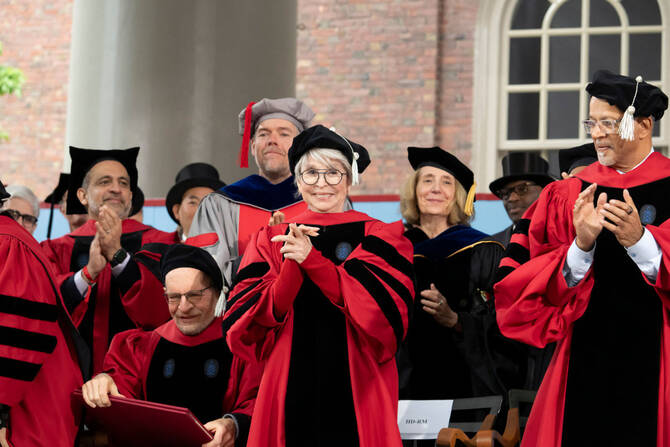
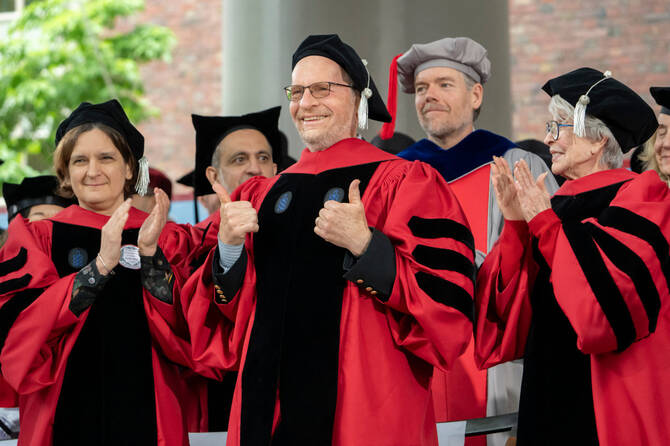
Former NBA star Kareem Abdul-Jabbar (L) applauds UC Berkeley professor and writer Elaine Kim as she receives an honorary degree during the 374th Harvard Commencement in Harvard Yard in Cambridge, Massachusetts, on May 29, 2025. (AFP)
“After seeing so many cowering billionaires, media moguls, law firms, politicians and other universities bend their knee to an administration that is systematically strip-mining the US Constitution, it is inspiring to me to see Harvard University take a stand for freedom,” he said.
Brynn Macaulay, who received a master’s degree in public and global health, said she hopes such students will keep enrolling because they bring a wealth of knowledge and perspective.
“On a personal level, it feels like somebody is attacking people that I love and that I consider to be family,” she said.
Samartha Shrestha, a fellow public health graduate from Spokane, Washington, said it was disheartening to see the funding cuts’ impacts — one of his professors was laid off — and international students’ worrying.
“I’m hopeful that they’re able to continue getting an education from one of the best, if not the the best, universities in the whole world,” he said. “My hope and dream is that one day they do graduate, just like I did today, and get to carry on the Harvard tradition to bring change wherever they go in the world.”