

Army chief calls water Pakistan’s ‘red line,’ rejects any deal on Kashmir

Pakistan’s Chief of Army Staff Field Marshal Asim Munir speaks during a “Hilal Talks” forum at the Army Auditorium in Rawalpindi on May 29, 2025. (Handout/ISPR)
Short Url
Updated 29 May 2025
Follow

Army chief calls water Pakistan’s ‘red line,’ rejects any deal on Kashmir

  • Field Marshal Asim Munir addresses university academics at the inaugural Hilal Talks forum
  • He urges them to pass on Pakistan’s story and help shape the character of future generations

KARACHI: Pakistan’s army chief, Field Marshal Asim Munir, on Thursday called water his country’s “red line” and ruled out any deal on Kashmir during an address to university academics at the military’s inaugural Hilal Talks forum.

The forum is designed to engage Pakistan’s academic community on national and regional issues, where the army chief spoke just days after a military standoff with nuclear-armed India in which both sides resorted to missile, drone and artillery strikes.

Munir’s statement followed India’s unilateral suspension of the Indus Waters Treaty, a World Bank-brokered agreement that has governed water-sharing between the two countries since 1960. Kashmir, a Himalayan region claimed by both India and Pakistan but ruled in parts, also remains a major flashpoint between both states.

“No deal on Kashmir is possible,” the army chief was quoted as saying by the military’s media wing, Inter-Services Public Relations (ISPR), while addressing the forum. “We can never forget Kashmir.”

“Water is Pakistan’s red line,” he continued, “and we will never compromise on the basic right of 240 million Pakistanis.”

Munir said Pakistan would never accept India’s dominance, adding New Delhi had tried to suppress the Kashmir issue for decades but that was no longer possible.

The army chief spoke at the Army Auditorium in Rawalpindi where he was joined virtually by over 1,800 participants, including vice chancellors, senior faculty and students from across Pakistan.

Hilal Talks is a newly launched initiative aimed at fostering sustained dialogue between Pakistan’s military and its academic institutions, with a focus on national harmony.

Munir urged educators to serve as custodians of Pakistan’s story and builders of future generations.

“Teachers are Pakistan’s greatest asset,” he said. “Whatever I am today, it is because of my parents and my teachers.”
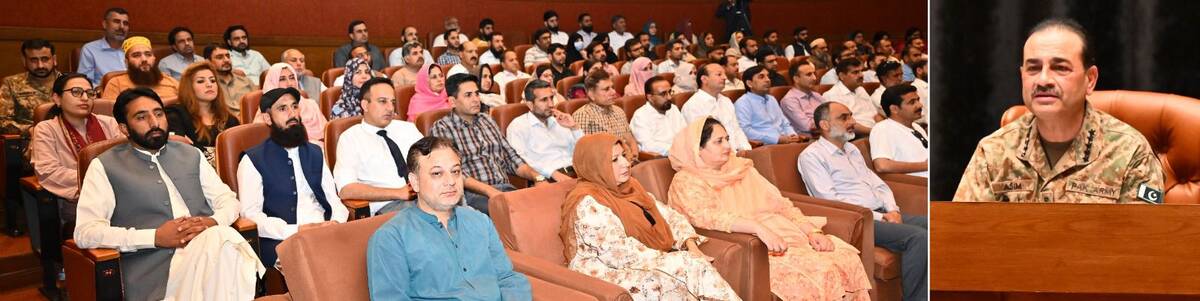


This combination of photos shows Pakistan’s Chief of Army Staff Field Marshal Asim Munir speaking to university academics during a “Hilal Talks” forum at the Army Auditorium in Rawalpindi on May 29, 2025. (Handout/ISPR)

“You are the ones who must pass on Pakistan’s story to the next generation,” he added. “It is your responsibility to shape [students’] character.”

The army chief reiterated India was stoking unrest in Pakistan’s southwestern province of Balochistan, saying, “The terrorist insurgents in Balochistan are a foreign-backed menace and have nothing to do with the local population.”

He said it was important for Pakistan to become a strong state where all institutions operate within their constitutional limits and without political, financial or personal interference.

“We must reject any narrative that seeks to weaken the state,” he added.


Pakistan moves to end week-long transport strike disrupting goods movement nationwide

Updated 3 sec ago
Follow

Pakistan moves to end week-long transport strike disrupting goods movement nationwide

  • Federal delegation sent to Karachi as talks intensify with transporters
  • Strike over axle loads and tolls has hit supply chains and economic activity

ISLAMABAD: Pakistan’s federal government on Monday stepped up efforts to end an over week-long strike by goods transporters that has disrupted the movement of cargo across the country, directing a high-level delegation to hold urgent negotiations with transport unions in Karachi, according to an information ministry statement.

The strike, now in its eighth day, has slowed the flow of goods between ports, industrial centers and markets, raising concerns over supply chains in an economy heavily reliant on road transport for domestic trade and exports. Trucking is the backbone of Pakistan’s logistics system, moving food, fuel, raw materials and manufactured goods, and prolonged disruptions can quickly translate into higher costs and shortages.

Transport unions have been protesting against stricter enforcement of axle-load limits — legal caps on how much weight trucks can carry — as well as increases in toll taxes and what they describe as heavy-handed policing on highways and motorways. 

The action comes at a sensitive time for Pakistan, which is trying to stabilize its economy under an International Monetary Fund-backed reform program that places emphasis on controlling inflation and improving fiscal discipline.

“Prolonged strikes cause losses to all stakeholders, particularly those associated with the transport sector,” Federal Minister for Communications Abdul Aleem Khan said while chairing a meeting with representatives of the Pakistan Goods Transport Alliance, according to the statement.

Transporters briefed the government on their concerns, including axle-load regulations, toll charges and enforcement practices.

The communications minister said the government was committed to resolving all legitimate issues “through dialogue and consultation” and confirmed that a five-member committee formed earlier had been tasked with finding a solution. He directed a senior delegation to immediately travel to Karachi to continue negotiations and seek a timely and amicable resolution.

The government also pledged to address issues related to driving licenses, road safety and accident prevention on a priority basis, while stressing that axle-load regulations were designed to protect national highways and improve long-term safety.

Representatives of the Pakistan Goods Transport Alliance expressed satisfaction over the progress of talks and assured the government of their cooperation, reaffirming their preference for constructive engagement, the statement said.

Authorities have warned that a prolonged transport shutdown could deepen economic disruptions, particularly by affecting port operations, industrial supply chains and the distribution of essential goods.