

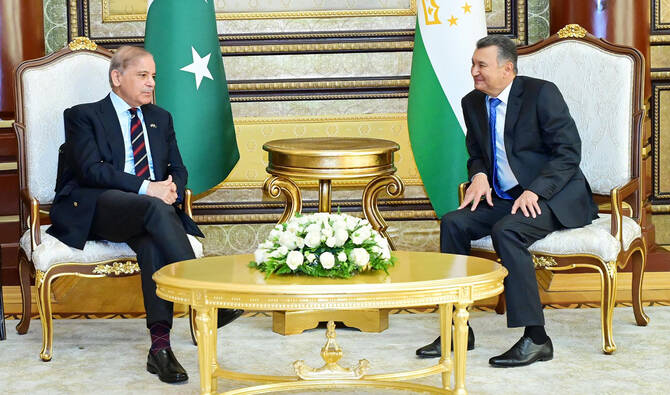

ISLAMABAD: Prime Minister Shehbaz Sharif arrived in Tajikistan’s capital Dushanbe on Thursday, the final stop in a five-day regional diplomacy tour that earlier took him to Türkiye, Iran and Azerbaijan, following a recent military confrontation with archrival India.
The tour has seen Sharif engage with regional allies to reaffirm diplomatic ties and economic cooperation, while also garnering support in the wake of heightened tensions with India.
Sharif was received at the Dushanbe airport by Tajik Prime Minister Qohir Rasulzoda.
“Prime Minister Muhammad Shehbaz Sharif has arrived in Dushanbe, the capital of Tajikistan, on a two-day visit,” his office said in a statement.
“During the visit, he will hold a bilateral meeting with Tajik President Emomali Rahmon to discuss cooperation in various sectors and thank the Tajik leader for his strong support during the recent India-Pakistan tensions,” it continued.
Earlier in the day, Sharif concluded his visit to Azerbaijan, where he announced that the Azeri leadership had reaffirmed plans to invest $2 billion in Pakistan and deepen collaboration in commerce, defense, education and health.
On Wednesday, Sharif attended a trilateral summit in the Lachin district with Azerbaijan’s President Ilham Aliyev and Turkish President Recep Tayyip Erdoğan. The three leaders pledged to expand cooperation and turn their longstanding fraternal ties into a strategic partnership for regional prosperity.
During his previous stops, Sharif also met Iranian President Masoud Pezeshkian and Supreme Leader Ayatollah Ali Khamenei in Tehran to discuss trade, energy and regional connectivity. In Türkiye, from where he kicked off his regional tour, the Pakistani prime minister held talks with Erdoğan on defense, infrastructure and intelligence cooperation.
Pakistan has long sought to strengthen ties with landlocked Central Asian nations by offering them access to its Arabian Sea ports, part of its broader push for regional connectivity and economic integration.
The Prime Minister’s Office said in its statement Sharif will also participate in a high-level international conference on glacier preservation in Tajikistan, where he is expected to brief participants on the impact of climate change on Pakistan and reaffirm the country’s commitment to environmental protection.


