Marcos orders all CEOs of Philippine government-owned corporations to quit

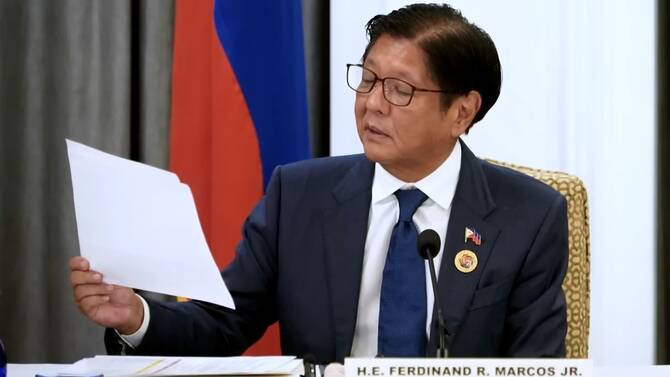
Philippine President Ferdinand Marcos Jr. gives a press conference in Kuala Lumpur, Malaysia, May 28, 2025. (Radio Television Malacanang)
Short Url
Updated 29 May 2025
Follow

Marcos orders all CEOs of Philippine government-owned corporations to quit

  • Last week, Marcos requested all his Cabinet secretaries to render their resignations
  • Reshuffle follows his allies’ recent failure to secure majority of contested Senate seats

MANILA: Philippine President Ferdinand Marcos Jr. has ordered all ranking executives of government-owned and controlled corporations to resign, days after asking his Cabinet members to step down.

All appointed chairpersons, CEOs, directors, trustees, and members of governing boards of government-owned and controlled corporations were asked to “immediately submit their respective courtesy resignations to the President through the Office of the Executive Secretary,” according to a notice from the Governance Commission for GOCCs, which was released on Wednesday.

The move follows Marcos’ request last week for his government members to render their resignations as he attempted to address the public’s dissatisfaction over his administration’s performance.

Most of his Cabinet secretaries have either immediately submitted their resignations or expressed their readiness to do so.

“This process is part of a rigorous and ongoing evaluation of government performance not only at the Cabinet level but across the entire bureaucracy,” Lucas Bersamin, executive secretary of the Philippines — the head and highest-ranking official of the Office of the President — told reporters on Thursday.

“The people expect results, and the president has no patience for underperformance. In line with this, the president has also instructed the heads of government-owned and controlled corporations to submit their courtesy resignations. He has further indicated that senior officials will likewise be included in the continuing review.”

Marcos’ decision to reshuffle the Cabinet and leadership of state-owned corporations follows his allies’ failure to secure a majority of contested Senate seats in the May 12 midterm elections, raising questions about his weakened mandate for the remaining three years of his term, which ends in 2028.

The son of the late Philippine dictator who was overthrown in 1986, Marcos won the presidency by a landslide in 2022 after campaigning on a message of national unity and presenting himself as a candidate of change.

Public support for the 67-year-old leader has, however, dropped sharply this year, with Pulse Asia surveys showing his approval rating falling to 25 percent in March, from 42 percent in February.

The survey showed that a majority of Filipinos disapproved of the Marcos administration’s handling of the most pressing issues, including controlling inflation and combating corruption, with disapproval rates at 79 percent and 53 percent, respectively.

The bureaucrats and executives affected by the president’s decision will continue in their roles unless and until the Office of the President issues further directives or formally acts on their resignations.

“All these people who offered their courtesy resignations are expected to continue performing their functions, discharging their duties until their replacements have been appointed,” Bersamin said.

“And that is expected of all public servants; no one abandons because that is part of the obligation of a public servant.”


Russia says two crew members from US-seized tanker released

Updated 28 January 2026
Follow

Russia says two crew members from US-seized tanker released

  • “Two Russian sailors have been released and are on their way home to Russia,” Zakharova said
  • Russia announced earlier this month that the US had decided to release the Russian duo

MOSCOW: Moscow said Wednesday two Russian crew members of a tanker seized this month by the United States in the Atlantic had been released and were on their way home.
US authorities took over the Russian-flagged vessel earlier this month, alleging it was part of a shadow fleet carrying oil from countries such as Venezuela, Russia and Iran in violation of US sanctions.
The United States said publicly that the Marinera’s crew could be prosecuted. Russia said that would be “categorically unacceptable” and accused Washington of stoking tensions and threatening international shipping.
“Two Russian sailors have been released and are on their way home to Russia,” foreign ministry spokeswoman Maria Zakharova told the state-run RIA Novosti news agency on Wednesday.
Russia announced earlier this month that the United States had decided to release the two Russian crew members, but last week its Foreign Minister Sergei Lavrov said the decision had not yet been implemented.
The captain and the first officer of the tanker have left UK waters, Solicitor General for Scotland, Ruth Charteris told a court hearing Tuesday, Press Association news agency reported.
“The captain and the first officer are now aboard the US Coast Guard vessel Munro and have departed the United Kingdom’s territorial sea,” Charteris said.
Twenty-six of the 28 crew have left the ship, officials told AFP. They were processed at a military site in Inverness, Scotland, the court was told, according to Press Association.
Five wanted to travel to the United States and 21 elsewhere. None have claimed asylum, the court heard.
“At the request of the US authorities, crew members have been allowed to disembark for onwards travel,” a UK government spokesperson told AFP Wednesday.
“They will be processed in line with all appropriate immigration and legal requirements.”
Britain was not involved in the movement of the other two crew members, the government said.
The United States seized the tanker, previously known as Bella 1, which was being escorted by the Russian navy, after chasing it from near the Venezuelan coast.
It was re-flagged and re-named to bring it under Russian jurisdiction in a bid to discourage the United States from trying to take it as part of its campaign against Venezuela.