Signs of hope for a cricket nation in transition

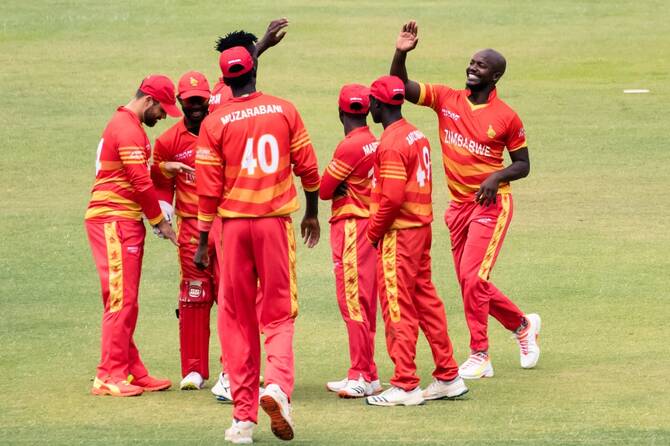
Zimbabwe’s playing performances over the last three decades have fluctuated drastically. (FILE/AFP)
Short Url
Updated 29 May 2025
Follow

Signs of hope for a cricket nation in transition

  • In 2019 Zimbabwe Cricket was suspended from ICC tournaments because of government interference. Only recently has optimism for the future of cricket in the African country returned

On May 23, a one-off, four-day Test match began at Trent Bridge, Nottingham, between England and Zimbabwe. It was the first match in any format between the countries since 2007 and only the seventh Test match played between them. The last meeting was in 2003 when England hosted two Tests, winning both by an innings.

Overall, England has won four of the seven Tests, with three drawn. Two of these were in December 1996, the first time England toured Zimbabwe, which was granted full membership of the International Cricket Council in 1992.

Zimbabwe’s playing performances over the last three decades have fluctuated drastically. In the first 30 Test matches, only one was won, at home to Pakistan in early 1995. This prompted discussion that the granting of Test status had been premature. However, a talented group of players emerged to provide the basis for a Test team that became one of the hardest to beat in the late 1990s. It won a one-off Test against India in October 1998, following up on this by beating Pakistan 1-0 in a three-match Test series in November and December 1998. The one-day international team qualified for the 1999 World Cup, narrowly missing out to New Zealand on a semi-final place because of an inferior net run-rate.

These golden years were ended by political turmoil. The 2003 World Cup was jointly hosted by Zimbabwe, Kenya and South Africa. Concerns over security of players caused England to forfeit a match scheduld to be played in Harare. A desperate shortage of food, a deteriorating economic situation and violent clashes between rival factions led two Zimbabwean players, Andy Flower and Henry Olonga, to stage a protest. In a long statement they said that they could not “ignore the fact that millions of our compatriots are starving, unemployed and oppressed … that thousands of Zimbabweans are routinely denied their right to freedom of expression.” They wore black armbands, “mourning the death of democracy.”

Unsurprisingly, the government was embarrassed, both players were dismissed from the team and felt compelled to leave Zimbabwe. Team harmony, already affected by government involvement in selection, was further disrupted, with a succession of players deciding to end their international careers prematurely. In 2004, the team captain, Heath Streak, was sacked by the Zimbabwe Cricket Union, prompting 14 other players to walk out.

Despite attempts at rapprochement, results failed to improve in an environment of mistrust. Another bout of player resignations led the cricket board to voluntarily suspend the team from Test cricket in late 2005. After a six-year exile, Test cricket returned to Zimbabwe in August 2011 when Bangladesh was beaten in a one-off match in Harare. In subsequent years, off-the-field issues continued to dominate, whilest performances on the field were patchy and disappointing. 

In July 2019, the ICC voluntarily suspended Zimbabwe Cricket from ICC tournaments because it had failed to ensure that it was free from government interference. This meant that ICC funding was frozen and that neither men’s nor women’s teams could compete in T20 World Cup preliminaries and qualifiers, despite a lifting of the suspension three months later.

It is only recently that greater optimism for the future of cricket in Zimbabwe has emerged. Control over finances seems to have been established, ICC funding of $13.5 million being used to support a five -team domestic structure, national sides and the expensive business of hosting Test matches. Since 1992, the men’s Test team has played 124 Test matches, winning only 14, drawing 30 and losing 80. It would be easy for ZC to downplay Test cricket at a time when its relevance is being questioned.

The stance of ZC’s chair, Tavengwa Mukhulani, is diametrically opposite. He wants to see all Full Member teams play each other on a home and away basis, believing that the way for Zimbabwean cricketers to improve is by playing the stronger teams. Consequently, Mukuhlani is not in favor of a two-tier Test system. It is also an issue for him that Zimbabwe is not part of the World Test Championship, for reasons which are not clear to him. Zimbabwe’s commitment to Test cricket is clear. In 2025, it will play 11 Tests, joint highest with Australia.

The issues for Zimbabwe at Test level were illustrated at Trent Bridge. England was invited to bat first and raced to score almost 500 runs on Day 1, against bowling that betrayed a lack of knowledge of how to perform on an English pitch. In reply to England’s 565 for six, declared, Zimbabwe’s batters attacked, none more so than Brian Bennett, 21. He wrote himself into the history books by scoring the fastest Test century for Zimbabwe. Although England ultimately won by an innings and 45 runs, it was clear that Zimbabwe has talent to nurture. 

Some of this nurturing will fall to experienced team members. One of them, Sikandar Rasa, has played for Zimbabwe since 2013. Prior to the Test at Nottingham, he was playing in the Pakistan Super League for Lahore Qalandars. Once the Test, in which he bowled 25 overs and batted for 20 overs, had finished a day early, he flew back to Lahore via Birmingham, Dubai and Abu Dhabi, arriving minutes before play started. Lahore was set 202 to win. When Rasa went out to bat, 57 runs were needed from 3.2 overs. He immediately hit a four and six and, in the final over, repeated the feat to secure victory with one delivery remaining.

Zimbabwean cricket has suffered tough times over the past 20 years. Superhuman feats such as Rasa’s and the individual performances witnessed at Nottingham, where the team enjoyed colourful and musical support, provide hope for a brighter future. In Zimbabwe's first World Cup match at Trent Bridge in June 1983, when Australia was dramatically beaten by 13 runs, a bright future was suggested. Then, the team consisted almost entirely of white players, Ali Shah being the exception. Fifteen years later, nine of the team were white. At Trent Bridge last week, seven of the team were black, including the 6 foot, eight inches tall fast bowler, Blessing Muzarabani, who had claimed 26 Test wickets in 2025 prior to Nottingham.

Robert Mugabe, who ruled Zimbabwe between 1980 and 2017, is attributed with saying that “Cricket civilises people and creates good gentlemen. I want everyone to play cricket in Zimbabwe. I want ours to be a nation of gentlemen.” Noticeably, there was no mention of women.

Zimbabwe’s women’s team made its international debut in 2006 at the ICC Africa Regional Qualifier for the Women’s Cricket World Cup. The team has yet to reach the final stages of a World Cup although it did win a gold medal at the Africa Games in 2023. Currently, the team consists entirely of black players.

In the past two decades, a transformation has taken place that has turned the men’s national cricket team into one that more closely represents Zimbabwe’s demographics, in which white Zimbawean’s make up less than 1 percent of the 17 million population. The women’s team is totally reflective of that fact. Zimbabwean cricket needs an era of stability and support to allow its new generation of cricketers to mature.    


‘This league is going places’: DP World ILT20 now firmly established on cricket’s franchise landscape

Updated 08 January 2026
Follow

‘This league is going places’: DP World ILT20 now firmly established on cricket’s franchise landscape

  • Season 4, which saw Desert Vipers crowned champions, provided fireworks on and off the pitch

At 6:25 p.m. on Sunday Jan. 4, the Dubai International Stadium was full and expectant, but the start of the DP World ILT 20 final was not to be until 25 minutes later because of a surprise drone show.

This lit up the sky above the stadium with a succession of colorful images. These ranged from welcomes to symbols of the UAE and the tournament, culminating in the trophy itself.

A salvo of fireworks rounded off the spectacular introduction. Such entrees have become de rigueur in cricketing events, but this must be on a par with the best. Without saying it openly, everyone hoped for cricket as spectacular.

The Mumbai Indian Emirates, champions in 2024, won the toss and asked the Desert Vipers to bat, probably in the knowledge that they preferred to chase down a target. This was a repeat of the situation in qualifier one on Dec. 30, when the Vipers scored 233 and won by 45 runs, propelling them straight into the final.

In the final, the MIE did not start well — bowling wides and misfielding. Although both the Vipers’ openers fell, a crucial partnership was built by the Englishmen Sam Curran and Max Holden, both leading the league’s run-scoring charts.

The wily West Indians Kieron Pollard and Romario Shepherd tried to slow the game down but the batters stayed calm to post a total of 182. In reply, the MIE were off to a flying start, scoring 40 for the loss of one wicket after four overs.

In the post-match press conference, I asked the MIE’s coach, Robin Singh, if he felt that his team were ever in control of the match. In reply, he felt that it was at the end of the fourth over when they had a chance of taking control, but then lost two quick and crucial wickets, after which their task became increasingly difficult.

Curran agreed that was a tipping point. Otherwise, he felt his team had been in control, although what might have happened had his partnership with Holden not prospered, no one will ever know.

What we do know is that the Vipers were superior in the field and caught superbly. We also know that their Pakistani contingent contributed magnificently to the Vipers’ success, by 46 runs. Twice losing finalists, in seasons one and three, they were, by common acclaim, deserving winners.

There has been much talk during the tournament about standards and whether they have risen. This is a very subjective issue and depends on what objective criteria are available.

It was instructive to listen to Ian Bishop, former West Indian fast bowler between 1989 and 1998, now a leading commentator, who is of little doubt that standards have risen.

His evidence is based on the heightened performances of UAE players, how these have been achieved by exposure to international players, coaches, training and assessment regimes.

He cites Junaid Siddique, bought at auction for $170,000 by the Sharjah Warriorz; Muhammad Waseem, who “we don’t talk about anymore (as promising) because he is an established player;” and Khuzaima Tanvir, who broke through with the Desert Vipers in season four, claiming 17 wickets, one behind the two leading wicket-takers.

Bishop says that the next developmental stage is for Saudi Arabia and Kuwait players to follow the same pathway. Although only one of the 12 players from these countries made it onto the team sheet — Mohamed Shafeeq for the MIE — others were close.

Jonathan Trott, coach of the Gulf Giants, provided an insight when answering my question about what he had learnt most in his first experience with the ILT20. He responded by saying that it had proved difficult to fit everyone in.

Each playing 11 must have two UAE players and one from an associate member country. This one player must be selected from four and it is probable that the two non-Saudi or Kuwaiti associate players have greater experience of cricket at this level.

Two other experienced commentators, who have been involved since the inception of the ILT20, have reinforced Bishop’s view concerning the strides made by the league.

Wasim Akram, a great of the game for Pakistan between 1992 and 2003, noted the improvement in local talent, especially among the bowlers. He specified Tanvir and Ajay Kumar, who claimed 18 wickets, equal with Afghanistan’s Waqar Salamkheil, the winner of the best bowler award.

Akram also noted the continuing excellence of Muhammad Waseem, who finished narrowly second behind Curran in runs scored. Waseem was fourth in the rating for most-valuable player and first in the UAE player ratings. In Akram’s view, “this league is going places.”

Simon Doull, the former New Zealand bowler turned commentator, echoed the comments of Bishop and Akram, adding a mention for the role of spinners. He said “we once thought that T20 cricket might be the death of spin, but that hasn’t been the case. Every franchise wants a quality wrist spinner.”

This was in response to my question relating to the irony of seeing quality spinners in the ILT20 on a day when Australia and England entered the Sydney Test match without a spinner in their teams — the first time since 1888. Doull also welcomed the league’s expanding regional footprint and the year-on-year improvement in standards.

One vital aspect of standards is, of course, the quality of players and their performances. Several issues are impacting these. One is the competition for the same players with other leagues being played at the same time.

Three franchise tournaments overlapped with the ILT20’s season four. Each has different mandates for the number of overseas players per playing 11 and squad.

In Australia’s Big Bash League, it is three and seven. In the SA20, it is four and seven, whilst in the Bangladesh Premier League, it is four and eight. All three leagues allow franchises to sign replacements to cover player injury and unavailability for other reasons.

Injuries are inevitable. The Desert Vipers, for example, lost their captain, Lockie Ferguson, halfway through the ILT20 schedule. Curran stepped in with great success, whilst the Vipers signed the Pakistan spinner, Usman Tariq, as Ferguson’s replacement.

Tariq made a major contribution to the Vipers’ winning cause. Other players appear to disappear, literally overnight, only to reappear shortly afterwards in the BBL or SA20.

The MIE’s captain, Pollard, was asked at a press conference about the significance of losing both Nicholas Pooran and Rashid Khan to the SA20 around Dec. 20. His reply was very sanguine.

Pooran had been recruited as a wildcard player and Khan had replaced a player injured before the tournament started. Both players are part of the MI franchise stable and it was known that they would join MI Cape Town in the SA20 when it opened.

It seems that these comings and goings are an inherent feature of franchise cricket. Players who are part of serial franchise owners are likely to find themselves shunted between leagues.

This can only be minimized if there is no overlap. It is not confirmed when the fifth edition of the ILT20 will be held — whether it will be between similar dates to season four or revert to January/February.

The BBL’s dates are unlikely to vary greatly, but the SA20 may start in January 2027 because South Africa will have Test matches against England starting on Boxing Day 2026 and New Year 2026-27.

Whatever the case, the well-organized DP World ILT20 has established itself on cricket’s franchise landscape. Now, one is left to ponder what spectacular backdrops may be devised to illuminate the next edition or what changes may be made in its evolution.