

Manchester United stretch loyalty of ‘numbed’ Chinese fans to the limit

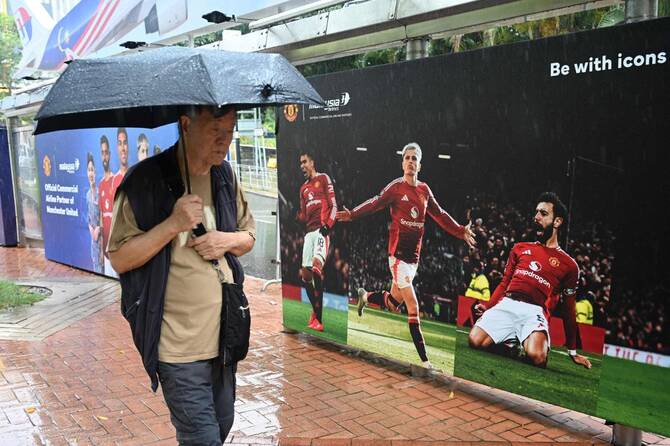
A man walks past posters of Manchester United players outside the Hong Kong Stadium on May 29, 2025 where they will play a Hong Kong team. (AFP)
Short Url
Updated 29 May 2025
Follow

Manchester United stretch loyalty of ‘numbed’ Chinese fans to the limit

  • Manchester United once claimed to have more than 100 million followers in China
  • But like supporters of the club everywhere their loyalty is being put severely to the test

HONG KONG: Yan Gang speaks for many Manchester United fans when he says: “We’ve been numbed by performances over the past few seasons.”

Manchester United once claimed to have more than 100 million followers in China, Yan among them, but like supporters of the club everywhere their loyalty is being put severely to the test.

As an illustration of United’s fall from grace in China and beyond, tickets for Friday’s friendly at the 40,000-capacity Hong Kong Stadium against the city’s representative team were still available on Thursday afternoon.

Tickets also appeared on resale websites with their prices slashed 50 percent.

United were beaten 1-0 in Malaysia by a Southeast Asian XI on Wednesday and booed off, a fresh low in a dismal season for Ruben Amorim’s bedraggled men.

“Every season ends with the same old story with no sign of recovery,” said Yan, a supporter for 23 years and organizer of a United fans’ association in Shenzhen, just across the border from Hong Kong in mainland China.

Amorim’s side left for Asia on Sunday, hours after concluding their worst season since 1974, to play friendlies in Kuala Lumpur and Hong Kong.

The Old Trafford club made no attempt to hide the motivation for flying across the world straight after a draining and demoralizing campaign that saw them come 15th in the Premier League and fail to lift a trophy.

“Tour fixtures drive significant additional revenue which help make the club stronger, allowing us to keep investing in success on the pitch,” chief executive Omar Berrada said.

This week’s Asia visit will generate about $10 million (£7.8m) for United, the BBC reported.

China has the world’s second-biggest economy and second-biggest population, making it a vital market.

United’s finances are under scrutiny with co-owner Jim Ratcliffe implementing steep cuts since buying a minority stake just over a year ago.

The club recently announced a further 200 redundancies were planned after 250 jobs were cut last year.

Ratcliffe claimed in March that the Red Devils would have “run out of money at Christmas” otherwise.

From Kuala Lumpur, where it was 32 Celsius (90 Fahrenheit) at kickoff on Wednesday, it is a four-hour flight to a similarly sticky Hong Kong.

July friendlies in the city between Tottenham and Arsenal, and Liverpool and AC Milan, sold out within hours of going on general sale.

No such luck for United for their exhibition match with the Hong Kong team, and with a day until kickoff they face the ignominy of playing in front of empty seats.

The 39-year-old fan Yan said that the United supporters club in Shenzhen has about 2,000 members.

That number has hardly grown in the past few years, he said.

Older fans make up the vast majority of members.

“I can’t think of any words we can use to attract new fans because the team has a bad record and no standout stars to recruit younger fans,” said Yan.

He Zhiyi, a United fan for more than a decade, is flying to Hong Kong from the southwestern Chinese city of Chengdu.

She had hoped to see the squad parade the Europa League trophy, but Amorim’s side lost 1-0 to Tottenham in the final.

With it went United’s hopes of sneaking into the Champions League, which would have brought badly needed revenue, prestige and pulling power.

“The team is all over the place – players, coaches and management are not moving in one direction,” said the 32-year-old He, a football content creator and author.

“It feels like the team is killing the enthusiasm of the fans, as if the romance can’t be sustained anymore.”

Zhang Chongqian, also from Chengdu, said United’s “spirit and traditions” have been lost.

“In recent years, our fans (in China) gradually stopped watching Manchester United or even football,” the 38-year-old lifelong supporter said.

Zhang will not join those fans abandoning his side, even after the poorest season in the club’s recent history.

“Manchester United have been experiencing a period of sinking,” he said.

“But there are still so many fans who will never give up on them.”


From Jeddah to the world stage: Bader Idrees and Saudi Arabia’s tennis rise

Updated 25 December 2025
Follow

From Jeddah to the world stage: Bader Idrees and Saudi Arabia’s tennis rise

RIYADH: As tennis continues to gain momentum throughout Saudi Arabia, several local players are beginning to emerge on the national and international scene. One of them is Saudi national team player Bader Idrees, whose journey mirrors the Kingdom’s evolving relationship with the sport.

Idrees’ first exposure to tennis came at a time when the local game was still developing. His interest began in early 2010 after watching his older sister train regularly.

“I was five years old when I used to watch my older sister playing tennis every day,” he told Arab News. “One of her coaches recommended that I try it out, and from the first hit, I fell in love with the sport.”

Now 20 years old, Idrees finds himself progressing alongside a country that is investing heavily in tennis. Over the past three months alone, Saudi Arabia has hosted the Six Kings Slam, the WTA Finals, and the Next Gen ATP Finals, an indication of its growing ambitions on the global tennis stage.

A defining moment in Idrees’ development came at the 2025 WTA Finals, where he reached a personal milestone in his role as a hitting partner for some of the world’s best players.

“It was one of the best experiences I’ve had so far,” he said. “To actually see the players and train with them was an eye-opening experience for me.”

The exposure offered by hosting elite tournaments has had a direct impact on aspiring Saudi athletes, providing valuable insight into the professional game.

“Seeing how players prepare for matches — from how they behave off the court to actually practicing on the court — was an amazing experience,” he said.

Beyond individual growth, Idrees believes the broader sporting ecosystem benefits from welcoming international events to the Kingdom.

“Hosting these events motivates every Saudi athlete,” Idrees said. “Foreign players get to know the country and the players who represent it, and it pushes us to perform better knowing that the world is watching.”

That motivation has translated into concrete goals. Idrees is planning a busy start to the year, with four international tournaments scheduled for January.

“I feel very positive about what I’ve accomplished so far, so hopefully I can kick off with a strong start in 2026.”

Despite recent progress, Idrees credits his early development at home as the foundation of his success.

“I don’t think I would be at this level if I weren’t in Saudi Arabia, and if I didn’t meet my coach Wajih there, who played a big role in my journey,” Idrees said.

To further advance his career, he later relocated to Cairo, where increased competition and exposure helped accelerate his development.

“That experience, combined with my coach’s motivation, made me believe I could truly go pro,” he said.

The journey was not without challenges. Idrees reflected on the limitations that once existed in the local tennis landscape.

“Tennis has grown massively in Saudi Arabia over the last few years,” he said. “But before that, we didn’t always have the best facilities or infrastructure. That’s why seeing the progress now makes me happy.”

Today, that transformation is happening at a rapid pace — something Idrees notices each time he returns home from international competition.

“Month by month,” as he puts it.

Whether in Riyadh, Jeddah, or Dammam, the changes are increasingly visible. Looking ahead, Idrees is optimistic about the next generation of Saudi players.

“I wouldn’t be surprised to see the kids playing at the under-10 and under-12 level find themselves in the top 500 or 300 within the next 10 years,” he said. “I see the discipline and motivation in them, and it truly is something special.”

He is also realistic about his own development compared with today’s young talents.

“I wasn’t at this level at 10, 12 years old,” he admitted. “Training with kids at that age now, I’m genuinely impressed. It’s why I’m feeling very positive about their future.”

With growing infrastructure, elite-level exposure, and rising ambition, Idrees’ story represents more than personal achievement. It highlights how Saudi Arabia’s expanding role as a host of global sporting events is reshaping its tennis landscape — and how a new generation of players may be poised to make an impact on the world stage in the years ahead.