

International rights bodies write joint letter to Pakistani PM calling for releases of Baloch activists

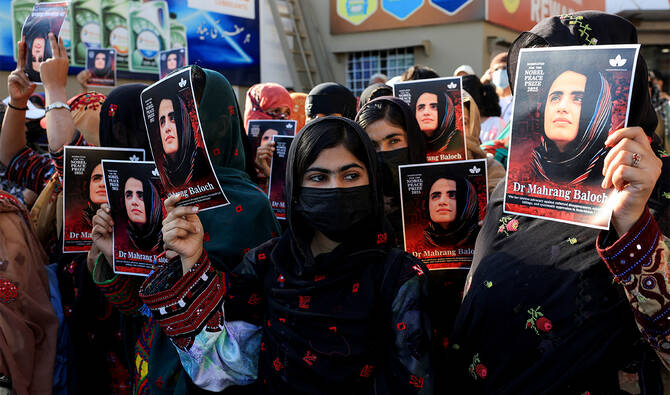
Women, supporting the Balochistan Yakjehti Committee (BYC), hold placards during a protest demanding the release of Dr Mahrang Baloch, a human rights activist, in Karachi, Pakistan, on March 24, 2025. (REUTERS/File)
Short Url
Updated 29 May 2025
Follow

International rights bodies write joint letter to Pakistani PM calling for releases of Baloch activists

  • Dr. Mahrang Baloch, one of the leading campaigners for Baloch minority, was arrested in March on charges of terrorism, sedition
  • In Balochistan, impoverished province that borders Afghanistan and Iran, security forces are battling a growing separatist insurgency

ISLAMABAD: Amnesty International along with four other human rights organizations on Wednesday wrote to the Pakistani prime minister, calling for an end to the “harassment and arbitrary detention” of Baloch human rights defenders (HRDs) exercising their rights to freedom of expression and peaceful assembly, particularly in Balochistan province. 

The letter comes in the wake of Dr. Mahrang Baloch, one of the leading campaigners for the Baloch minority and the leader of the Baloch Yakjehti Committee (BYC), and a number of other activists, being arrested in March on charges of terrorism, sedition and murder.

Security forces are battling a growing insurgency in Balochistan, an impoverished province that borders Afghanistan and Iran. Rights groups say the violence has been countered with a severe crackdown that has swept up innocent people. Authorities deny heavy handedness.

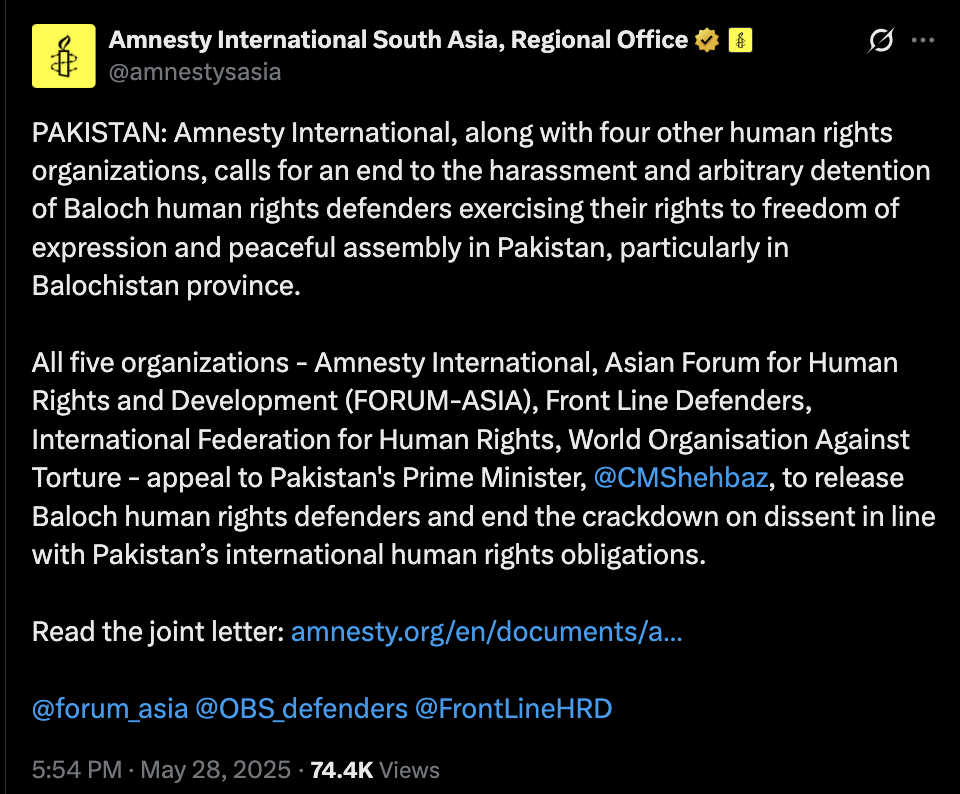
“All five organizations — Amnesty International, Asian Forum for Human Rights and Development (FORUM-ASIA), Front Line Defenders, International Federation for Human Rights, World Organization Against Torture — appeal to Pakistan’s Prime Minister to release Baloch human rights defenders and end the crackdown on dissent in line with Pakistan’s international human rights obligations,” Amnesty Internation said on X, sharing a copy of the joint letter.
The joint letter called on the government to take the following steps:

Immediately and unconditionally release all Baloch HRDs and their family members “arbitrarily detained solely for peacefully exercising their rights in line with the right to liberty and safety”; drop all charges against them; pending their release, ensure the safety of HRDs and family members, including by sharing accurate information about their whereabouts, providing effective access to family members, legal counsel and medical treatment; conduct a thorough, impartial, effective and transparent investigation into the allegations of torture and mistreatment by Pakistani authorities of Baloch HRDs under detention; end the crackdown against HRDs, journalists, protesters and dissidents by ensuring their right to freedom of expression and peaceful assembly are fully protected; cease all forms of reprisals against family members of HRDs; and conduct an “effective, prompt, thorough and impartial investigation into the unlawful use of force” against protesters including Dr. Baloch on March 21 in Quetta and bring those suspected of responsibility to justice through fair trials.

Activists say in the crackdown against militancy in Balochistan, authorities have harassed and even carried out extrajudicial killings of Baloch civilians. Pakistani authorities reject the “baseless allegations.”

A dozen UN experts called on Pakistan in March to immediately release Baloch rights defenders, including Dr. Baloch, and to end the repression of their peaceful protests. UN special rapporteur for human rights defenders Mary Lawlor said she was “disturbed by reports of further mistreatment in prison.”

Balochistan is the site of a long-running separatist movement, with insurgent groups accusing the state of unfairly exploiting Balochistan’s rich gas and mineral resources. The federal and provincial governments deny this, saying they are spending billions of rupees on the uplift of the province’s people. 


Pakistan terms climate change, demographic pressures as ‘pressing existential risks’

Updated 06 December 2025
Follow

Pakistan terms climate change, demographic pressures as ‘pressing existential risks’

  • Pakistan has suffered frequent climate change-induced disasters, including floods this year that killed over 1,000
  • Pakistan finmin highlights stabilization measures at Doha Forum, discusses economic cooperation with Qatar 

ISLAMABAD: Pakistan’s Finance Minister Muhammad Aurangzeb on Saturday described climate change and demographic pressures as “pressing existential risks” facing the country, calling for urgent climate financing. 

The finance minister was speaking as a member of a high-level panel at the 23rd edition of the Doha Forum, which is being held from Dec. 6–7 in the Qatari capital. Aurangzeb was invited as a speaker on the discussion titled: ‘Global Trade Tensions: Economic Impact and Policy Responses in MENA.’

“He reaffirmed that while Pakistan remained vigilant in the face of geopolitical uncertainty, the more pressing existential risks were climate change and demographic pressures,” the Finance Division said. 

Pakistan has suffered repeated climate disasters in recent years, most notably the 2022 super-floods that submerged one-third of the country, displaced millions and caused an estimated $30 billion in losses. 

This year’s floods killed over 1,000 people and caused at least $2.9 billion in damages to agriculture and infrastructure. Scientists say Pakistan remains among the world’s most climate-vulnerable nations despite contributing less than 1 percent of global greenhouse-gas emissions.

Aurangzeb has previously said climate change and Pakistan’s fast-rising population are the only two factors that can hinder the South Asian country’s efforts to become a $3 trillion economy in the future. 

The finance minister noted that this year’s floods in Pakistan had shaved at least 0.5 percent off GDP growth, calling for urgent climate financing and investment in resilient infrastructure. 

When asked about Pakistan’s fiscal resilience and capability to absorb external shocks, Aurangzeb said Islamabad had rebuilt fiscal buffers. He pointed out that both the primary fiscal balance and current account had returned to surplus, supported significantly by strong remittance inflows of $18–20 billion annually from the Middle East and North Africa (MENA) and Gulf Cooperation Council (GCC) regions. 

Separately, Aurangzeb met his Qatari counterpart Ali Bin Ahmed Al Kuwari to discuss bilateral cooperation. 

“Both sides reaffirmed their commitment to strengthening economic ties, particularly by maximizing opportunities created through the newly concluded GCC–Pakistan Free Trade Agreement, expanding trade flows, and deepening energy cooperation, including long-term LNG collaboration,” the finance ministry said. 

The two also discussed collaboration on digital infrastructure, skills development and regulatory reform. They agreed to establish structured mechanisms to continue joint work in trade diversification, technology, climate resilience, and investment facilitation, the finance ministry said.