

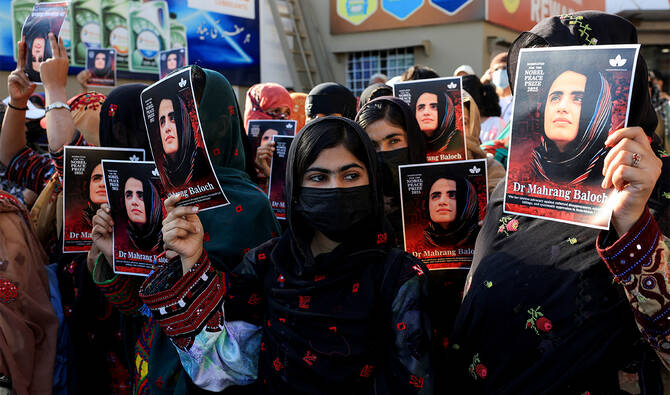

ISLAMABAD: Amnesty International along with four other human rights organizations on Wednesday wrote to the Pakistani prime minister, calling for an end to the “harassment and arbitrary detention” of Baloch human rights defenders (HRDs) exercising their rights to freedom of expression and peaceful assembly, particularly in Balochistan province.
The letter comes in the wake of Dr. Mahrang Baloch, one of the leading campaigners for the Baloch minority and the leader of the Baloch Yakjehti Committee (BYC), and a number of other activists, being arrested in March on charges of terrorism, sedition and murder.
Security forces are battling a growing insurgency in Balochistan, an impoverished province that borders Afghanistan and Iran. Rights groups say the violence has been countered with a severe crackdown that has swept up innocent people. Authorities deny heavy handedness.
“All five organizations — Amnesty International, Asian Forum for Human Rights and Development (FORUM-ASIA), Front Line Defenders, International Federation for Human Rights, World Organization Against Torture — appeal to Pakistan’s Prime Minister to release Baloch human rights defenders and end the crackdown on dissent in line with Pakistan’s international human rights obligations,” Amnesty Internation said on X, sharing a copy of the joint letter.
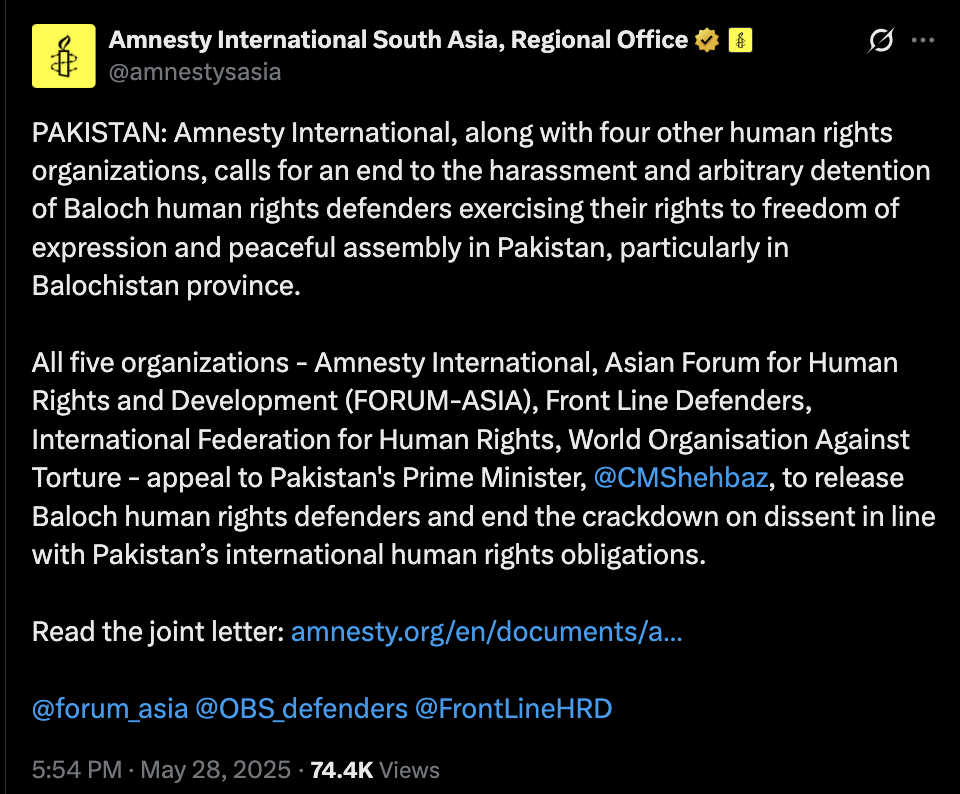
The joint letter called on the government to take the following steps:
Immediately and unconditionally release all Baloch HRDs and their family members “arbitrarily detained solely for peacefully exercising their rights in line with the right to liberty and safety”; drop all charges against them; pending their release, ensure the safety of HRDs and family members, including by sharing accurate information about their whereabouts, providing effective access to family members, legal counsel and medical treatment; conduct a thorough, impartial, effective and transparent investigation into the allegations of torture and mistreatment by Pakistani authorities of Baloch HRDs under detention; end the crackdown against HRDs, journalists, protesters and dissidents by ensuring their right to freedom of expression and peaceful assembly are fully protected; cease all forms of reprisals against family members of HRDs; and conduct an “effective, prompt, thorough and impartial investigation into the unlawful use of force” against protesters including Dr. Baloch on March 21 in Quetta and bring those suspected of responsibility to justice through fair trials.
Activists say in the crackdown against militancy in Balochistan, authorities have harassed and even carried out extrajudicial killings of Baloch civilians. Pakistani authorities reject the “baseless allegations.”
A dozen UN experts called on Pakistan in March to immediately release Baloch rights defenders, including Dr. Baloch, and to end the repression of their peaceful protests. UN special rapporteur for human rights defenders Mary Lawlor said she was “disturbed by reports of further mistreatment in prison.”
Balochistan is the site of a long-running separatist movement, with insurgent groups accusing the state of unfairly exploiting Balochistan’s rich gas and mineral resources. The federal and provincial governments deny this, saying they are spending billions of rupees on the uplift of the province’s people.


