

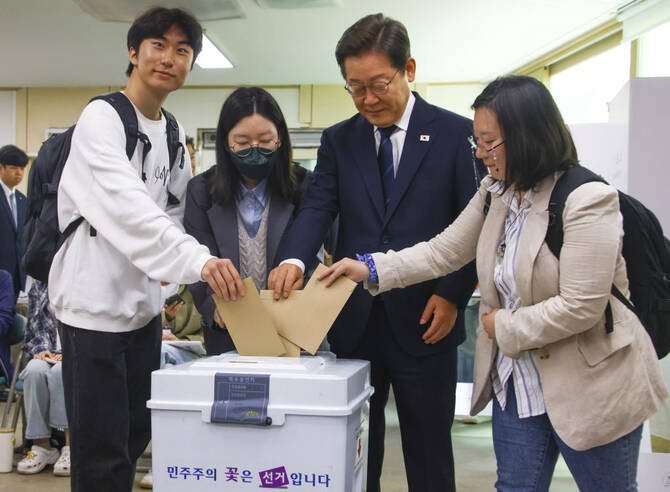

SEOUL: Early voting in South Korea’s presidential elections began on Thursday, with both main candidates casting ballots in a poll triggered by ex-leader Yoon Suk Yeol’s ill-fated suspension of civilian rule last year.
South Koreans are desperate to draw a line under months of political turmoil sparked by Yoon’s declaration of martial law, for which he was impeached.
Since then the Asian democracy has been led by a revolving door of lame duck acting presidents as its export-driven economy grapples with trade turmoil abroad and sluggish demand at home.
All major polls have placed liberal Lee Jae-myung as the clear frontrunner in the presidential race, with a recent Gallup survey showing 49 percent of respondents viewed him as the best candidate.
Trailing behind him is conservative ex-labor minister Kim Moon-soo of the ruling People Power Party – Yoon’s former party – at 35 percent.
While election day is set for June 3, those who want to vote early can do so on Thursday and Friday.
South Koreans have in recent years turned out in growing numbers for early voting, with 37 percent casting their ballots ahead of polling day in the 2022 presidential election.
By midday the early voting turnout rate was 8.7 percent, the highest yet for that time in South Korean election history, according to Seoul’s National Election Commission.
The overseas voter turnout also reached a historic high, with four-fifths of 1.97 million eligible voters casting their ballots.
“Given that this election was held in the wake of an impeachment and a martial law crisis, it naturally reflects the public’s strong desire to express their thoughts about democracy in South Korea,” Kang Joo-hyun, a political science professor at Sookmyung Women’s University, said.
Voting in Seoul on Thursday morning, Lee told reporters: “There’s a saying that a vote is more powerful than a bullet.”
“Even an insurrection can only truly be overcome through the people’s participation at the ballot box,” added Lee of the Democratic Party.
According to a Gallup poll, more than half of his supporters said they planned to vote early, compared to just 16 percent of Kim’s supporters.
Kim has said he will cast his vote in Incheon, west of Seoul, with his campaign framing it as “the beginning of a dramatic turnaround,” a nod to General Douglas MacArthur’s landing there during the Korean War.
Kim’s decision to vote early has surprised many on the right, where conspiracy theories about electoral fraud – particularly during early voting – are rife.
The 73-year-old however reassured his supporters that there is “nothing to worry about.”
“If you hesitate to vote early and end up missing the main election, it would be a major loss,” said Kim on Wednesday.
“Our party will mobilize all its resources to ensure strict monitoring and oversight of early voting,” he said.
“So please don’t worry and take part in it,” he said.
After early voting, Kim insisted he still has time to win the race.
“We’re closing the gap quickly, and at this pace, I’m confident we’ll take the lead soon,” he told reporters.
Conservative candidate Kim shot to public attention in the aftermath of Yoon’s martial law debacle, when he declined to bow in apology to the public for failing to prevent the suspension of civilian rule.
In contrast, lawyer-turned-politician Lee played a central role in stopping the push to suspect civilian rule, live-streaming his frantic drive to parliament and his scramble over the perimeter fence as he and other lawmakers raced to vote down the decree.
He has since vowed to “bring insurrection elements to justice” if elected president.
But whoever succeeds Yoon will have to grapple with a deepening economic downturn, some of the world’s lowest birth rates and a soaring cost of living.
He will also have to navigate a mounting superpower standoff between the United States, Seoul’s traditional security guarantor, and China, its largest trade partner.


