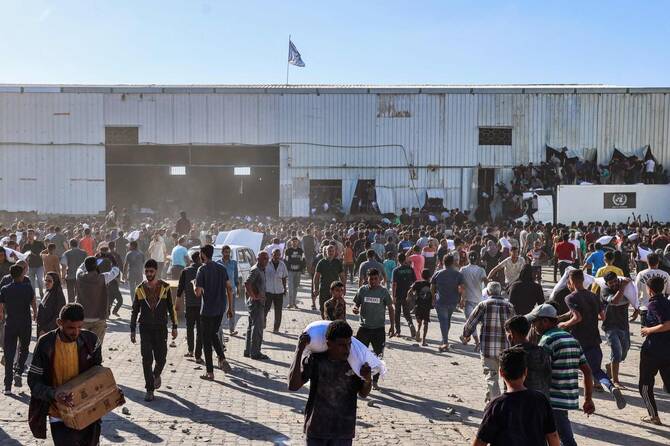

DEIR EL-BALAH, Palestinian Territories: Thousands of desperate Palestinians stormed a United Nations warehouse in central Gaza on Wednesday, with the World Food Programme reporting two possible deaths in the tumult as Israel and the UN traded blame over the deepening hunger crisis.
The humanitarian situation in Gaza, where aid has finally begun to trickle in after a two-month blockade, is dire following 18 months of devastating war. Food security experts say starvation is looming for one in five people.
AFP footage showed crowds of Palestinians breaking into a WFP warehouse in Deir Al-Balah and taking bags of emergency food supplies as gunshots rang out.
“Hordes of hungry people broke into WFP’s Al-Ghafari warehouse in Deir Al-Balah, Central Gaza, in search of food supplies that were pre-positioned for distribution,” WFP said in a statement on X.
“Initial reports indicate two people died and several were injured in the tragic incident,” WFP said, adding that it was still confirming details.
Israel accused the United Nations Wednesday of seeking to block Gaza aid distribution, as the global body said it was doing its utmost to facilitate distribution of the limited assistance greenlit by Israel’s authorities.
The issue of aid has come sharply into focus amid starvation fears and intense criticism of the Gaza Humanitarian Foundation (GHF), a private US-backed aid group that has bypassed the longstanding UN-led system in the territory.
Israel’s UN ambassador Danny Danon told the Security Council that aid was entering Gaza by truck – under limited authorization by Israel at the Kerem Shalom crossing – and via a “new distribution mechanism developed in coordination with the US and key international partners.”
Danon was referring to the GHF operation, which he accused the UN of “trying to block,” saying it was “using threats, intimidation and retaliation against NGOs that choose to participate in the new humanitarian mechanism.”
The UN said 47 people were injured Tuesday when thousands of Palestinians rushed a GHF site. A Palestinian medical source reported at least one death.
Stephane Dujarric, spokesman for UN Secretary-General Antonio Guterres, reiterated the world body’s opposition to coordinating with GHF.
“We will not participate in operations that do not meet our humanitarian principles,” Dujarric said.
He said the UN was doing all it could to send aid, adding that since last week 800 truckloads were approved by Israel but fewer than 500 made it into Gaza.
As the war entered its 600th day Wednesday, Israeli Prime Minister Benjamin Netanyahu said the offensive had “changed the face of the Middle East.”
He said it had killed tens of thousands of militants including Mohammed Sinwar, Hamas’s presumed Gaza leader and the brother of Yahya – slain mastermind of the October 2023 attacks that sparked the Gaza war.
Israeli media said Sinwar was targeted by strikes in southern Gaza earlier this month. His brother was killed in October 2024.
In Washington, US envoy Steve Witkoff expressed optimism about a possible ceasefire, saying he expected to propose a plan soon.
“I have some very good feelings about getting to a... temporary ceasefire, and a long-term resolution, a peaceful resolution of that conflict,” he said.
But Gazans remained pessimistic.
“Six hundred days have passed and nothing has changed. Death continues, and Israeli bombing does not stop,” said Bassam Daloul, 40.
“Even hoping for a ceasefire feels like a dream and a nightmare.”
Israel stepped up its military offensive earlier this month, while mediators push for a still elusive ceasefire.
In Tel Aviv, hundreds of people called for a ceasefire, lining roads at 6:29 am – the exact time the unprecedented October 7 attack began.
Relatives of hostages held since that attack also gathered in Tel Aviv.
“I want you to know that when Israel blows up deals, it does so on the heads of the hostages,” said Arbel Yehud, who was freed from Gaza captivity in January.
“Their conditions immediately worsen, food diminishes, pressure increases, and bombings and military actions do not save them, they endanger their lives.”
Out of 251 hostages seized during the October 7 attack, 57 remain in Gaza including 34 the Israeli military says are dead.
Some 1,218 people were killed in Hamas’s October 7, 2023, attack, mostly civilians, according to an AFP tally based on official figures.
The health ministry in Hamas-run Gaza said Wednesday at least 3,924 people had been killed in the territory since Israel ended the ceasefire on March 18, taking the war’s overall toll to 54,084, mostly civilians.